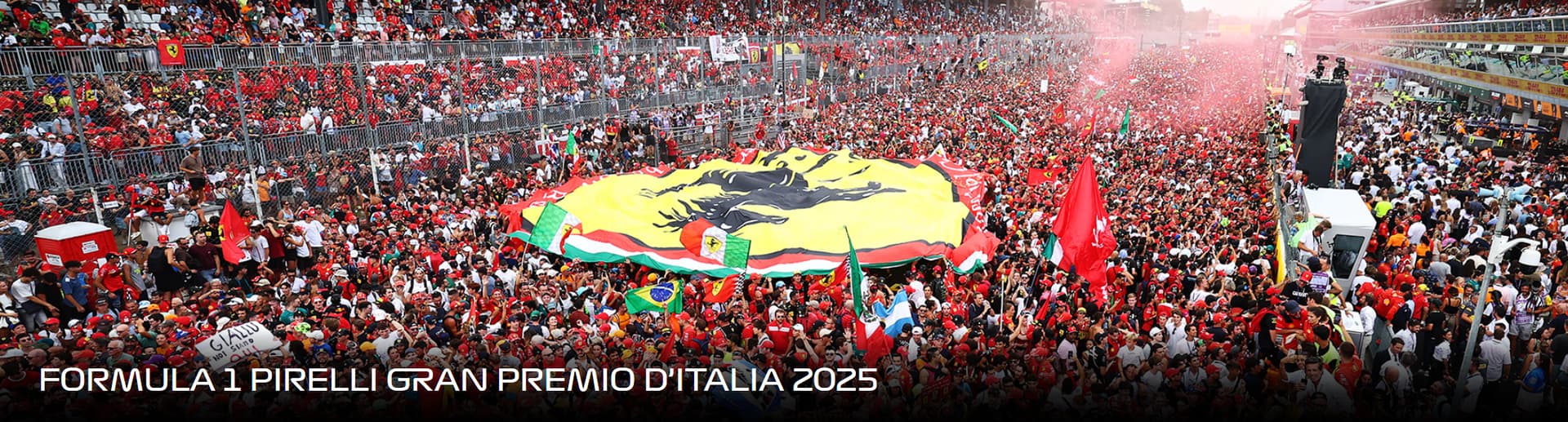
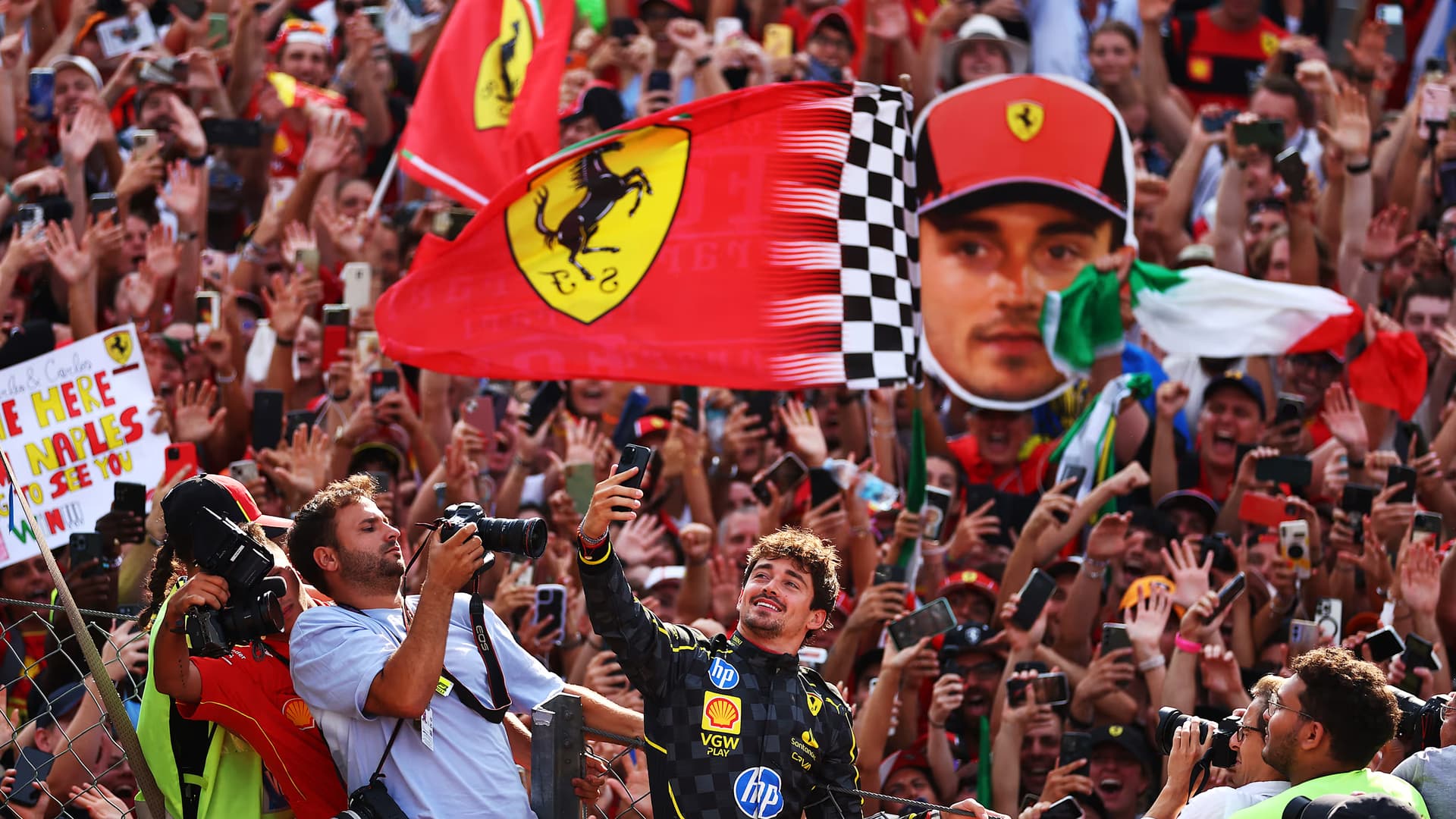
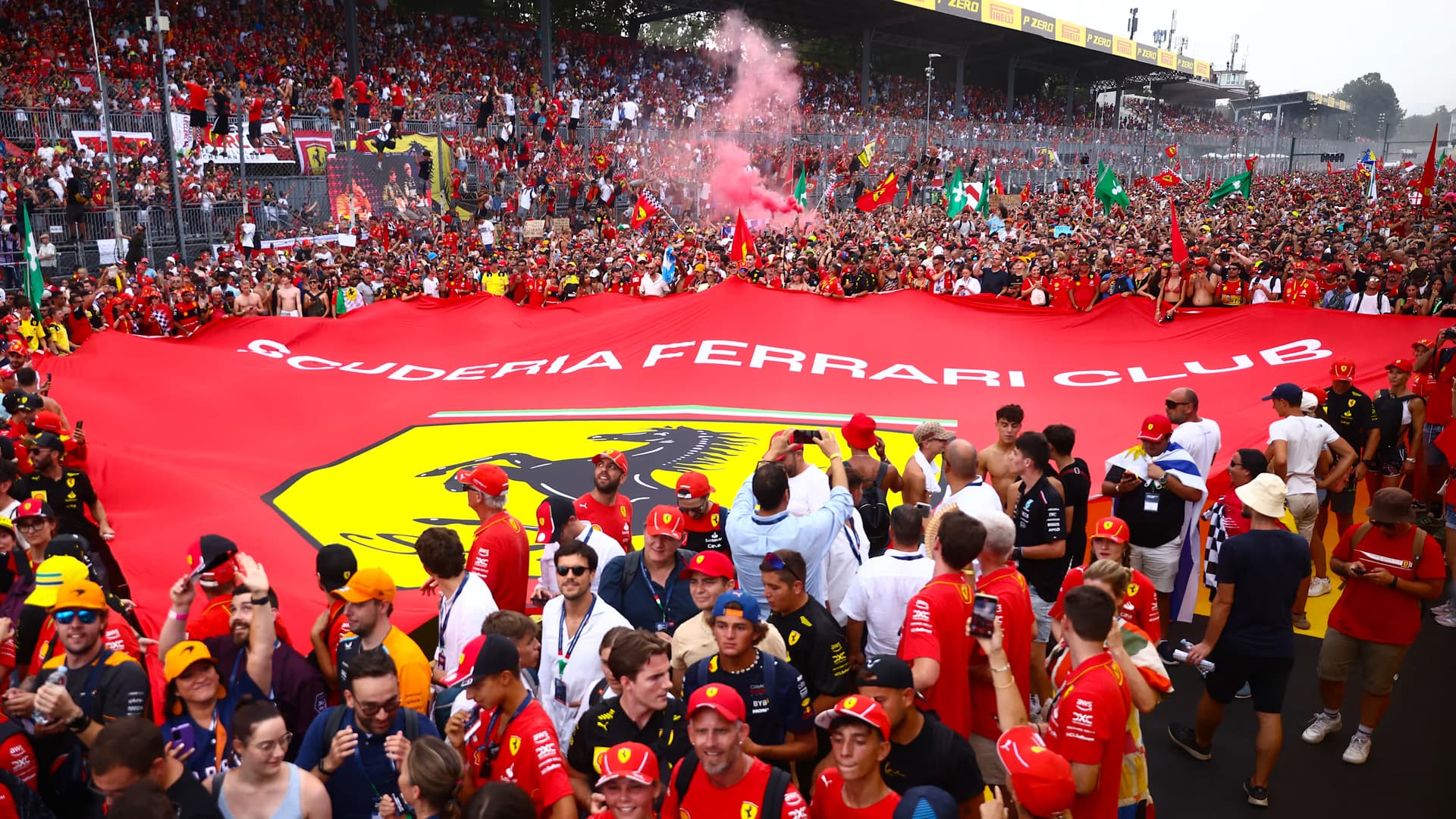
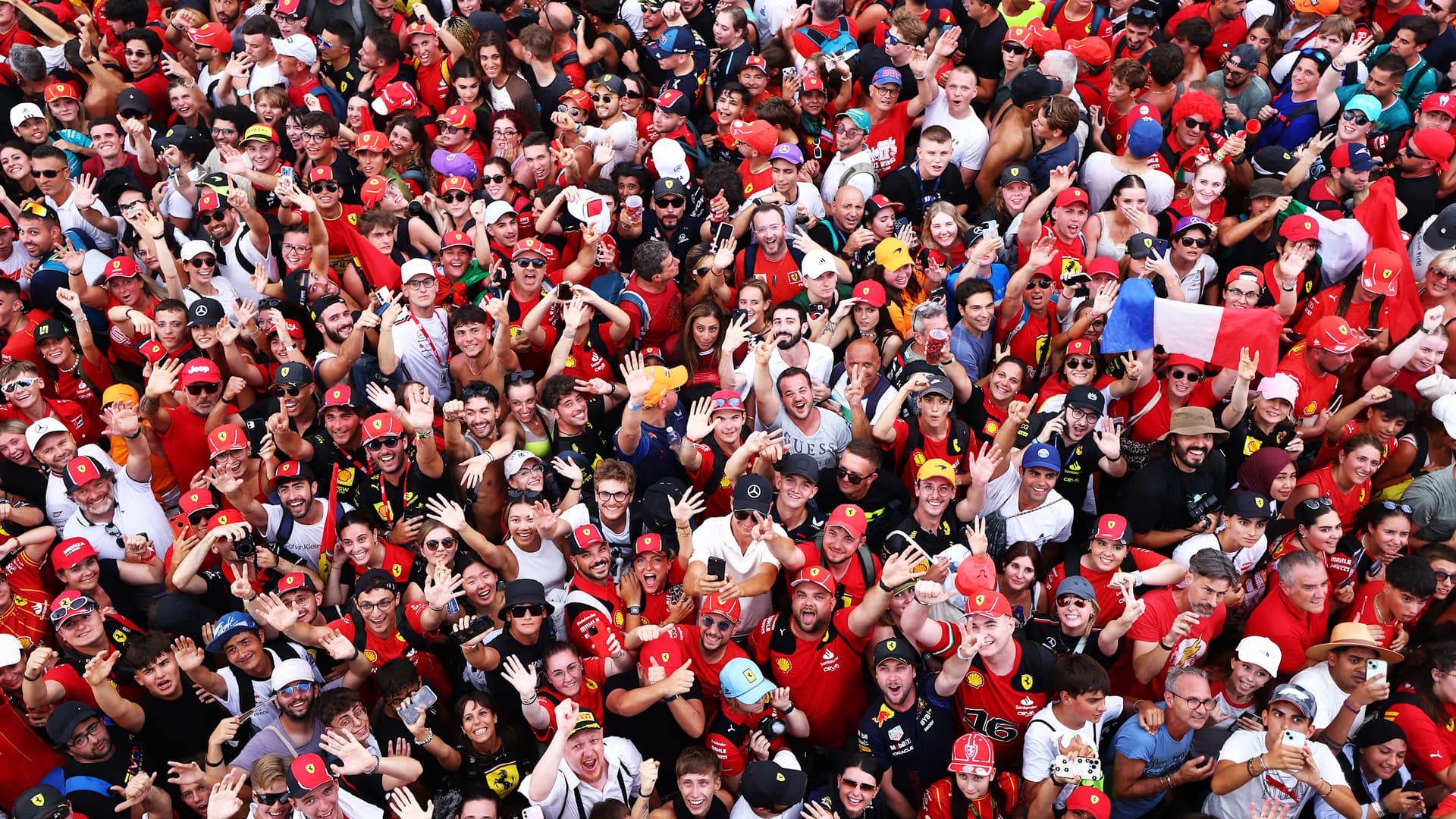
The Italian Grand Prix isn’t just another stop on the Formula 1 calendar – it’s a pilgrimage. Monza, the legendary Temple of Speed, is F1’s oldest circuit and one of the most iconic, where the Ferrari’s Tifosi turn the grandstands into a sea of red.
Race 2 of the European Summer Doubleheader and we’re in the heart of Ferrarilandia, the Temple of Speed that is Monza!
And after their double DNF last weekend at Zandvoort, the Ferrari duo will be hoping that the home advantage, the power of the Tifosi, and a retro livery will help push them to better results this time around. Whether they’ll be able to replicate Leclercs’ memorable win last year is probably a bit of a stretch though.
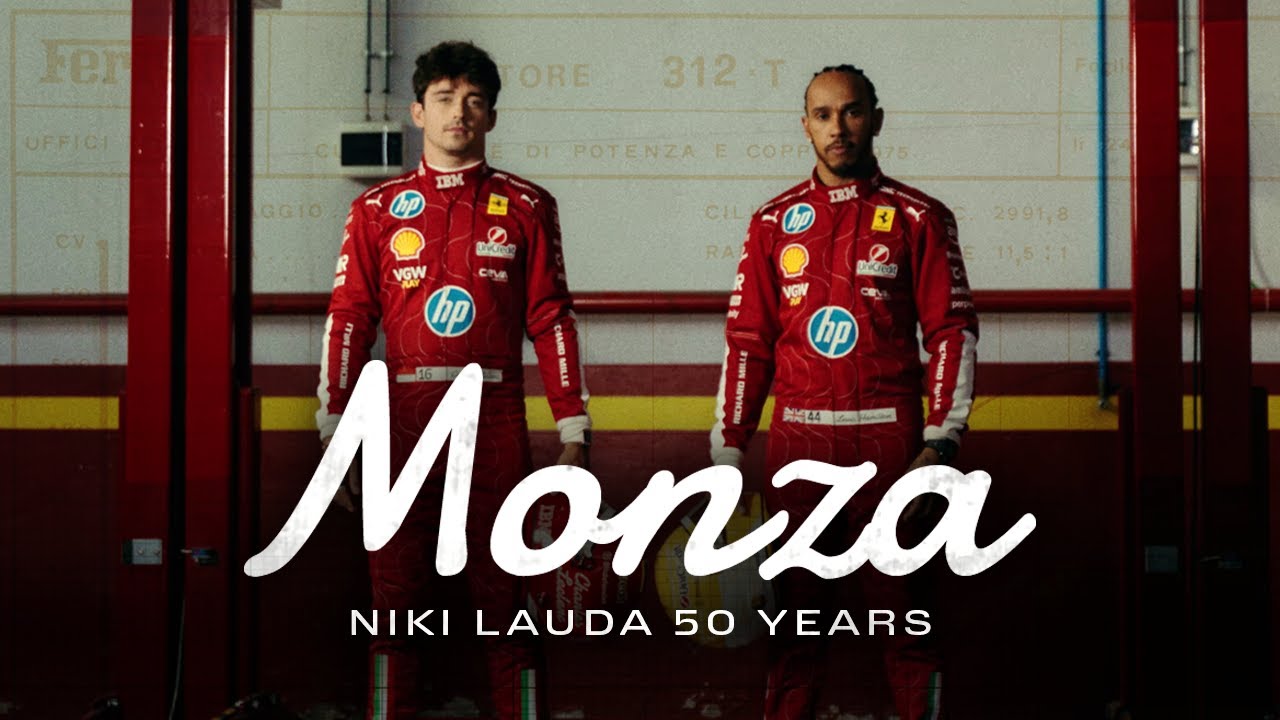
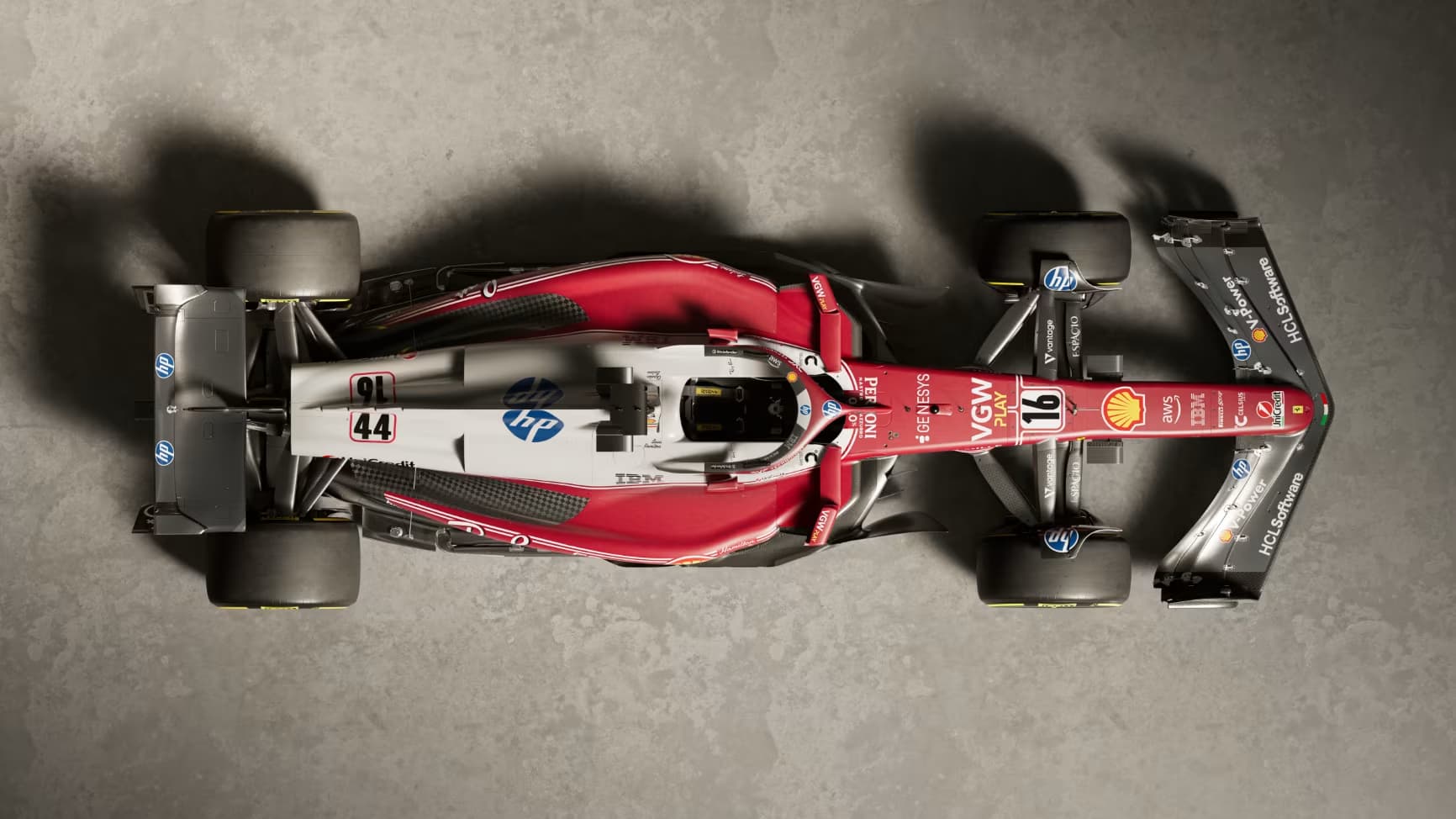
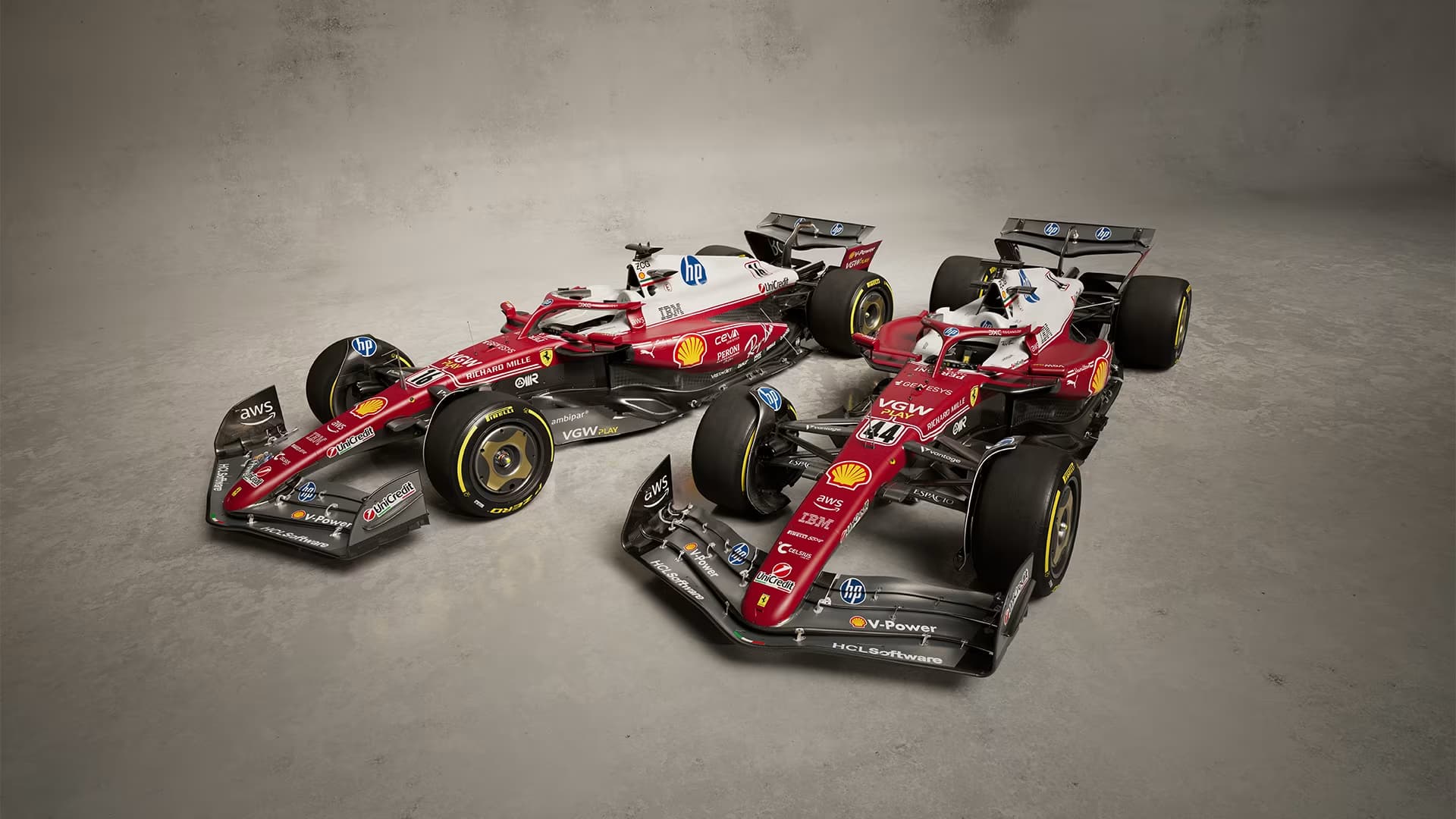
Ferrari have revealed the special livery that Charles Leclerc and Lewis Hamilton’s SF-25s will wear at this year’s Italian Grand Prix – the first race at Monza for seven-time World Champion Hamilton since joining the Scuderia.
Featuring a more prominent white on the engine covers, alongside retro numbers and wheel covers, the car pays homage to the colourway of the Ferrari 312T that Niki Lauda took to the 1975 Drivers’ Championship, and which earned the team the Constructors’ title in the same year.
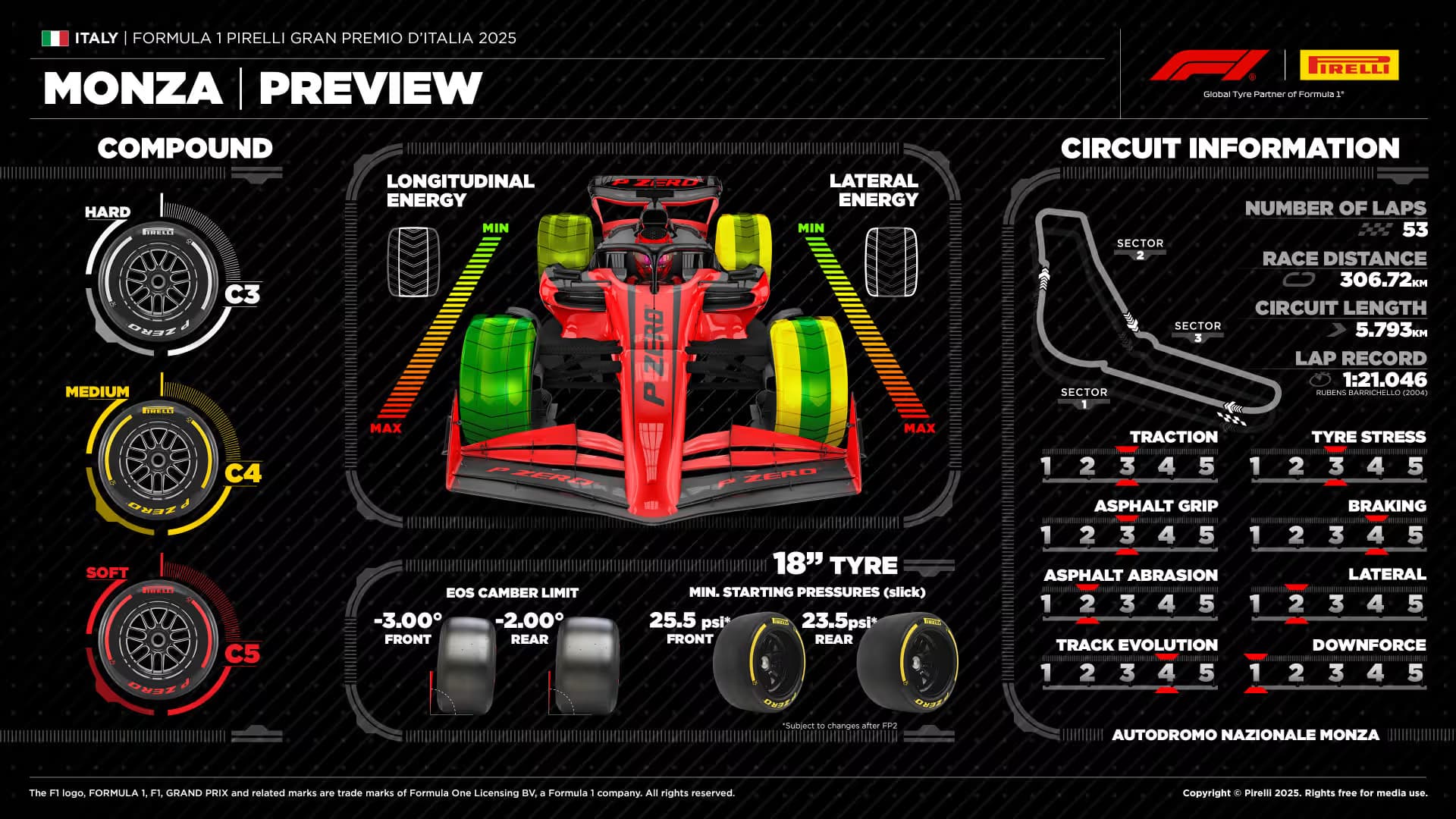
Lap record – 1m 21.046s, Rubens Barrichello, Ferrari, 2004
Most pole positions – Lewis Hamilton (7)
Most wins – Michael Schumacher and Lewis Hamilton (5)
Pole run to Turn 1 braking point – 472 metres
Overtakes completed in 2024 – 71
Pit stop time loss – 24.3 seconds
Safety Car probability – 50%*
Virtual Safety Car probability – 38%*
*From the last eight races at Monza
Trivia
The Italian Grand Prix has featured on the F1 calendar since the inaugural 1950 season, with Monza home to every race apart from 1980, when Imola played host.
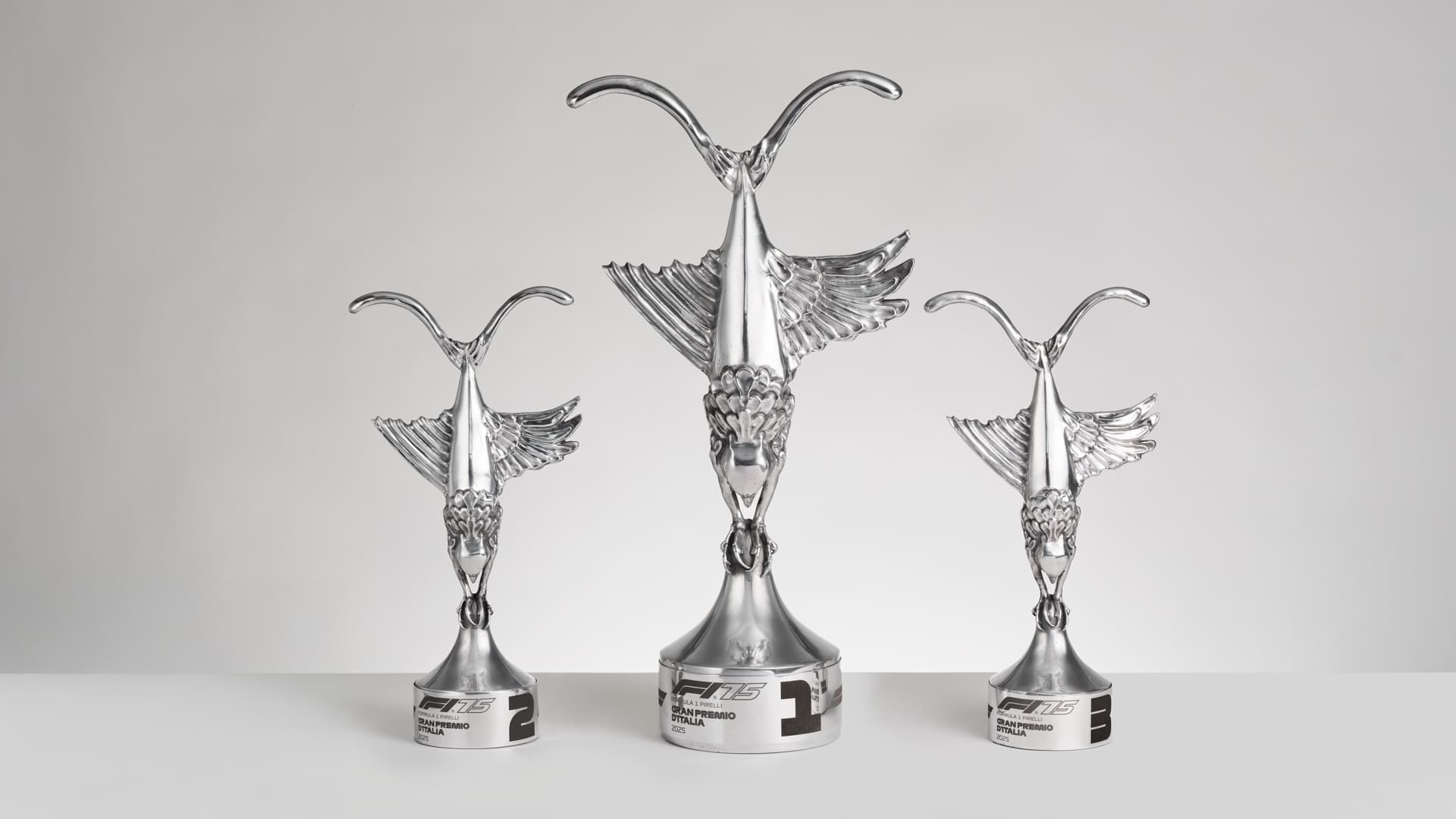
The drivers reaching the podium this year will receive unique trophies created by Italian artist Nico Vascellari. The sculpture, named “Chimera”, represents the movement of the three fastest creatures in the air, in water, and on land: the peregrine falcon, the sail fish and the cheetah respectively. Their individual aerodynamics, linked to the wings and talons in the case of the bird, the tail for the cat and the fin for the fish, come together to create a single fantastical creature, evoking evolution, metamorphosis and change.
When was the Autodromo Nazionale Monza built?
Constructed in just 110 days in 1922, the Autodromo Nazionale Monza was the world’s third purpose-built race track, coming after Brooklands in the UK and Indianapolis in the US. Like those two tracks, the original circuit featured a daunting series of banked curves, as well as much of the ‘outfield’ section that’s still in use today.
When was its first Grand Prix?
Monza opened its doors on September 3 1922, just a week before it hosted that year’s Italian Grand Prix. It was then part of the original Formula 1 calendar in 1950, and has held the Italian Grand Prix every year bar one since.
What’s the circuit like?
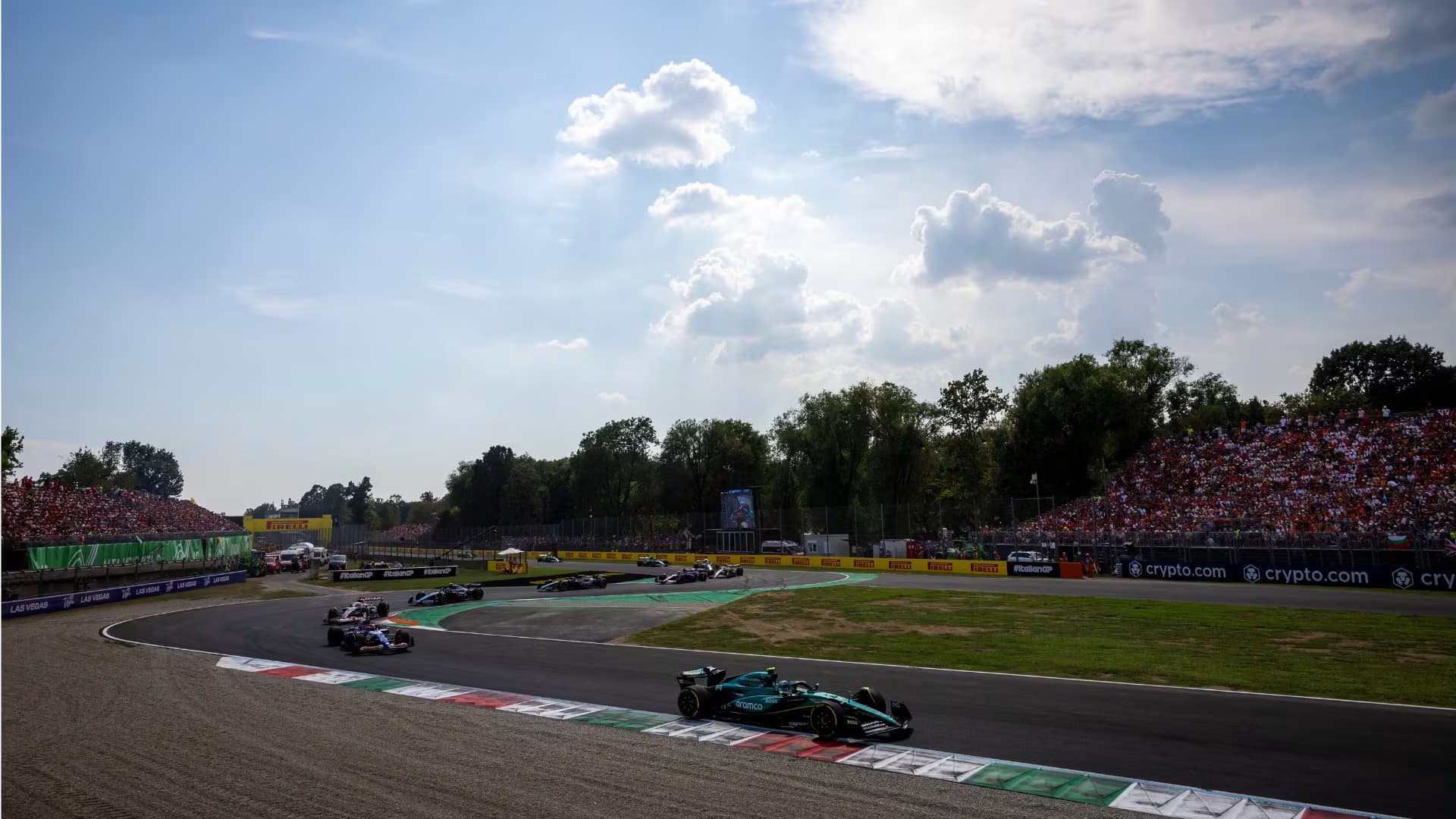
Rapido! McLaren driver Lando Norris’s 263km/h average speed during his 2024 pole lap should give you some idea of the nature of the track the locals call ‘La Pista Magica’. Cars are on full throttle for 80% of the lap, and hit their Vmax on the circuit’s 1.1km start/finish straight. From there, they roar off into the historic park section, where a series of big stops into tight chicanes give the brakes a good workout.
Monza is one of a kind on the calendar, yet in many ways is the simplest track. It’s low downforce and all begins with braking into the chicane for Sector 1 and getting your car to stop as nicely as you can for Turn 1 – that’s the key.
In the middle sector, the Lesmos are actually more fun to drive than they look, with a slight camber. You can carry a bit of speed in, pick your line for a little brake and again through Lesmo 2 as well.
Gravel can greet you if you carry too much speed into Turn 8/9/10 at Ascari – the first part of the corner is the crucial area – but it’s quite bumpy as well. Then stay pinned through 9 and 10, if you get 8 right, which takes you to Parabolica or Curva Alboreto (renamed after the late Michele Alboreto).
Sadly, they took away the gravel that was the charm of this final corner, but it’s still a cool challenge – attack it, run right around the outside to carry speed, get on the throttle as soon as possible and charge onto the main straight.
It used to be perilous with the gravel on the outside, whereas now a little bit of the exhilaration is maybe taken away with the tarmac run-off, but it’s still possible to crash and Monza is still a fantastic high-speed circuit.
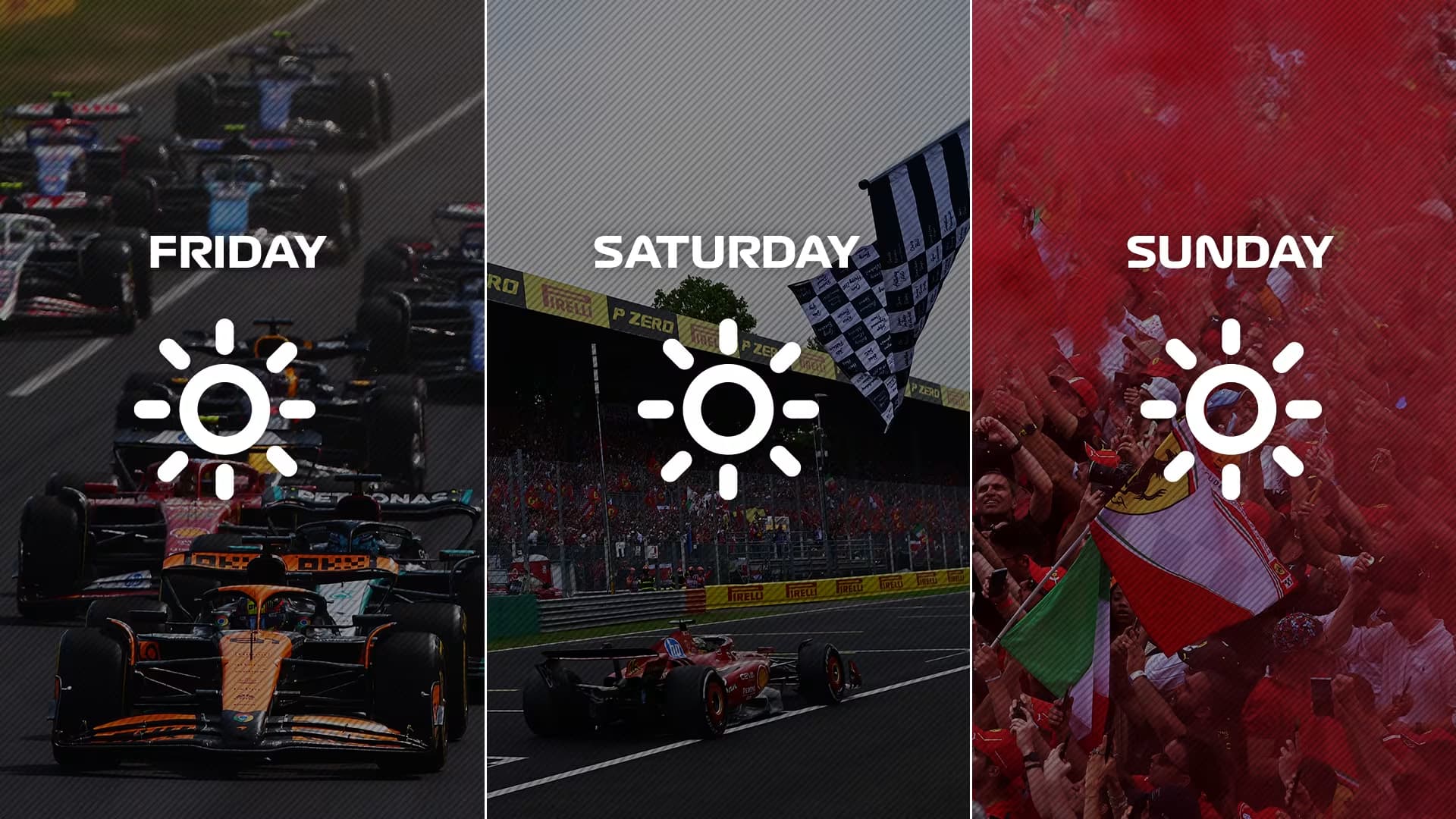
It looks like Italy will put on tempo perfetto for the weekend in Monza. Some early morning rain on Friday perhaps, but otherwise sunny, warm, and Italian summer perfect.
Improvement in the early morning with rain shifting eastward. Then, mostly sunny for the rest of the day. Dry conditions for the F1 sessions. Light south westerly wind.
FP1: 26°C // FP2: 26°C
Chance of rain: 60%
Saturday: FP3 and Qualifying
Mostly sunny with passing high clouds at times. Dry all day. Light southerly wind.
FP3: 26°C // Q: 26°C
Chance of rain: 0%
Sunday: Race
Mostly sunny and dry conditions expected all day. Light southerly wind.
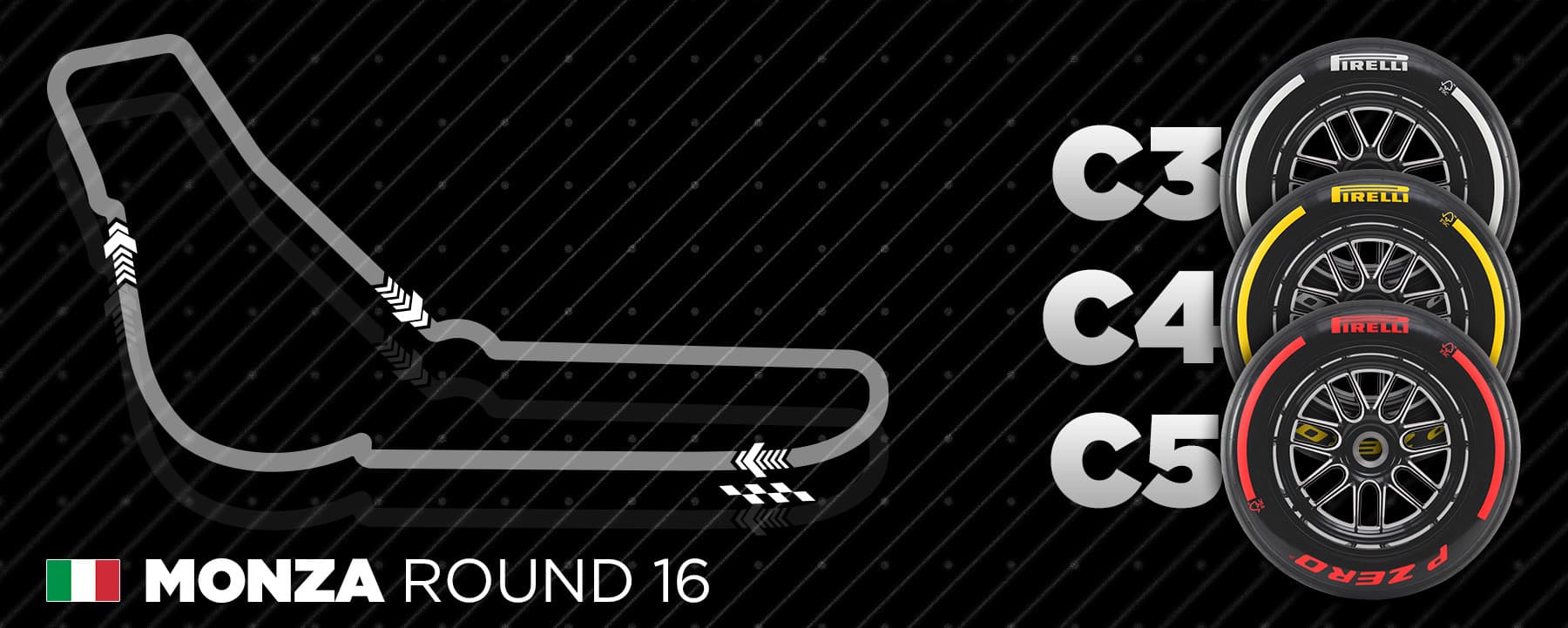
There is no change in compounds compared to last year, when the track had just been resurfaced for the Italian Grand Prix at the Autodromo Nazionale di Monza. The C3 is the Hard, the C4 Medium and the C5 Soft. Twelve months on, inevitably the surface will have aged, but it is unlikely to have any significant effect on the range of possible strategies at this circuit, where cars run in the lowest aerodynamic downforce configuration of the season.
It is likely that the most popular choices for the race itself will be the Hard and Medium. One can assume that the level of graining will be lower than last year as the track will now be bedded in. Time lost in the pit lane for a tyre change is among the longest of the season, so teams will try and run as long a stint as possible, keeping degradation under control, with the aim of only changing tyres once.
It is difficult to overtake at Monza, primarily because of the reduced effectiveness of the DRS, with the cars running minimum aero downforce levels. This too tends to swing the balance in favour of a one-stop strategy. On the other hand, temperature can have the opposite effect given that September in Lombardy can sometimes still feel like the height of summer. This can speed up tyre degradation, which would make a two-stop more competitive.
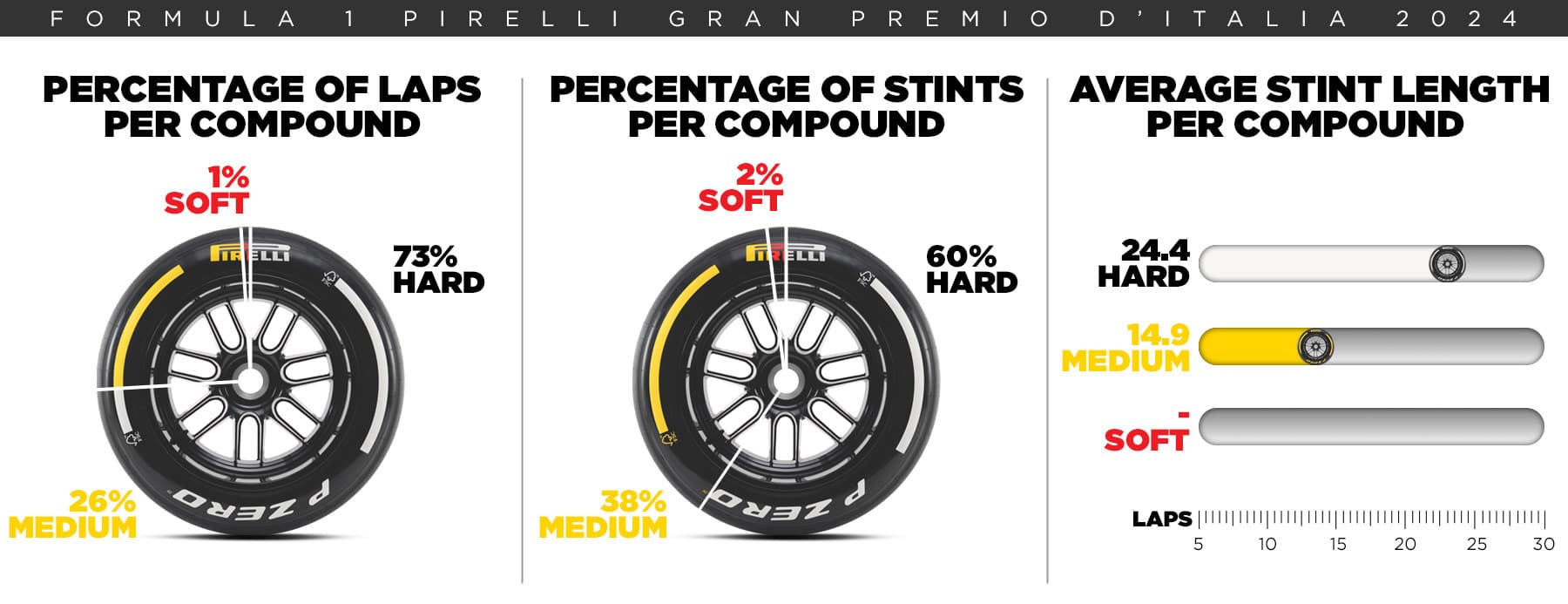
Last year 14 drivers opted to start on the Medium, the rest taking a more conservative approach with the Hard. Lance Stroll pitted three times and the remaining 18 finishers were split almost equally between one and two stoppers. The three drivers on the podium all started on the C4. The winner, Charles Leclerc, switched to the C3 on lap 15 and then went all the way to the chequered flag.
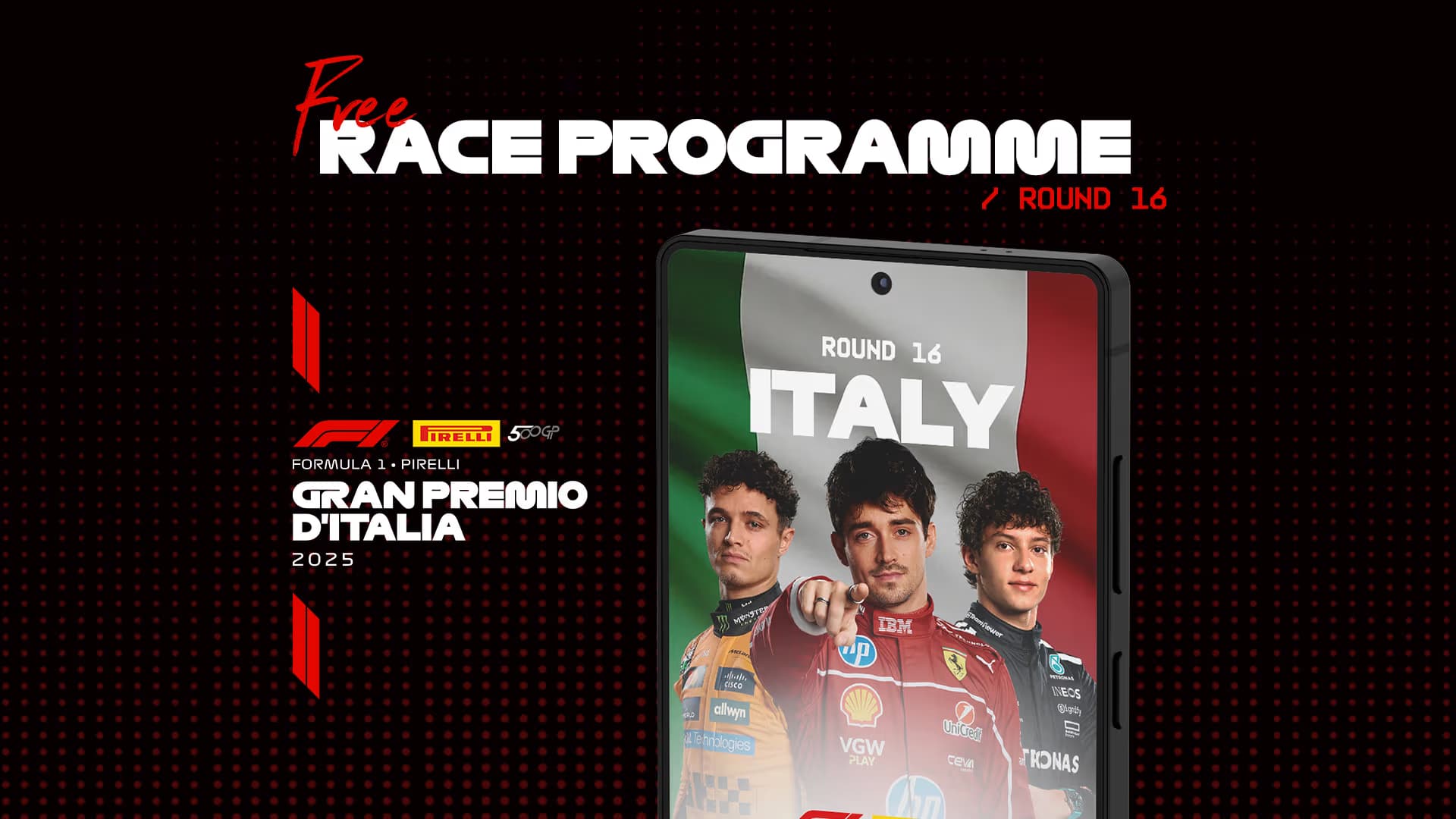
Get you some of that delicious digital programme for free!
Discover the big talking points in the paddock, the vital stats for the Monza circuit, what’s going on in the F1 Fanzone, plus what to see, do and eat when visiting this amazing region.
You can also get the lowdown on all 20 drivers and their teams, and in-depth features – including how Fred Vasseur is upbeat for Monza, Ferrari reveal a special livery for the weekend, a look at Formula 1 trophy mishaps and revisiting the best F1 cars from every decade.
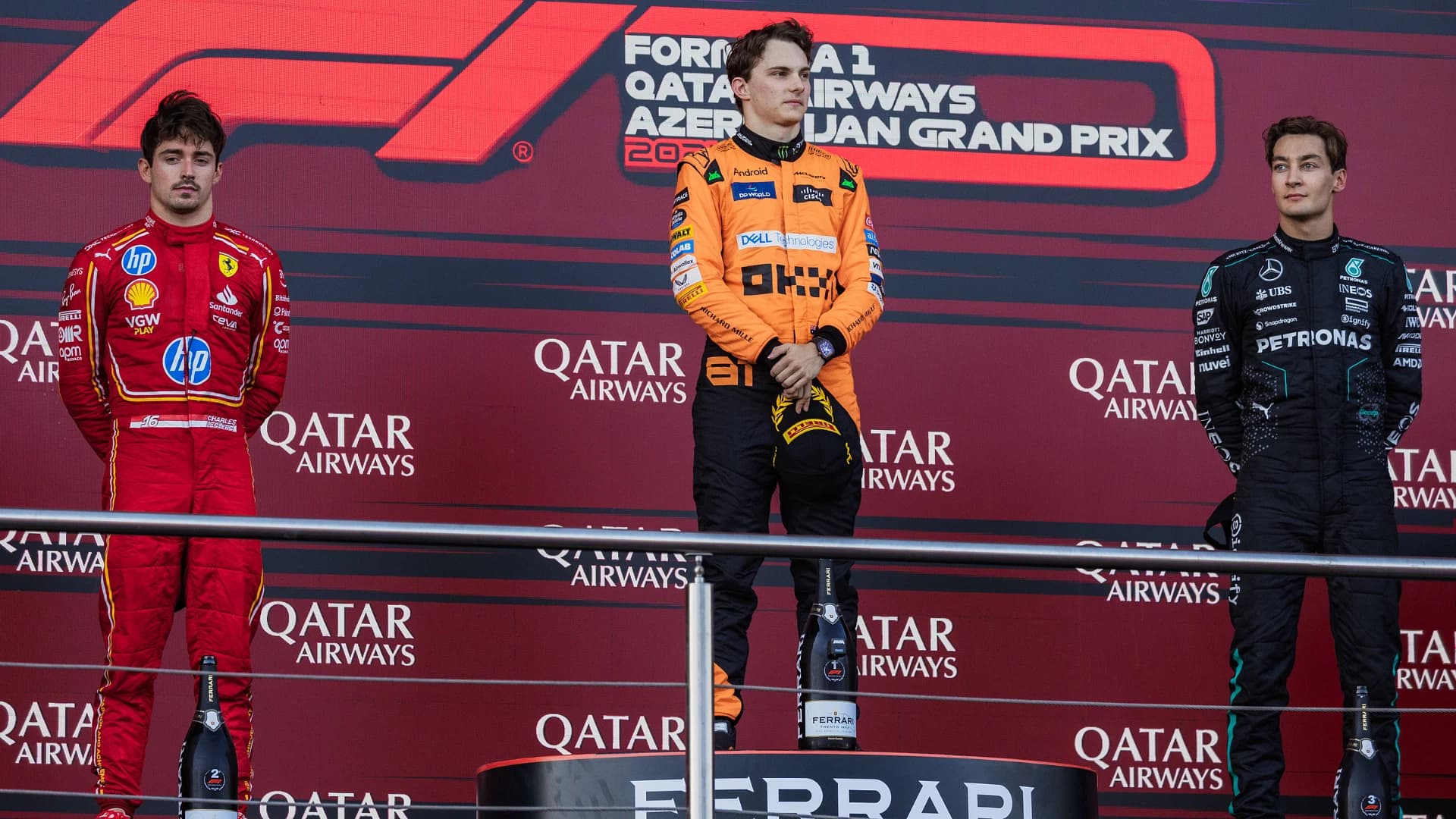
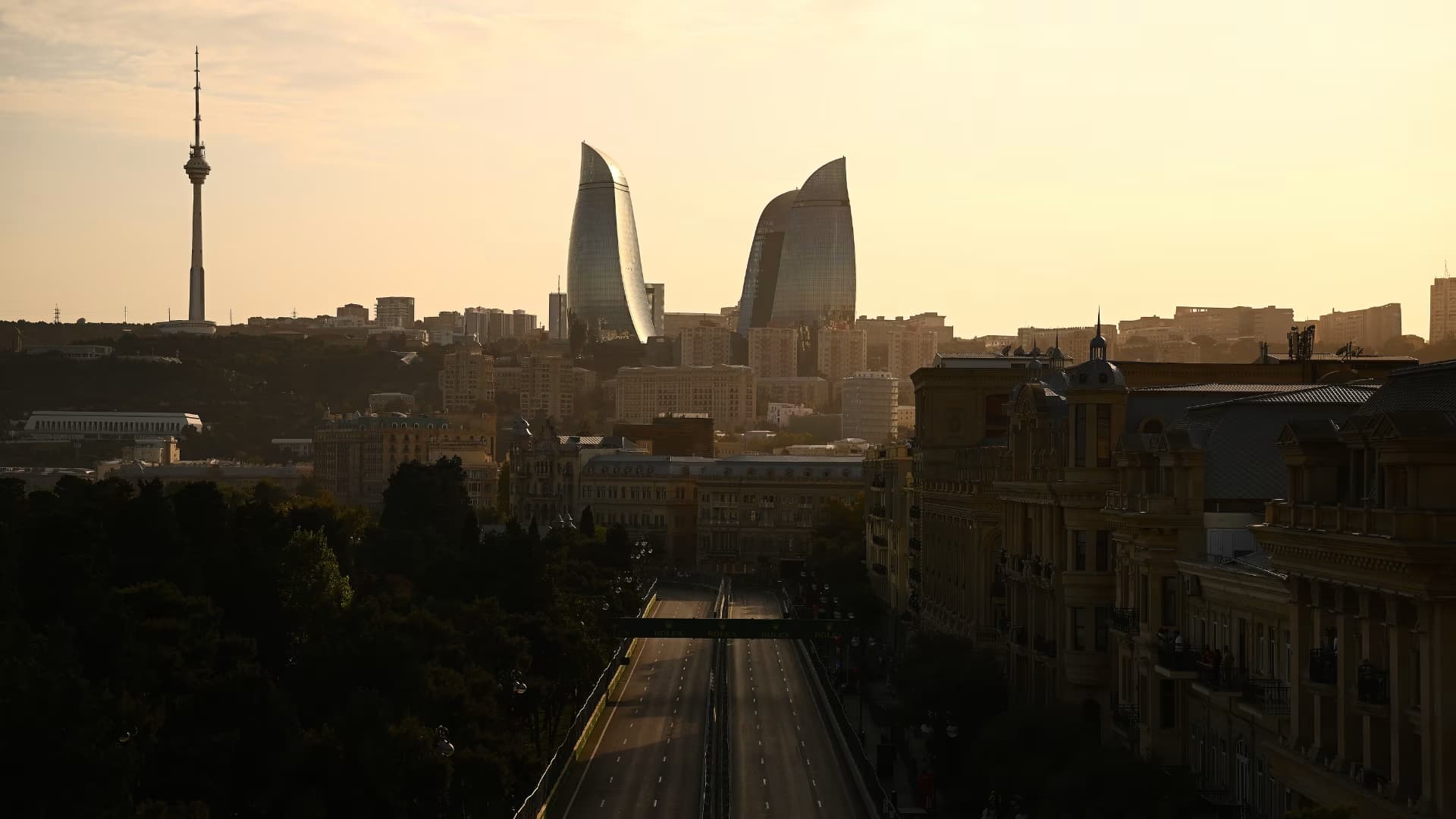
The European part of the Formula 1 season has come to an end and the sport bids farewell to the Old Continent as it prepares for the final third of the championship, starting in Baku, the City of Winds. The Azerbaijan capital is the biggest urban area on the Caspian Sea, as well as of the entire Caucasus region. It has hosted a Grand Prix every year since 2016 with the exception of 2020. Curiously, that first year it was known as the European Grand Prix, even though Azerbaijan is geographically in Asia.
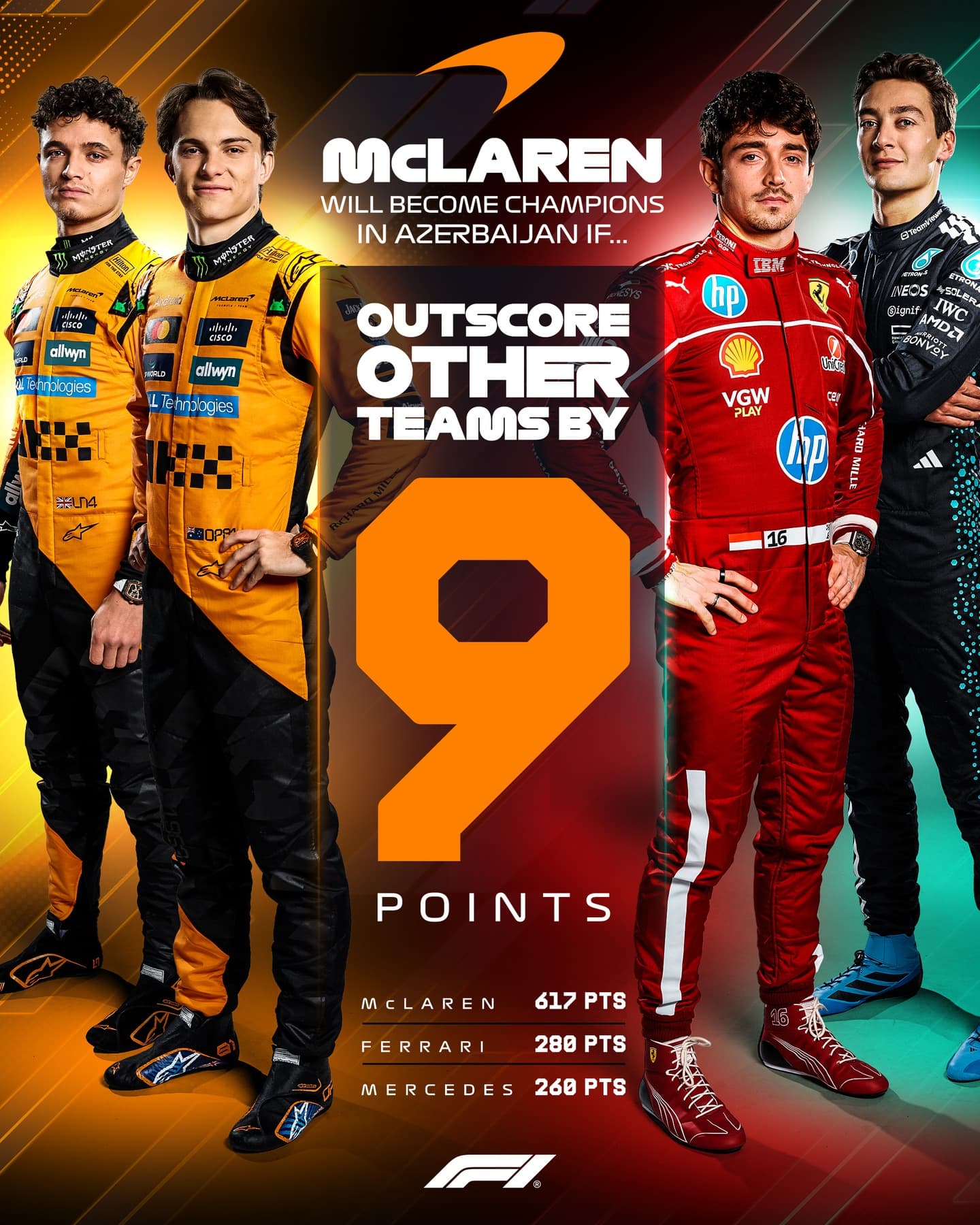
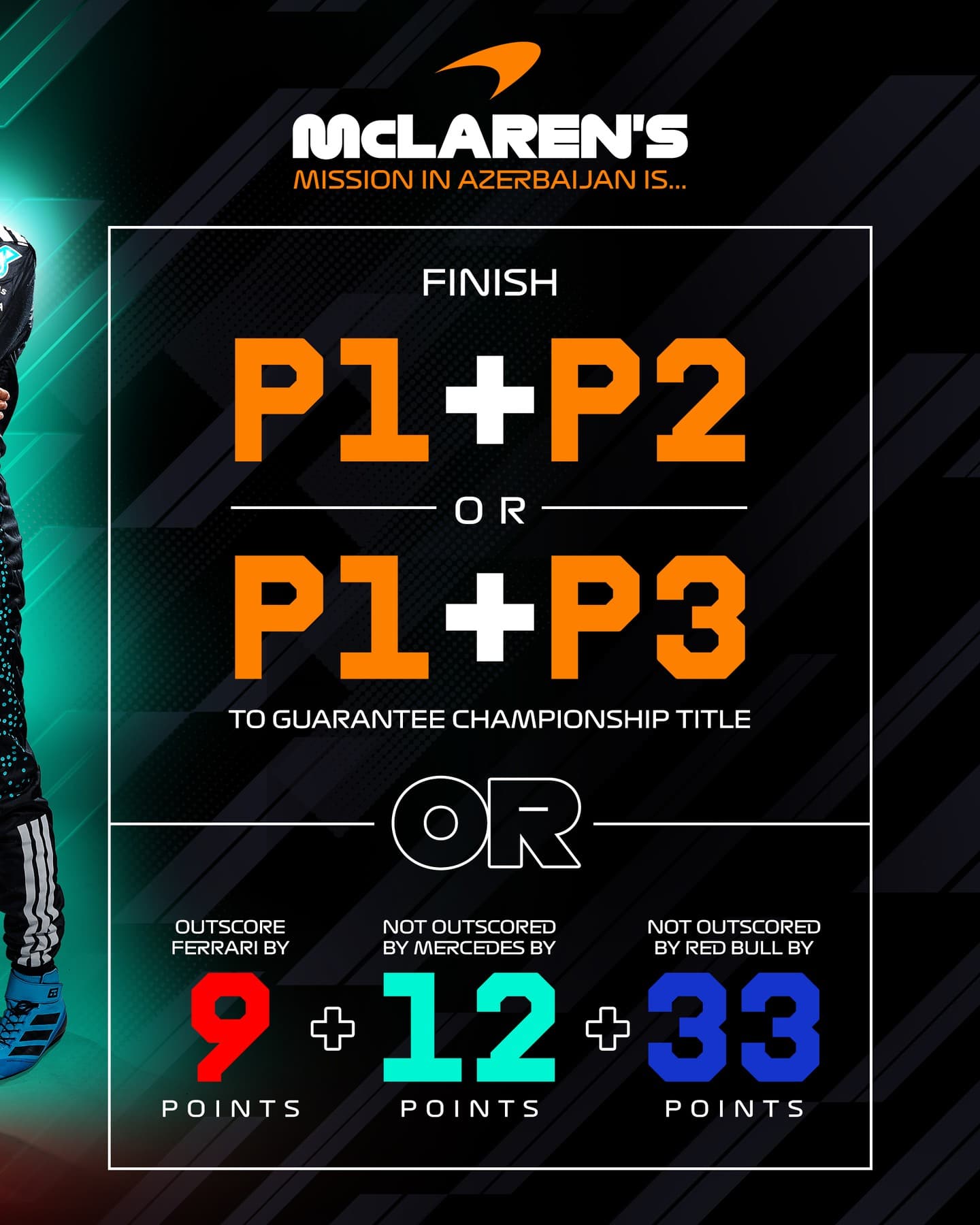
It’s back to Baku we go, and with the possibility of seeing McLaren claim a record earliest in the season Constructor’s Championship. That they could achieve the championship with seven races still to go is testament to the team’s complete dominance at the top of F1 for this season.
When was the Baku City Circuit built?
It wasn’t – Baku is among the newer street circuits on the Formula 1 calendar, joining the likes of Monaco, Melbourne, Singapore, Saudi Arabia and Las Vegas.
When was its first Grand Prix?
The first Grand Prix in Baku was held in 2016, as the European Grand Prix. That was followed by the inaugural Azerbaijan Grand Prix in 2017, which witnessed one of the biggest upsets of the season, with Daniel Ricciardo winning out from Valtteri Bottas and the Williams of Lance Stroll, while Lewis Hamilton and Sebastian Vettel engaged in some argy-bargy behind the Safety Car.
What’s the circuit like?
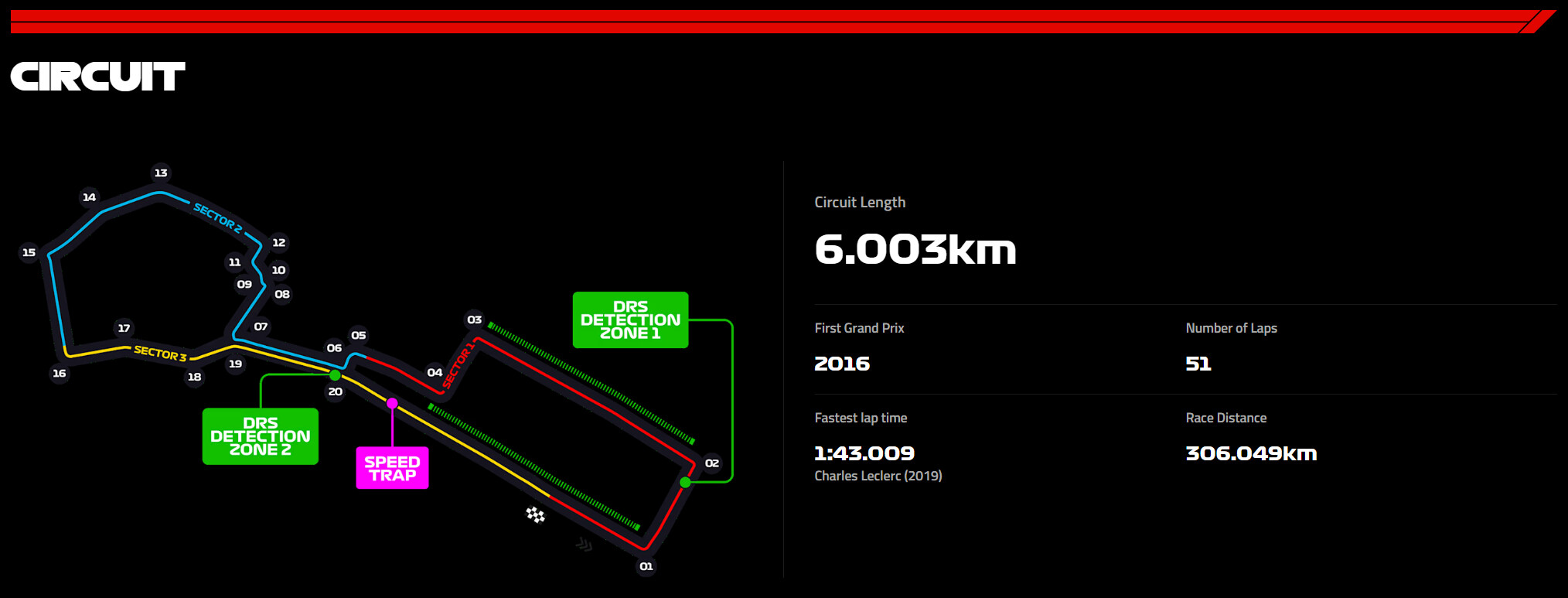
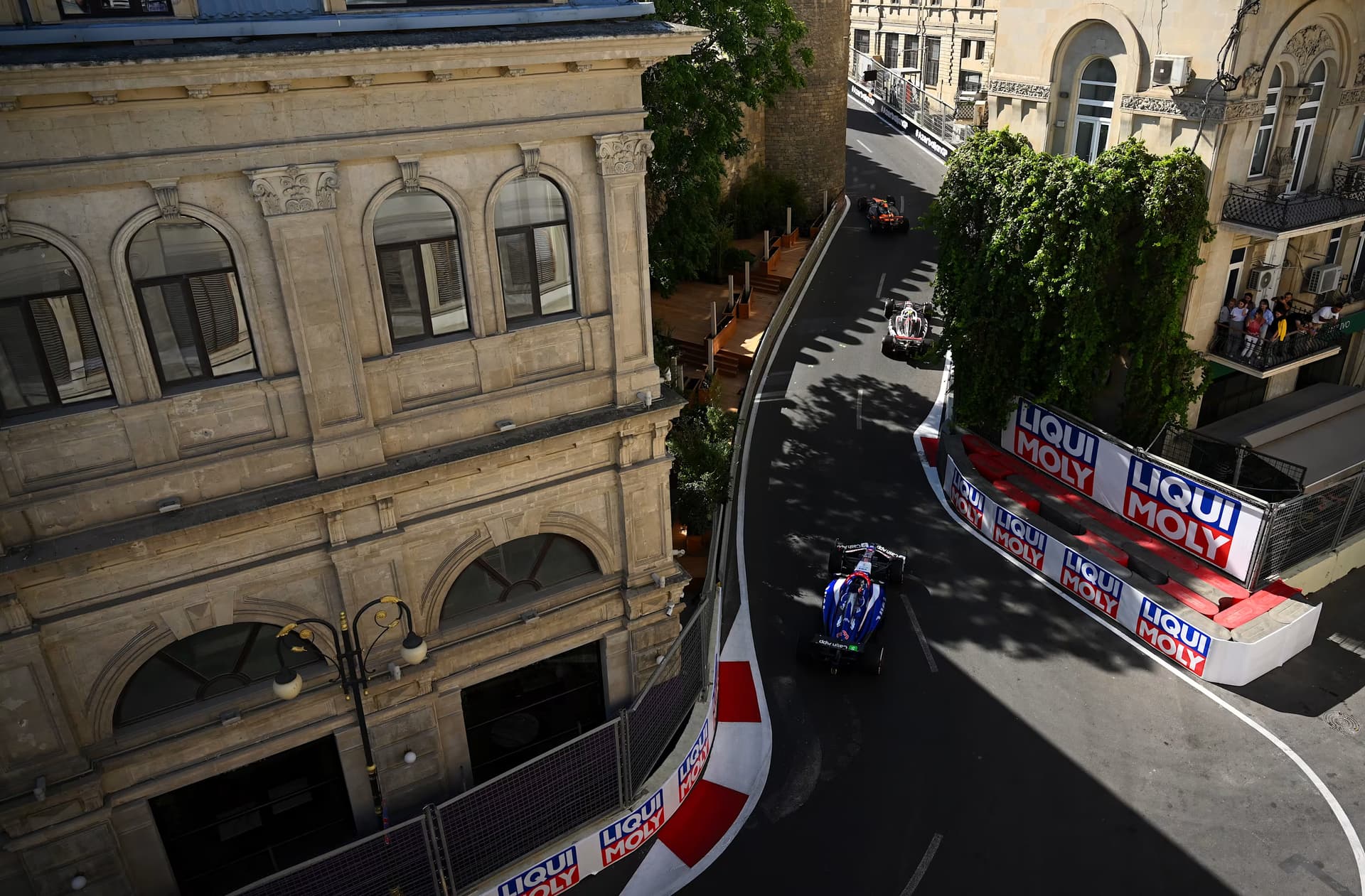
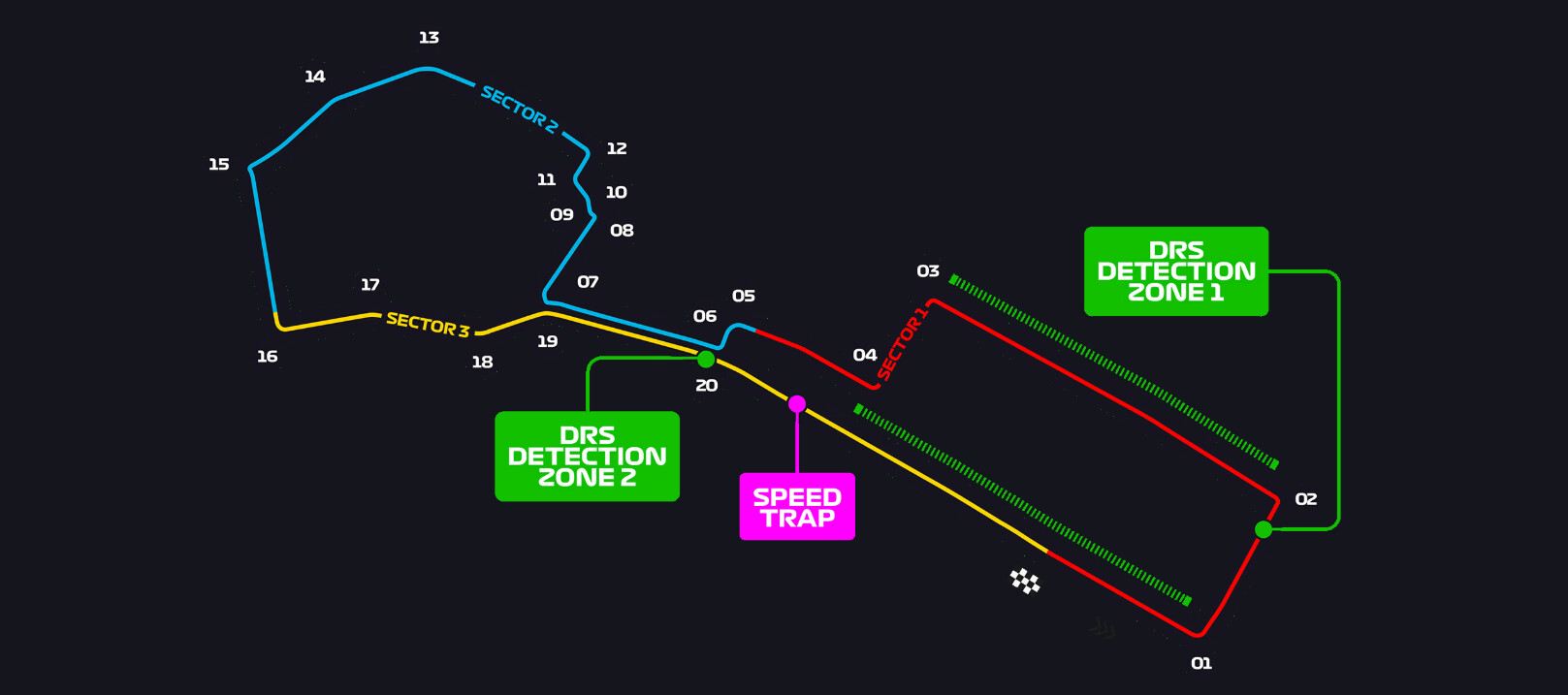
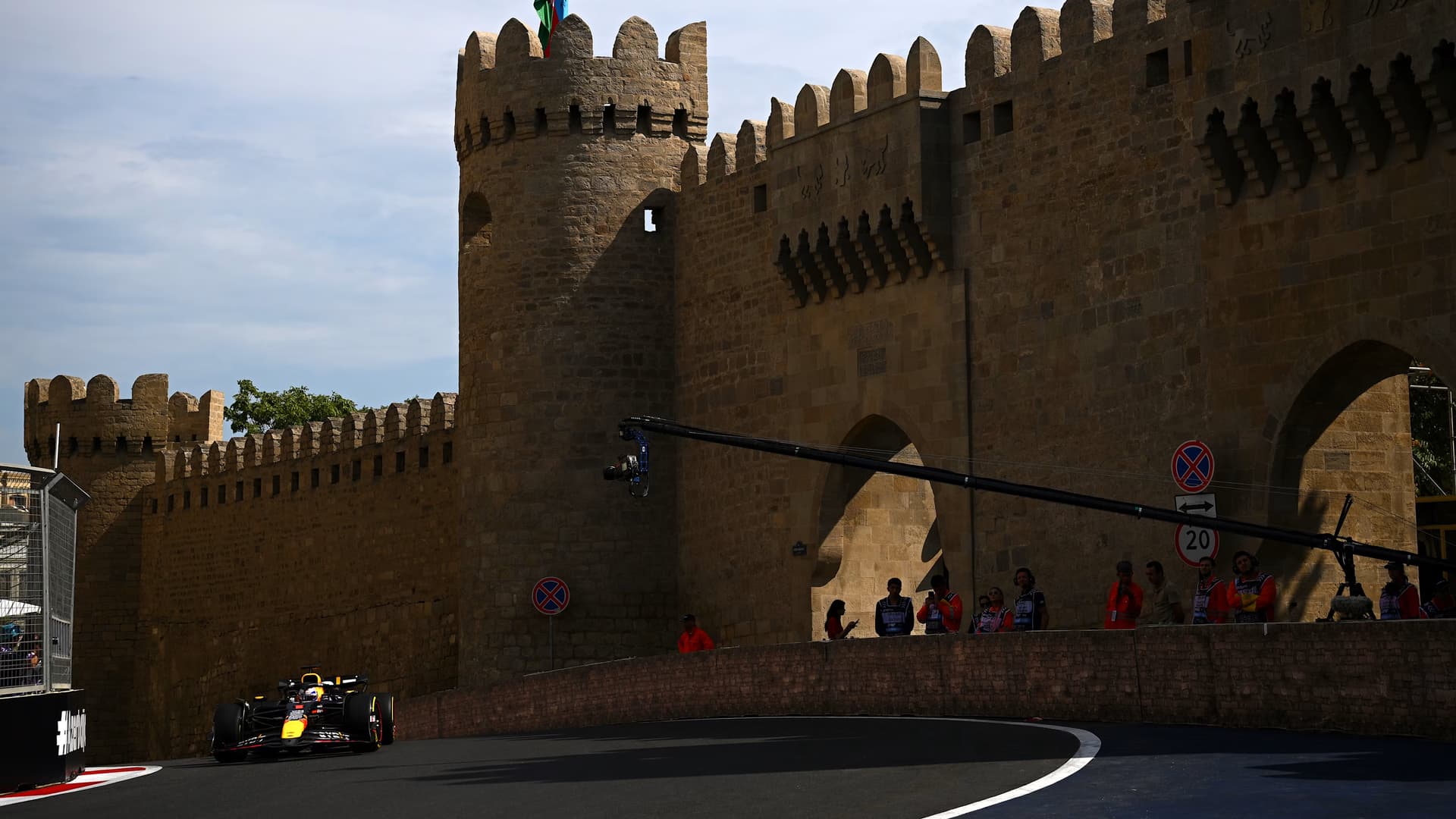
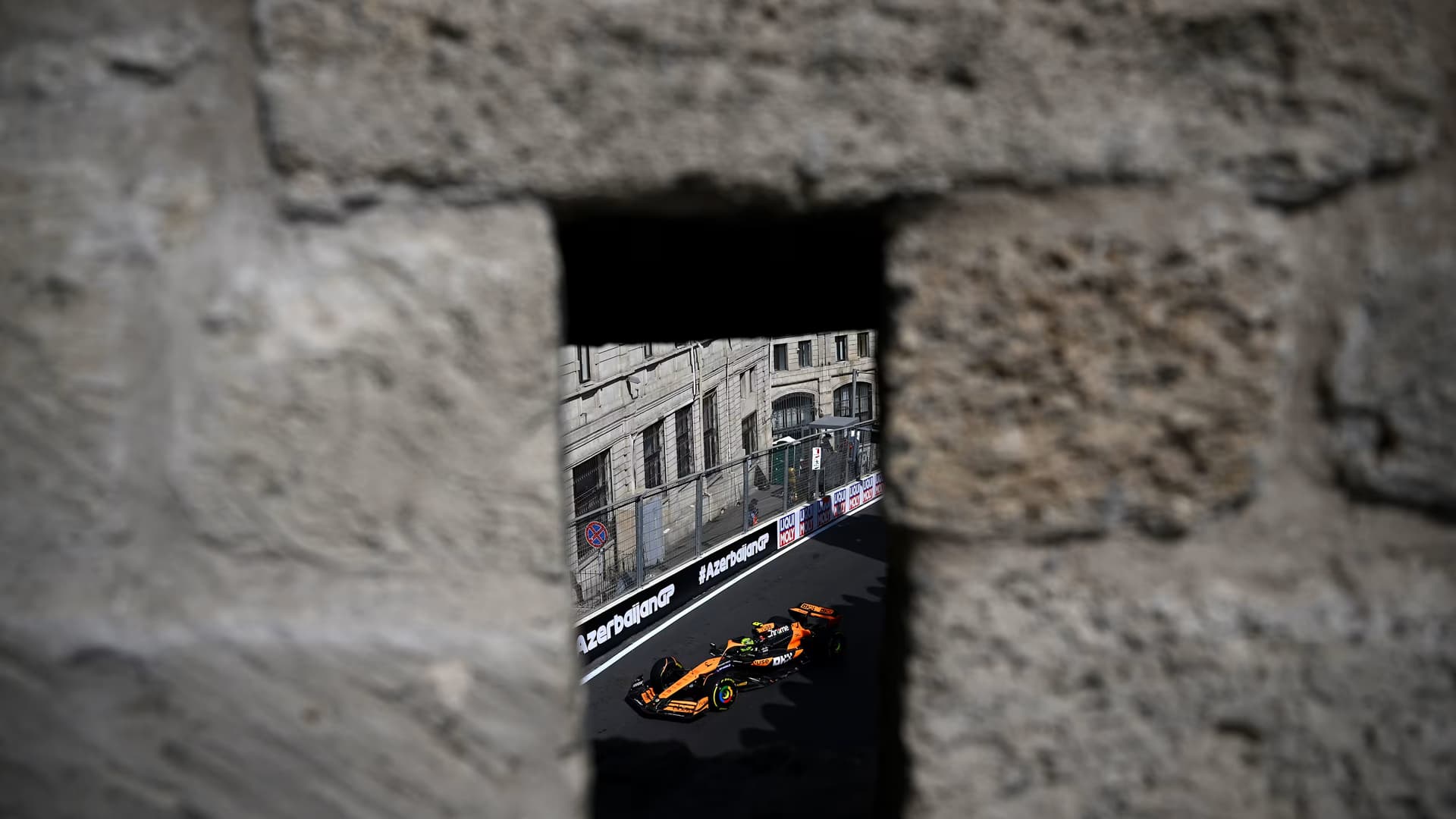
A mixture of wide and open and tight and twisty. The lonnnnng main straight along the Baku shoreline is a slipstreaming mecca, and with cars able to run three abreast into Turn 1, the action often looks more IndyCar than F1. However from there, the track loops around into the city’s narrow, winding Icheri Sheher old town, dramatically wending past Baku’s medieval city walls. As in Monaco, slightest mistakes are punished quickly and severely, while set-up wise, the teams are forced to choose between downforce for the twisty bits and less drag for the straight.
A long lap – there’s so much to put together in Baku, with lengthy straights and big braking zones in the first sector, before a winding second sector and a tough third sector.
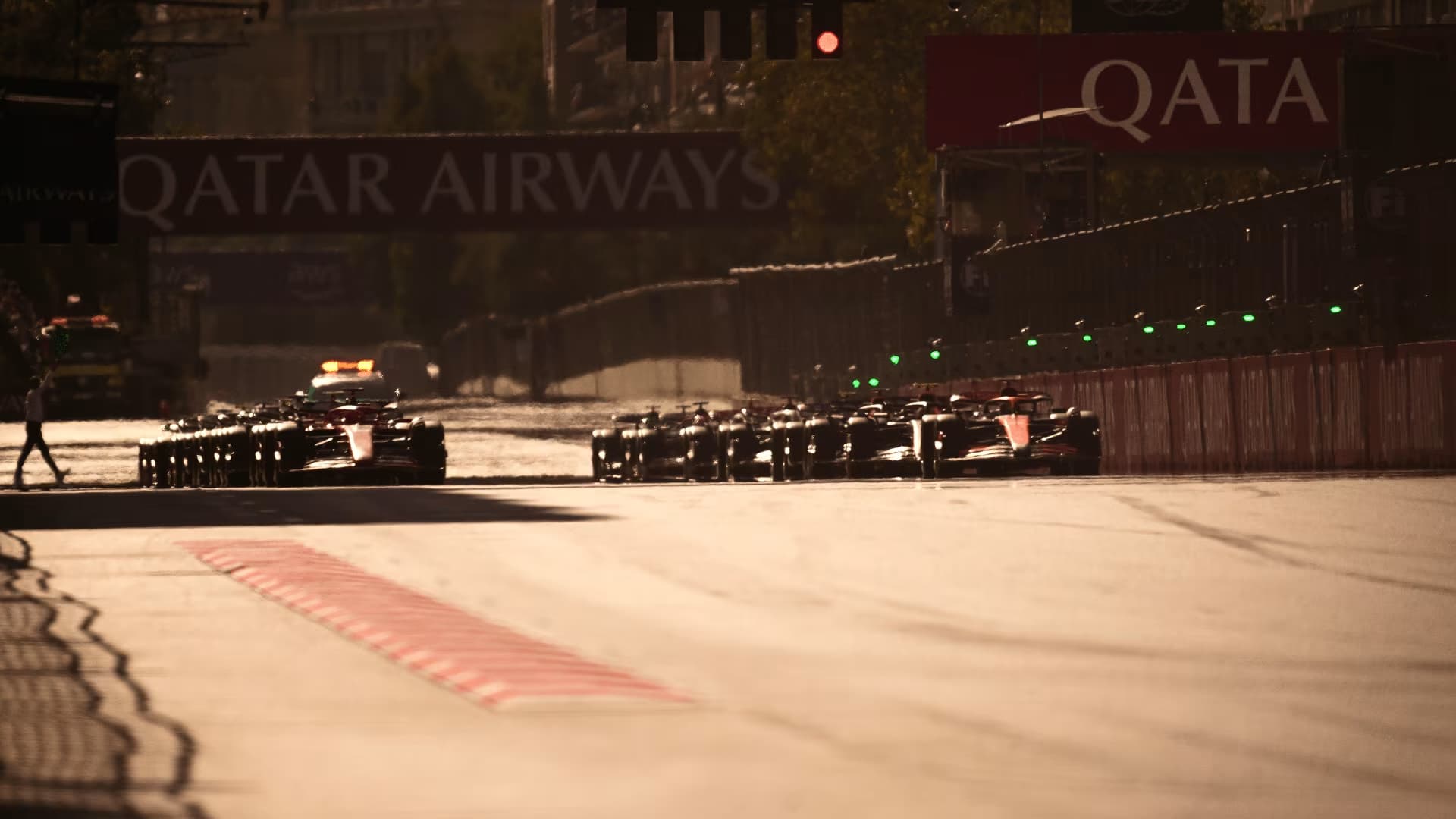
Braking for Turn 1 is tricky; the corner comes quickly after the start-finish line, but it somehow seems to take such a long time to get there from the final turn. With some slipstream, whether you luck into it or orchestrate it, you can gain a huge amount of time.
That’s something to watch for in Qualifying, but out-laps are also important; the track surface isn’t so abrasive, so with a slow out-lap you could fail to warm up the tyres and lock up into Turn 1.
The notorious castle section in the middle of the track is narrow and a place where accidents can easily happen, but the trickiest corner is probably Turn 15, where you’re accelerating towards the end of the lap.
Turn 15 is an unsighted left-hander in which you’re braking slightly to the right, then you’ve got to slow it down and not get into the run-off area, and avoid the looming walls in the process.
It’s all about the braking and, like at any street circuit, there’s plenty of time to be gained if you can carry sufficient speed out of the apex – just don’t get greedy with the apex and clout the wall.
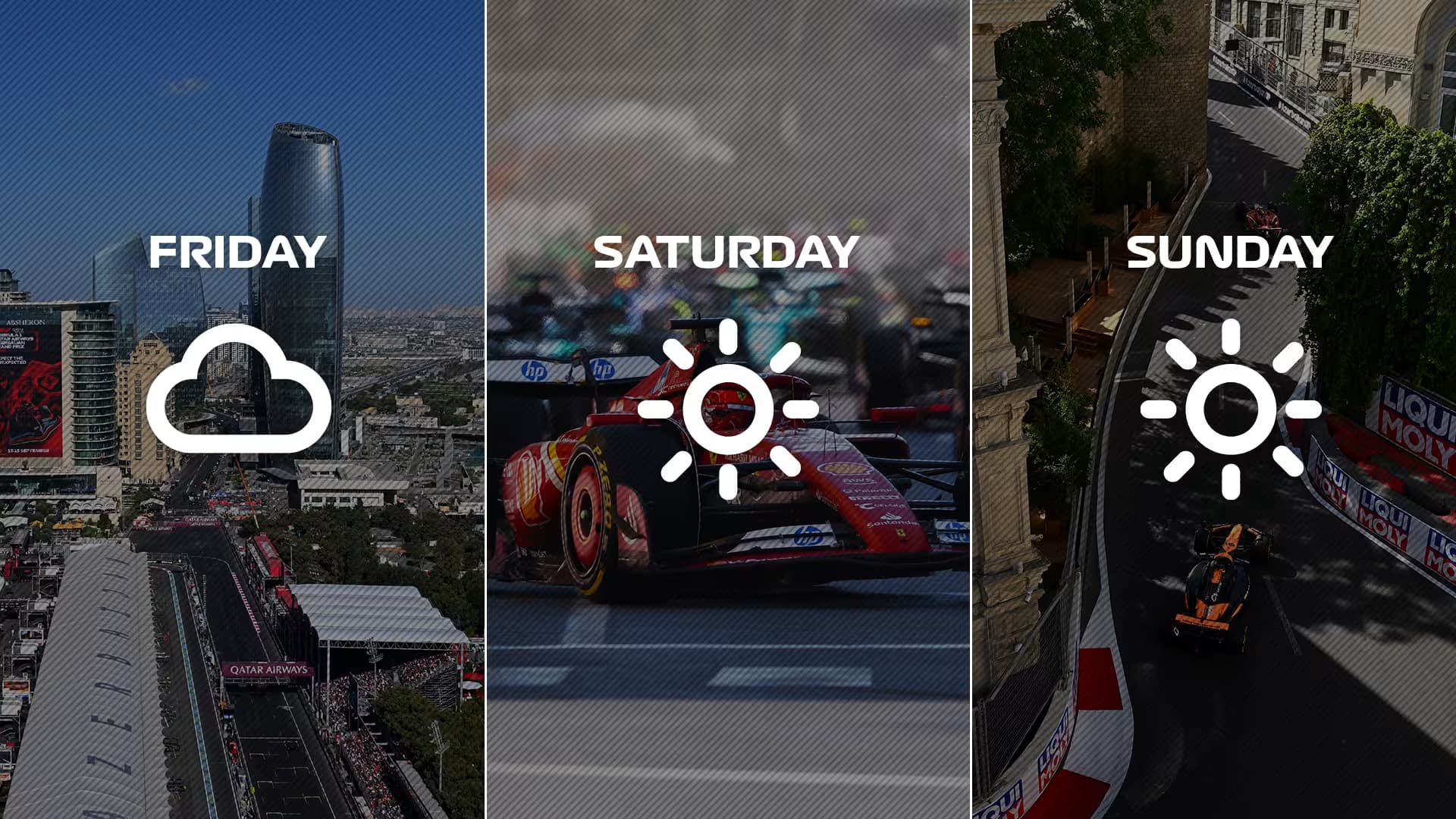
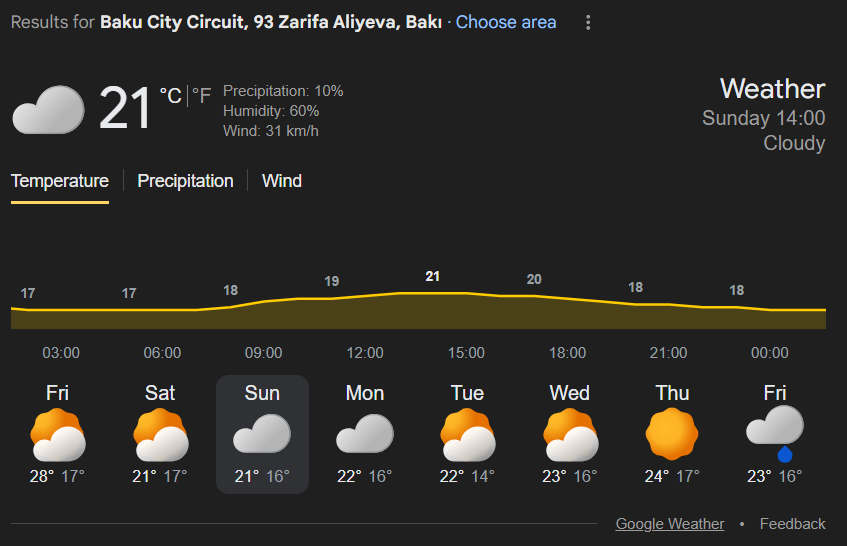
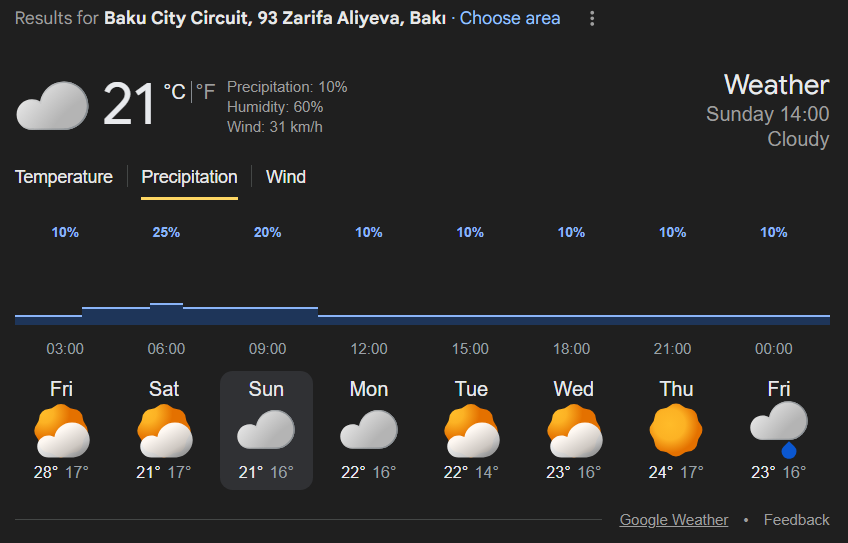
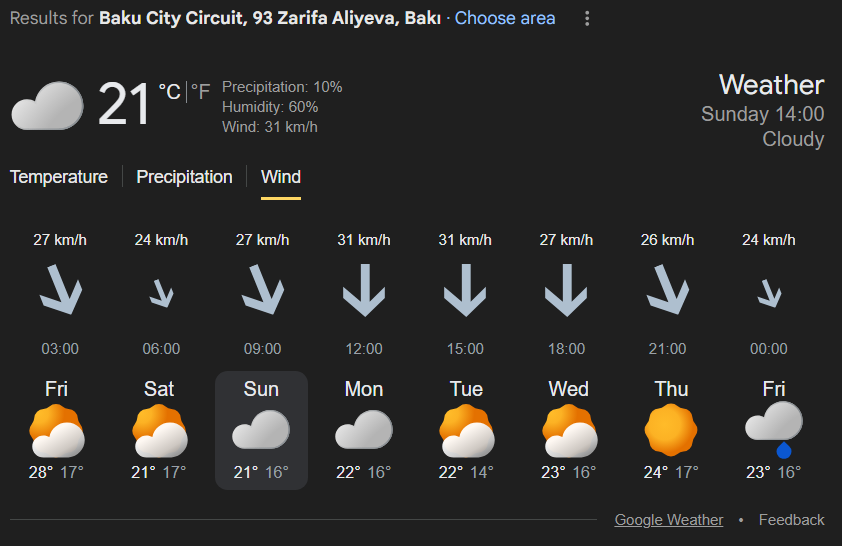
Partly cloudy with large sunny spells at first becoming cloudier in the late afternoon. Slight chance of one shower in the afternoon becoming moderate from the late afternoon and the following night. Light southeasterly wind veering northerly and becoming moderate in the evening.
FP1: 24°C // FP2: 23°C
Chance of rain: 40%
Saturday - FP3 and Qualifying
Mostly cloudy in the morning with a slight to moderate chance of showers from midnight until noon. Likely dry afternoon under a partly to mostly cloudy sky. Moderate to strong northwesterly wind with gusts up to 60 kph in the morning, decreasing a bit after that.
Mostly cloudy to overcast all day long. Improvement expected for the race. Slight chance of one light shower in the morning. At this range, likely dry race but chance of one shower is not excluded. Moderate northwesterly wind with gusts up to 50 kph in the morning and up to 40 kph during the race.
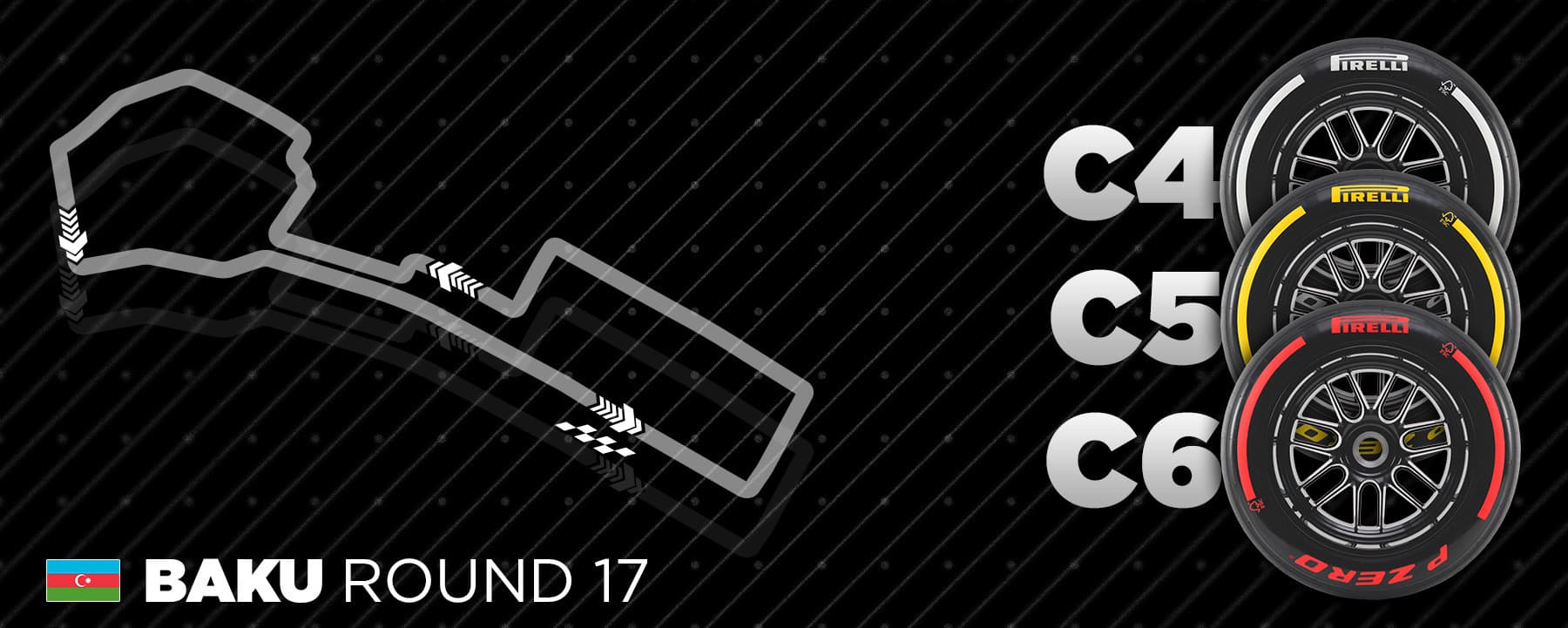
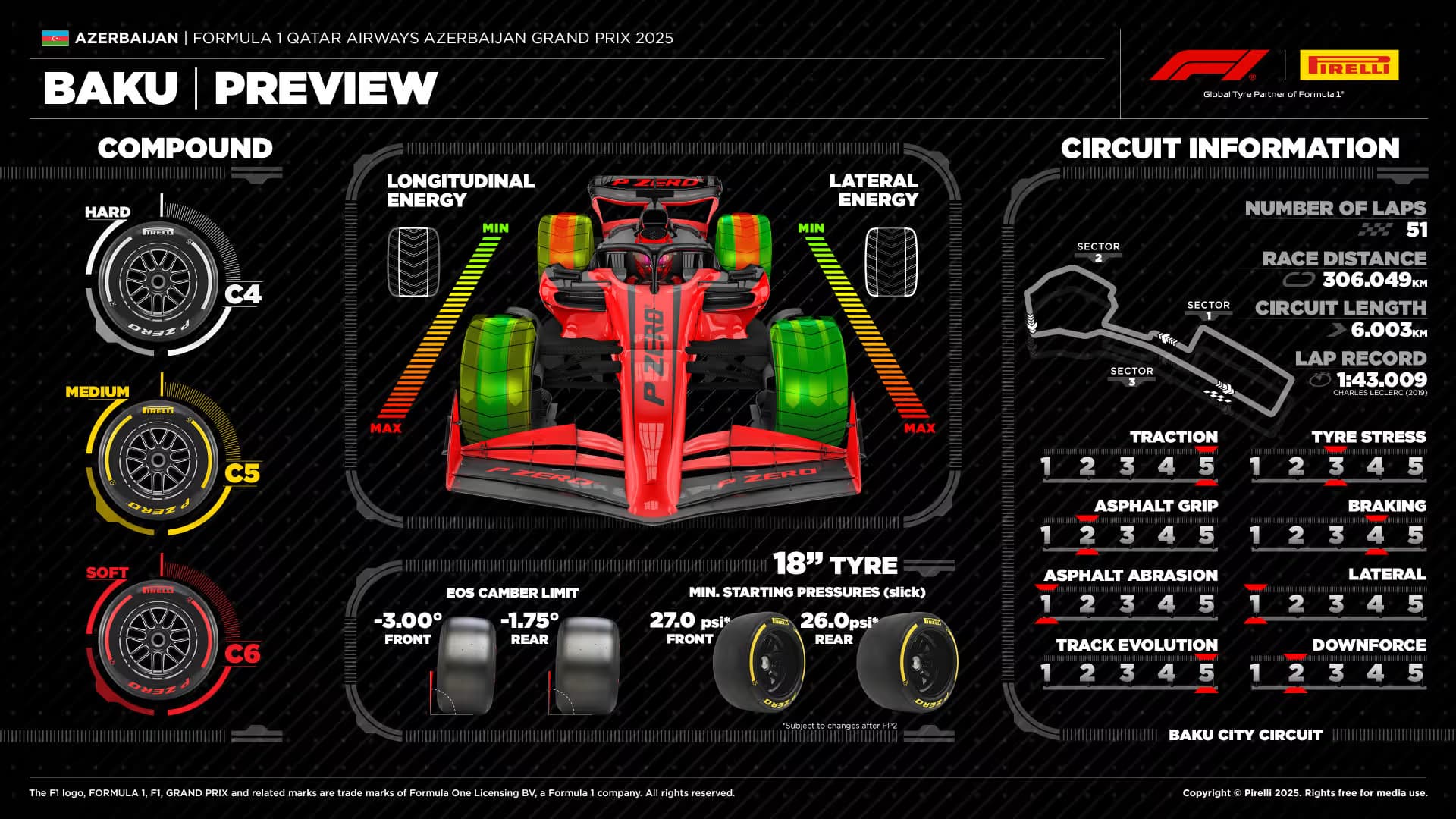
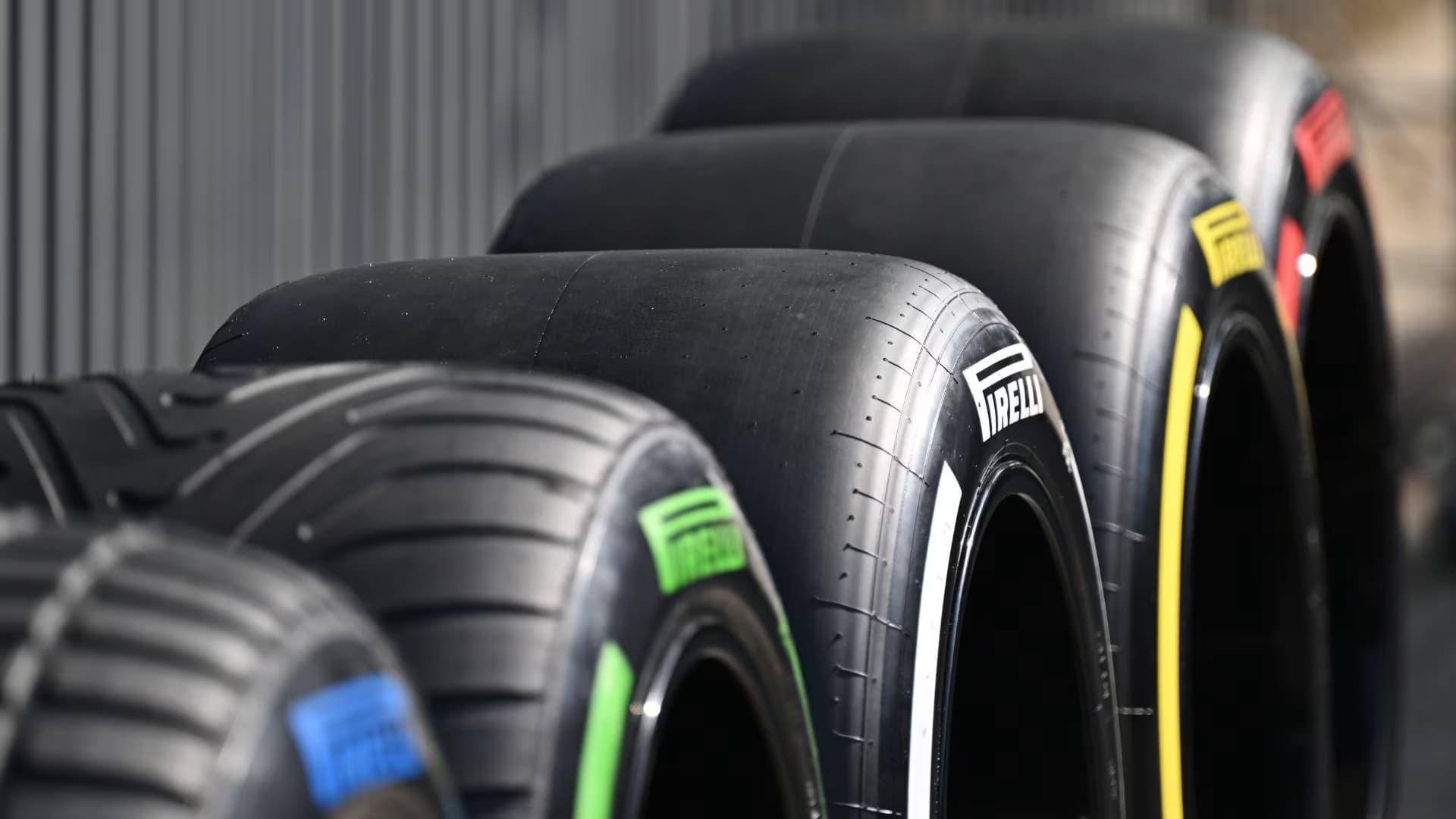
Pirelli is bringing its softest trio of 2025 compounds for the Azerbaijan Grand Prix, which is a step softer than last year. In fact, the C6 is back as the Soft, having already been used in Imola, Monaco and Montreal. The C5 will be the Medium and the C4 the Hard.
On a street circuit with low levels of grip and wear, bringing the same selection as in 2024 would inevitably have led to a one-stop strategy. At least this way, considering that this year’s range suffers much less from graining, it opens up the possibility of a two-stop strategy.
Moreover, it is clear that this year, most recently at Monza, the teams and drivers have become adept at managing the tyres well, so that the race is unlikely to see very different strategies. Although it’s a street track, Baku has some very long straights where the cars hit very high top speeds, that place significant vertical loads on the tyres.
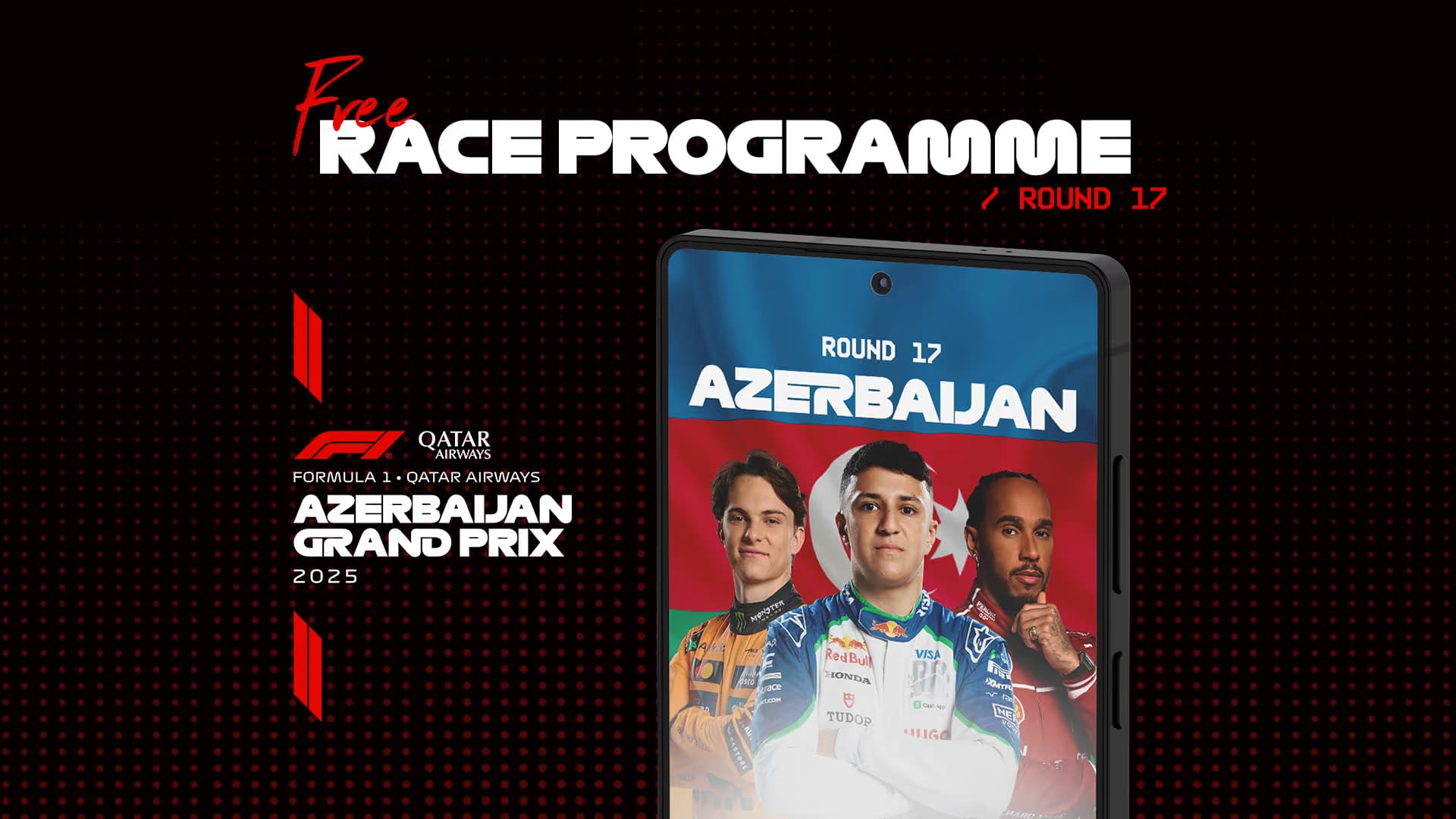
Discover the big talking points in the paddock, the vital stats for the Baku City Circuit, what’s going on in the F1 Fanzone, plus what to see, do and eat when visiting this amazing region.
You can also get the lowdown on all 20 drivers and their teams, and in-depth features – including a look at how McLaren can win the 2025 Constructors’ Championship in Baku, Cadillac Team Principal Graeme Lowdon on how the squad’s preparations are ramping up ahead of their F1 debut in 2026, and how ‘F1 The Movie’ is influencing fan fashion at Grands Prix.
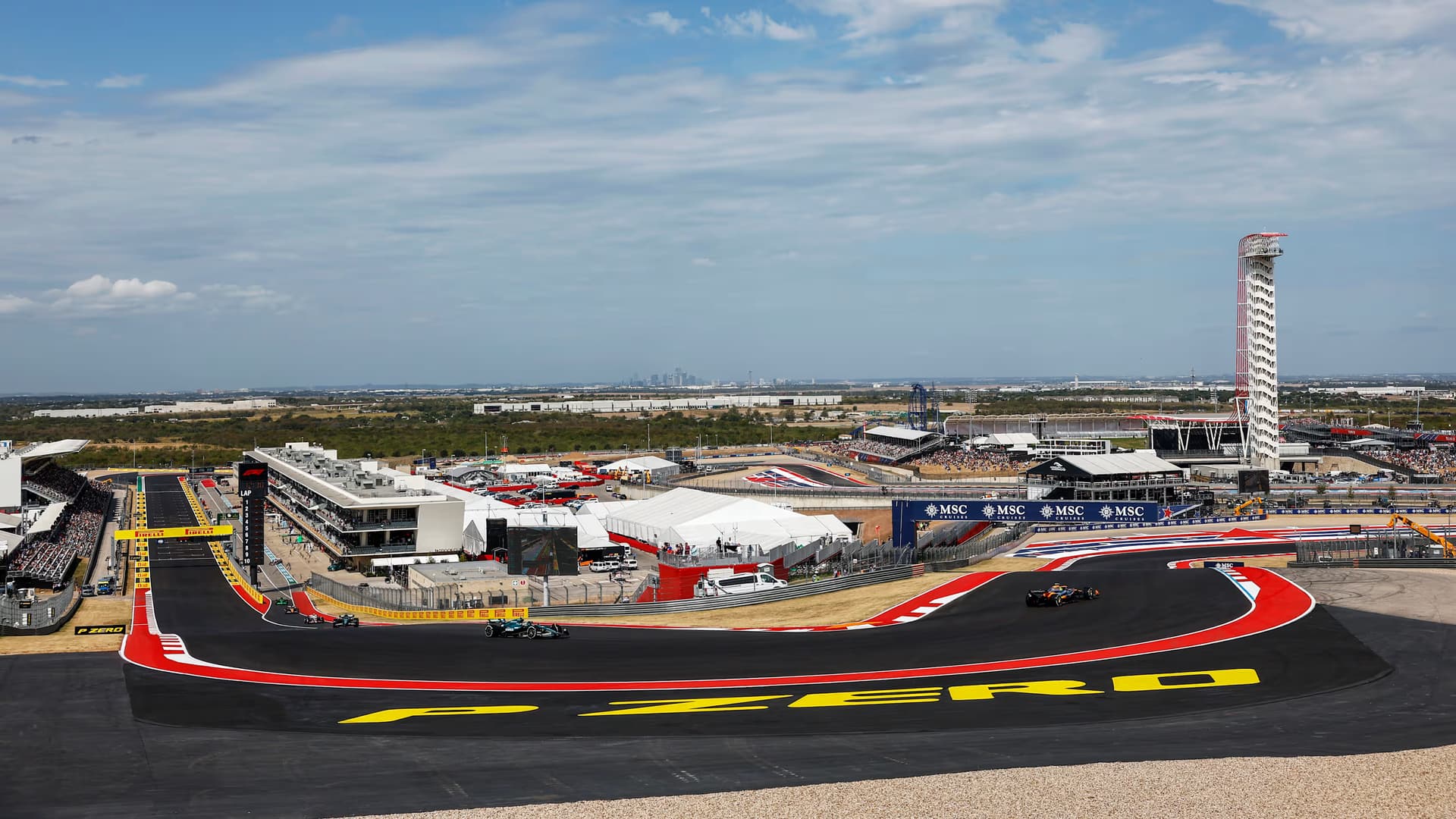
Formula 1 arrives at Austin’s Circuit of The Americas this weekend for Round 19 on the 2025 calendar, the United States Grand Prix.
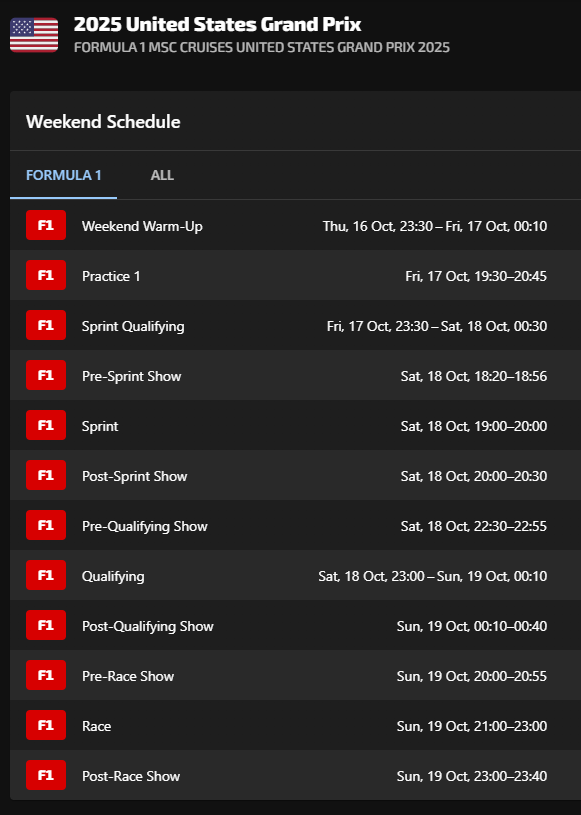
With the Sprint format in play, Free Practice 1 and Sprint Qualifying will take place on Friday, October 17, followed by the Sprint and Qualifying on Saturday, October 18, and the Grand Prix itself on Sunday, October 19.
It’s a party in the USA! At least for Boy George who is smiling as wide as his T-pose with a juicy new £30-million Mercedes contract for 2026 in his pocket.
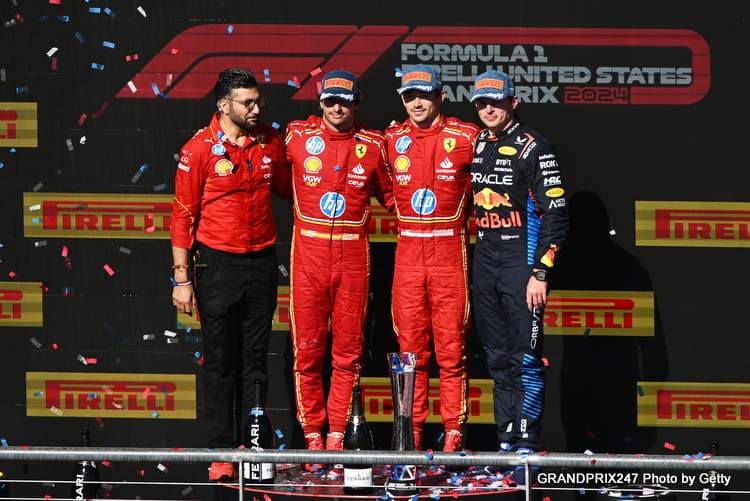
Can Max continue to hassle and then capitalise on the internal challenges that leading Mclaren pair are having? Can Ferrari overcome their poor performance last time out and replicate the highs of their 1-2 at COTA last year? Will the joyous George push his way into the party and play the spoiler game again?
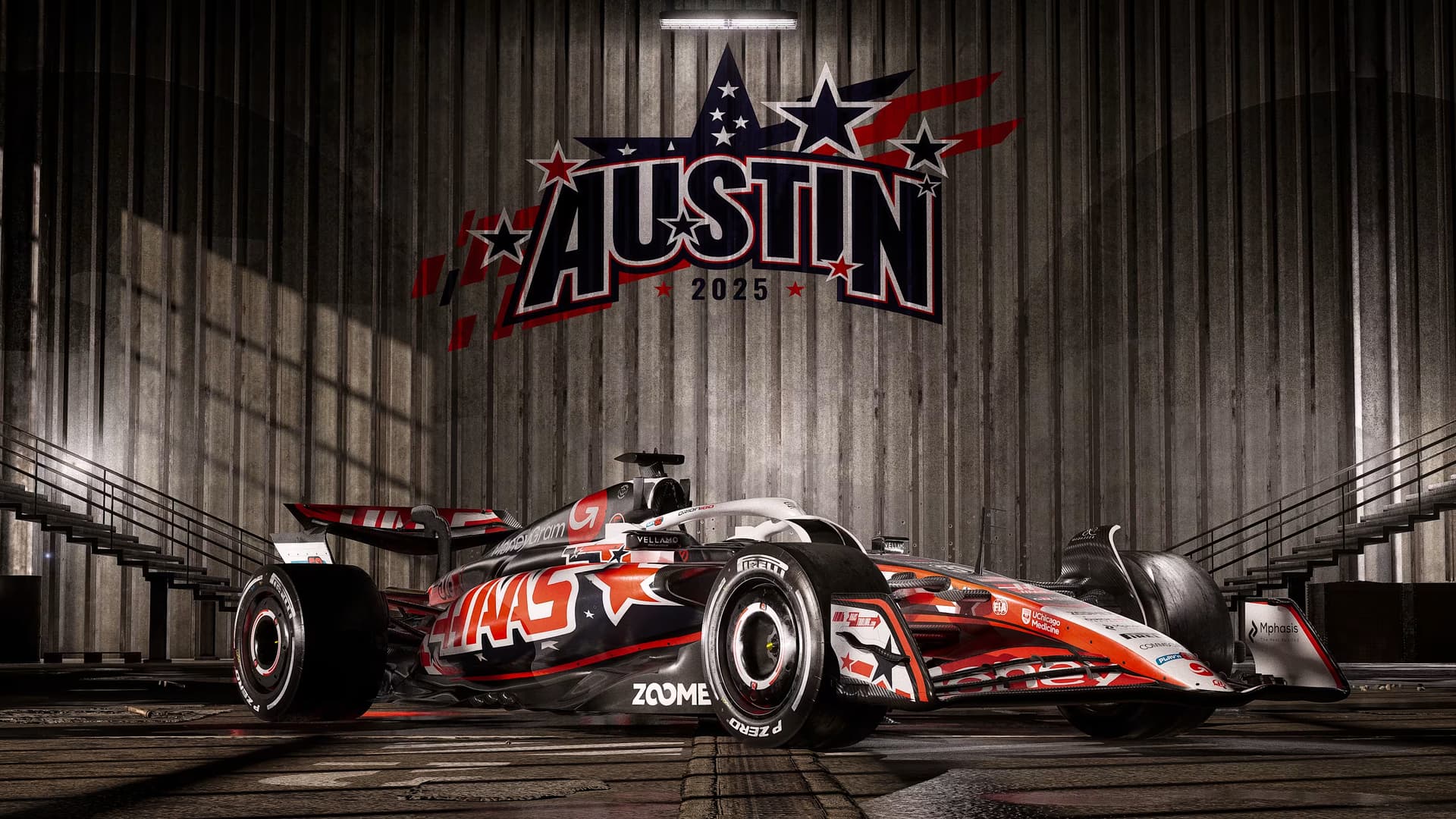
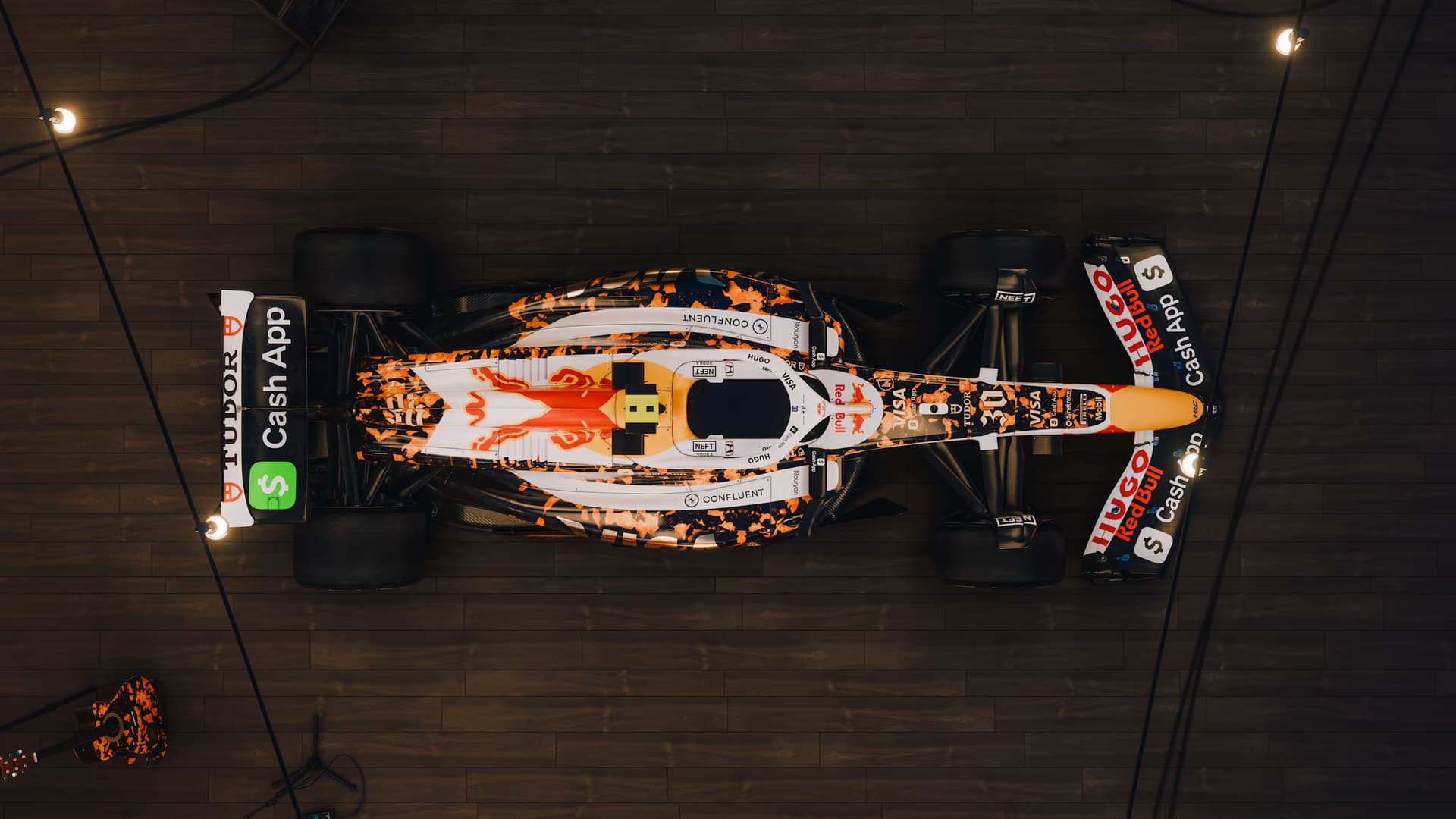
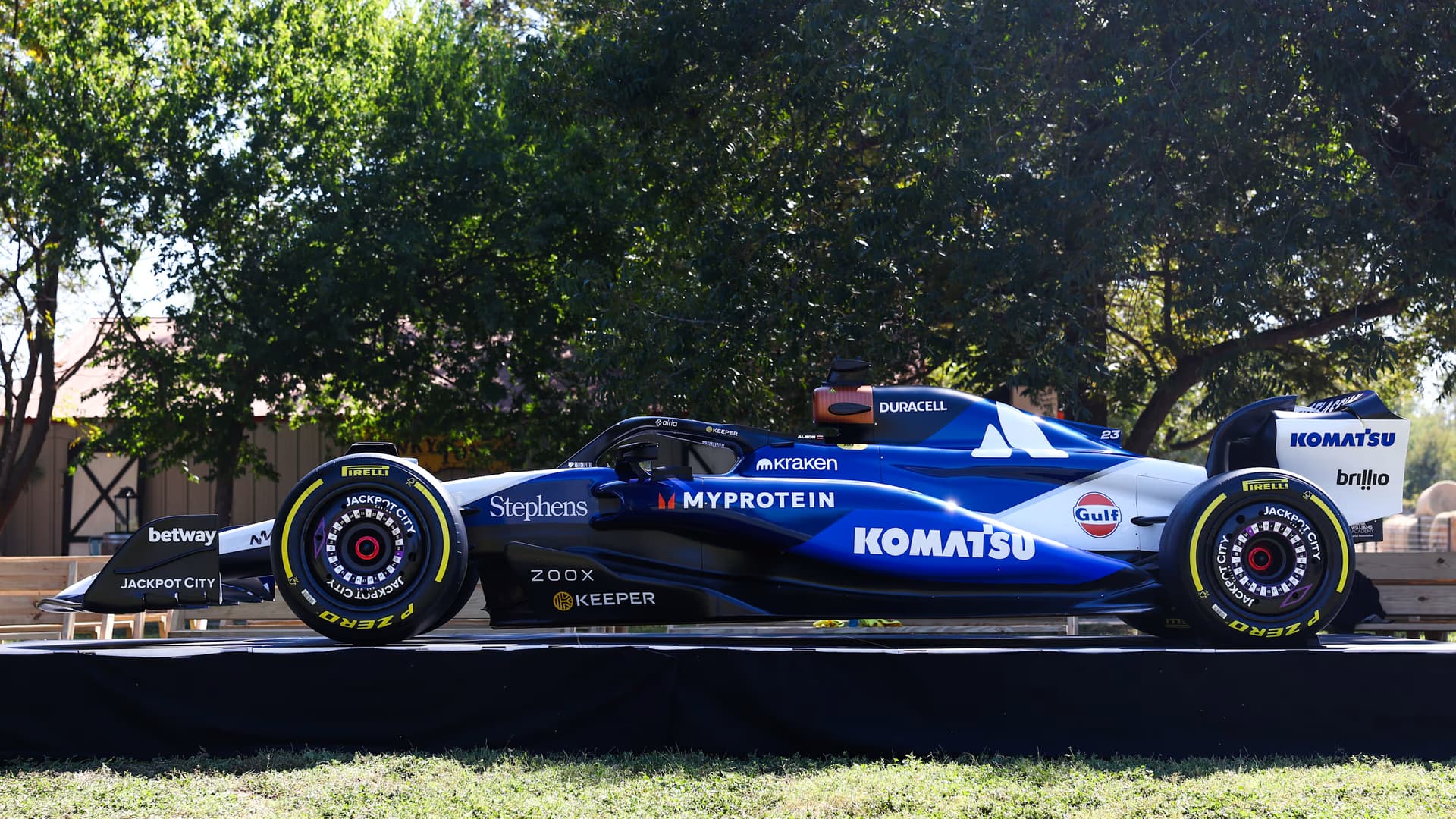
Five teams are out to catch eyeballs, and American sponsor purses, this weekend with some special liveries. The best one’s are from Williams, Haas and the Racing Bulls, but look out for the Mclaren and Aston reskins too.
It’s a busy old weekend of F1 action from COTA, what with it being a Sprint Weekend and all. But it all happens in American day time hours, so some late night viewing for us here this weekend.
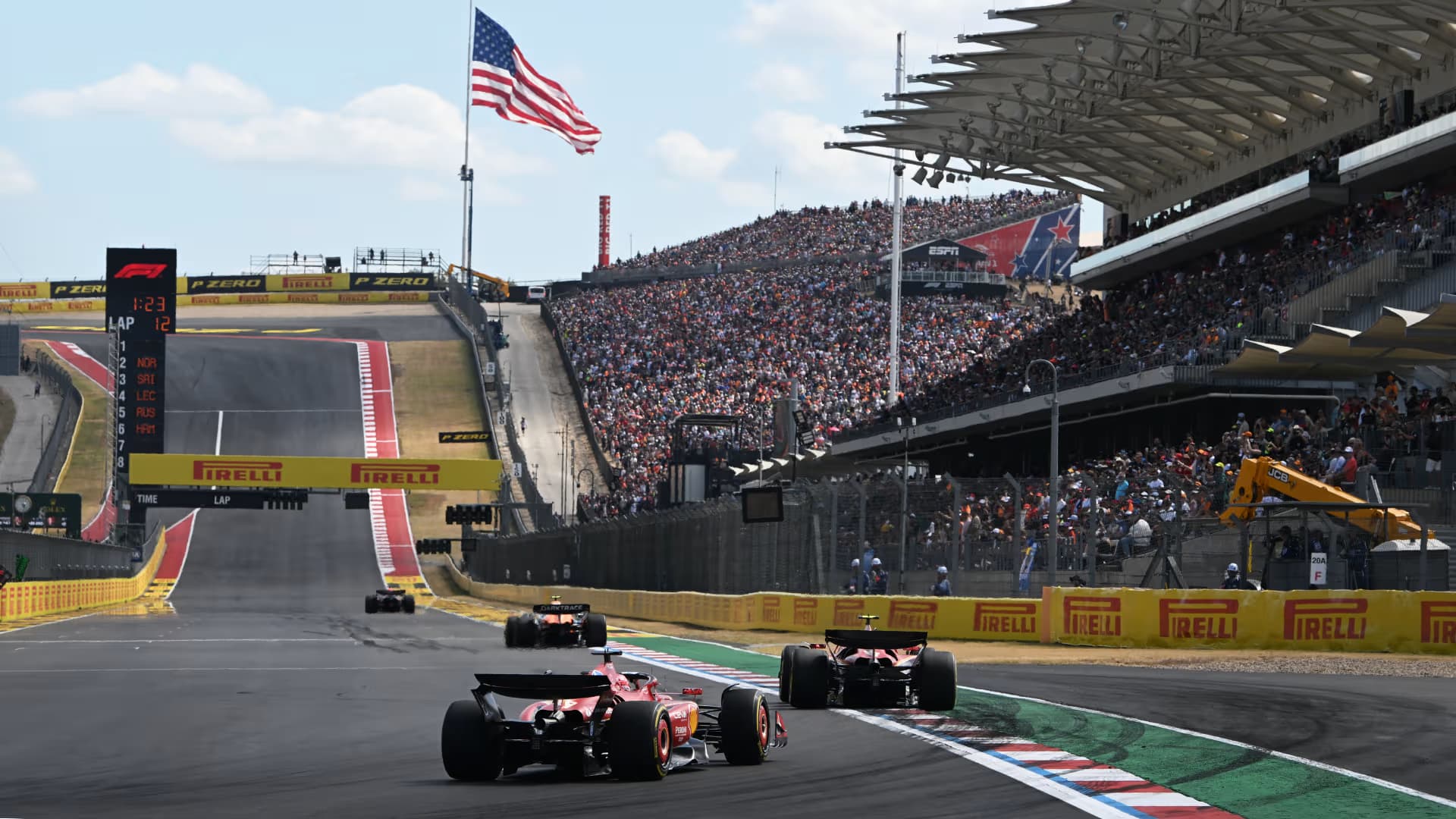
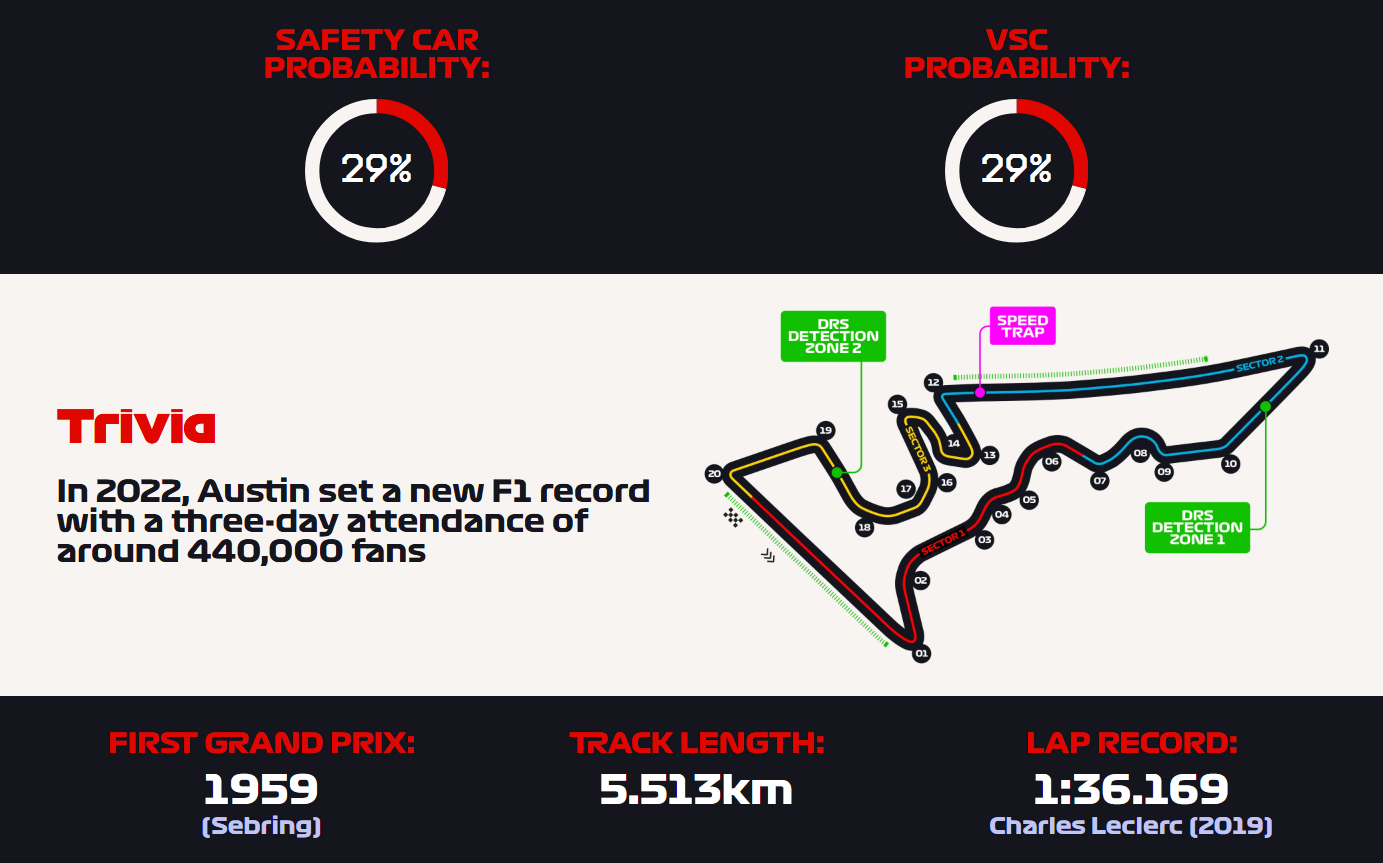
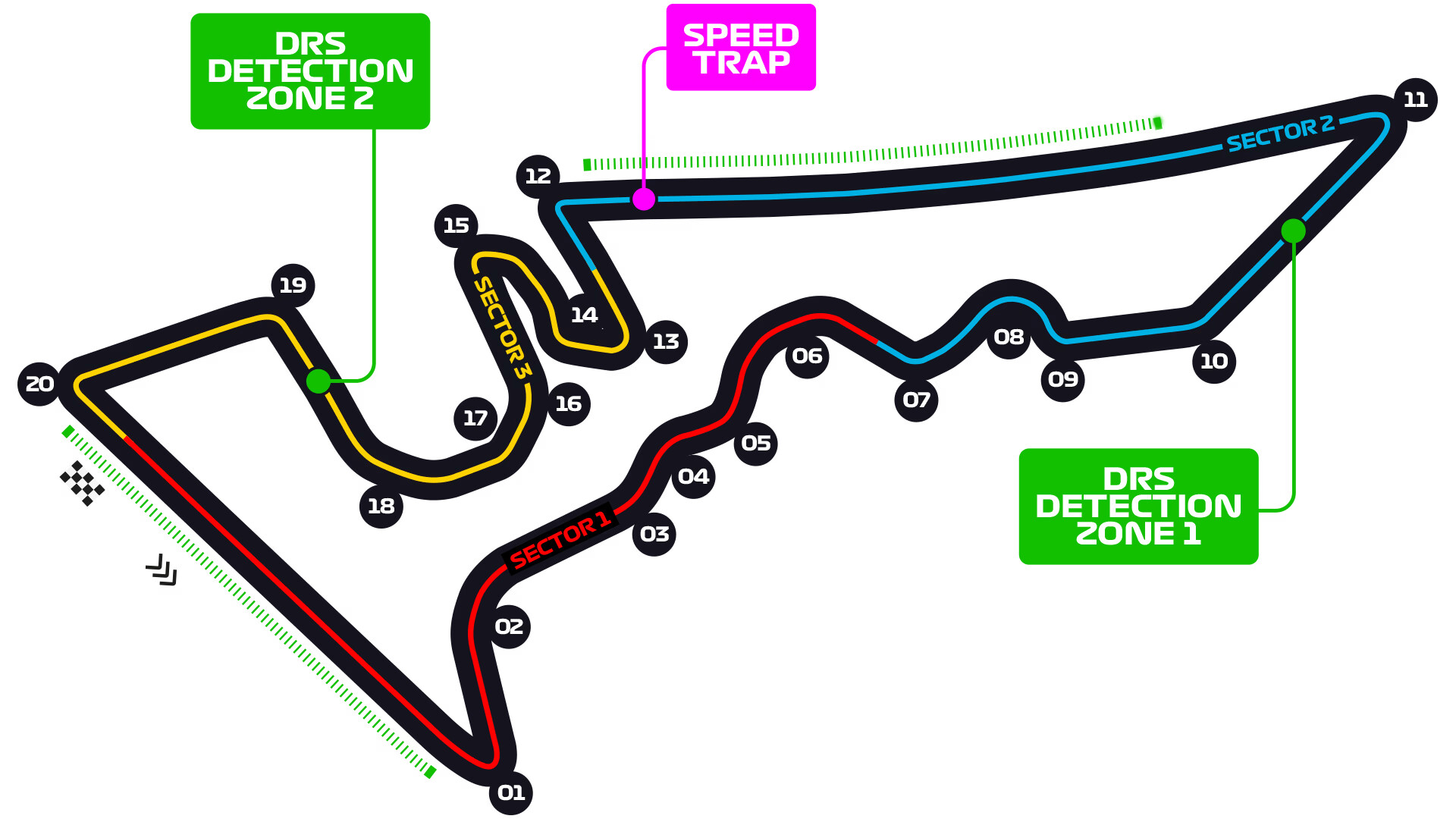
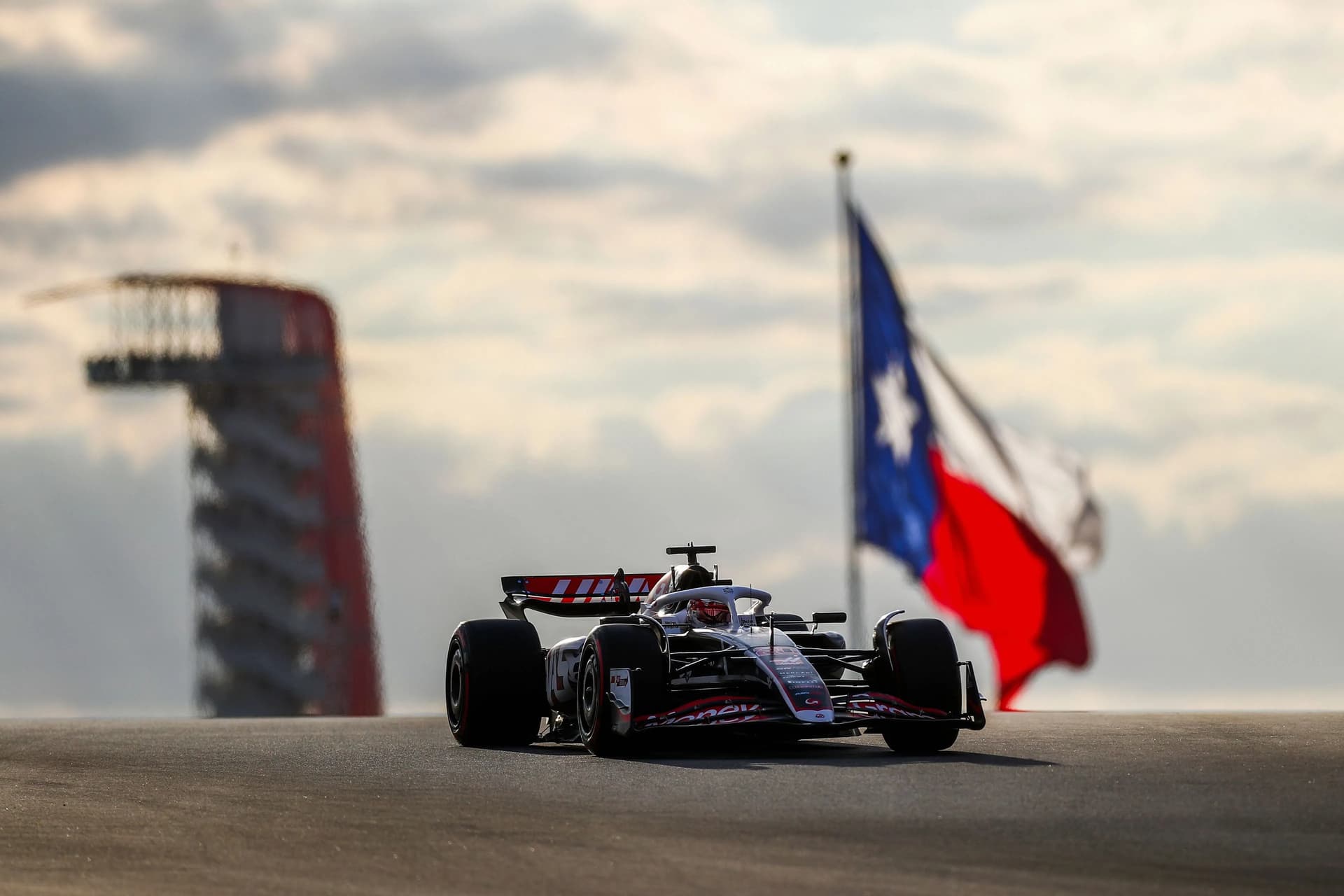
The Circuit of The Americas is a great track that takes inspiration from parts of other legendary corners on the calendar.
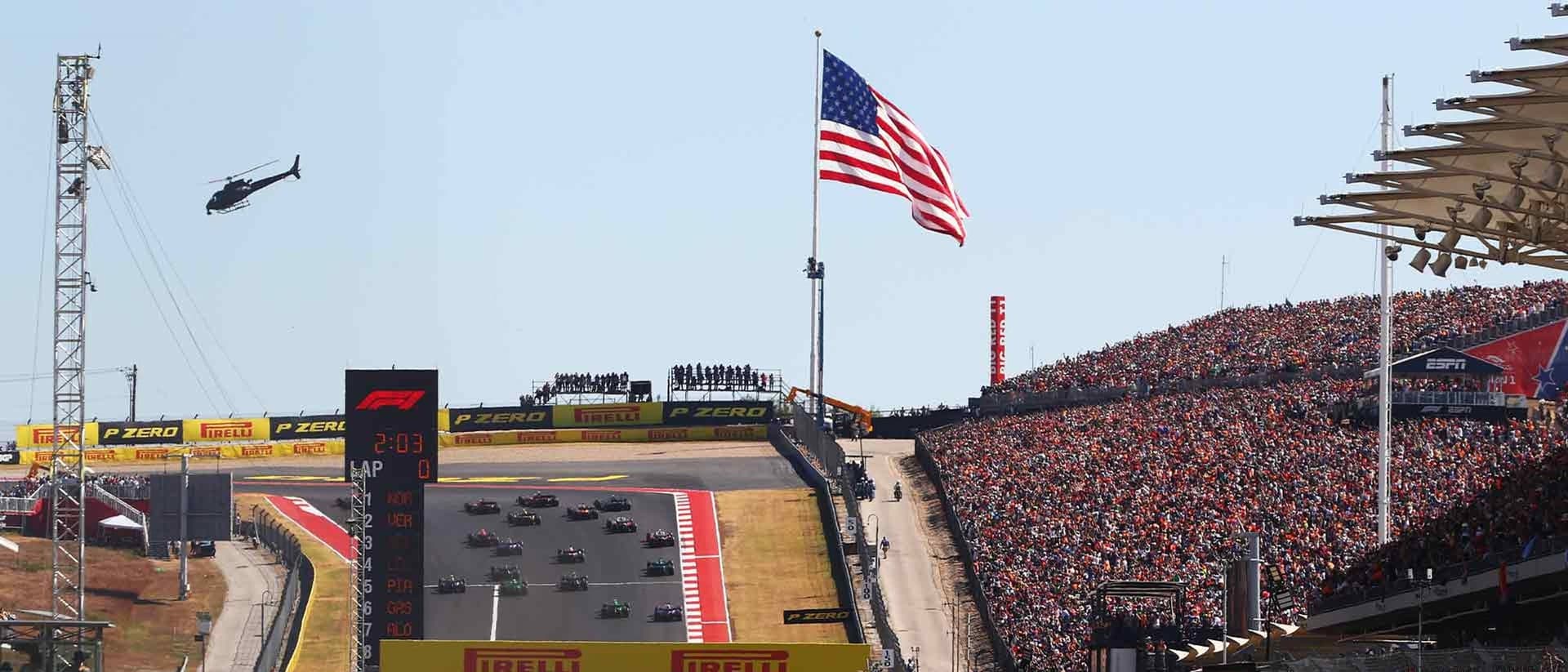
The uphill Turn 1 is difficult at the race start as there are loads of different lines that can be taken, then you sweep through the first sector, which is a bit like Silverstone, where you’re trying to find your rhythm.
After that, it’s the long back straight and you’ve got to get your braking point right at the end of it…
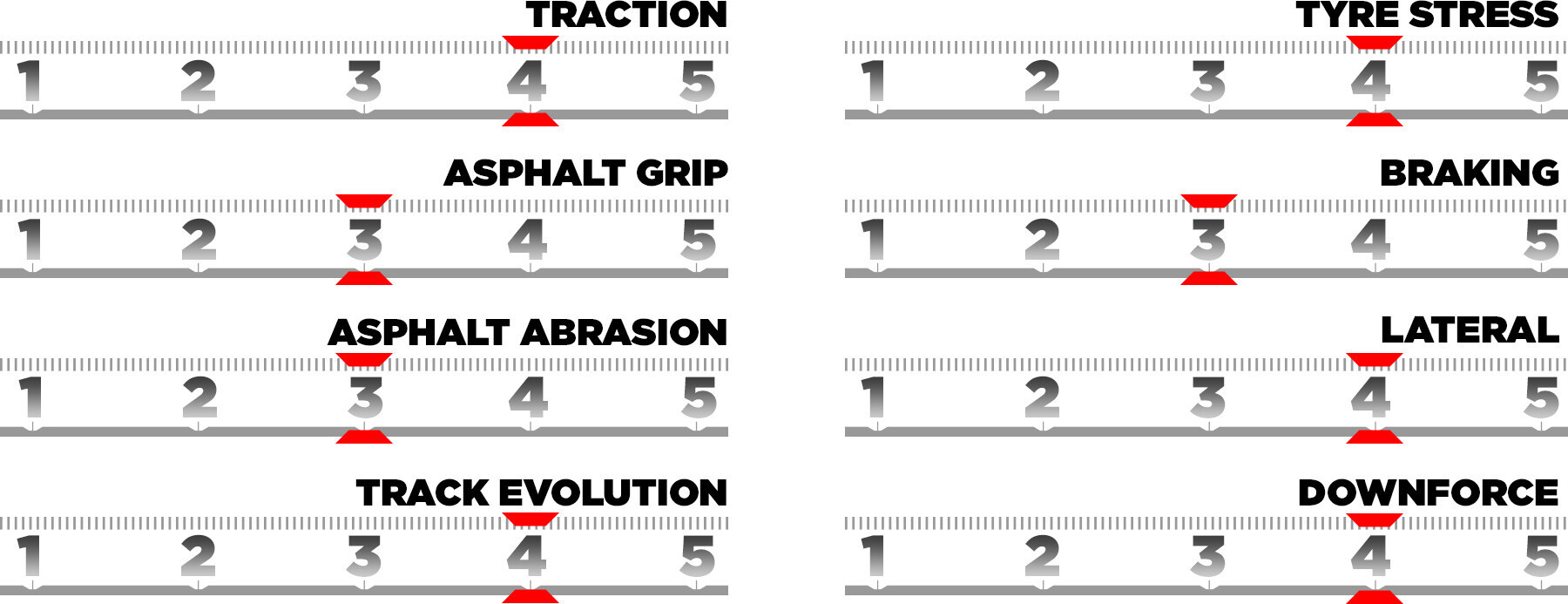
Probably the hardest section on the circuit is Turn 13 through to Turn 15, which feels like an odd complex of corners behind the wheel. Turn 13 is conventional, but finding your line through to 15 is not easy, while that Turn 14 area puts a lot of load on the tyres.
You go through the quadruple right-hander after that, followed by Turn 19, which is a really nice corner – though track limits are an issue.
Finally, you stop for Turn 20, then it’s a short burst to the line, but drivers need to be careful not to light things up as it’s easy to break traction.
There are also plenty of overtaking opportunities during the race with DRS on the run to Turn 12 and Turn 1.
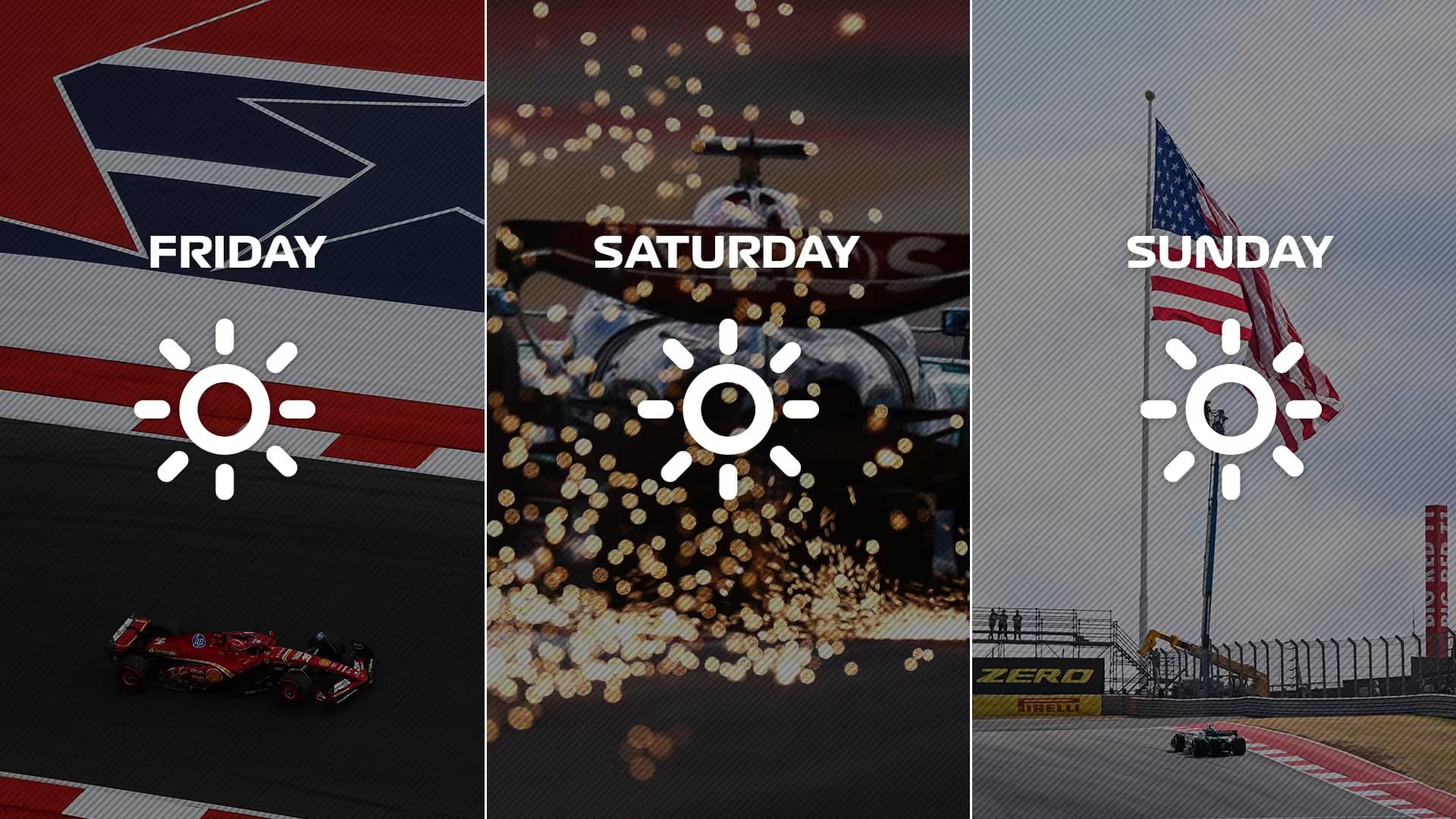
Austin is prone to a spot of rain now and then, and there is a vague outside chance of some this weekend. But mostly it’s rich Texan sunshine all the way through. In fact, the heat is going to be a bit of challenge this weekend.
Friday: FP1 and Sprint Qualifying
Mainly sunny and likely dry day. Hot. Light southerly wind.
FP1: 30°C | Sprint Qualifying: 32°C
Chance of rain: 0%
Saturday: Sprint Race and Qualifying
Sunny at first becoming cloudier with a gradually increasing chance of showers from the mid-afternoon. Hottest day of the week. Light south-westerly wind.
Sprint: 30°C // Q: 33°C
Chance of rain: 20%
Sunday: Grand Prix
Mostly cloudy with a moderate chance of showers until dawn. Becoming sunny afterwards.
Race start: 32°C
Chance of rain: 20%
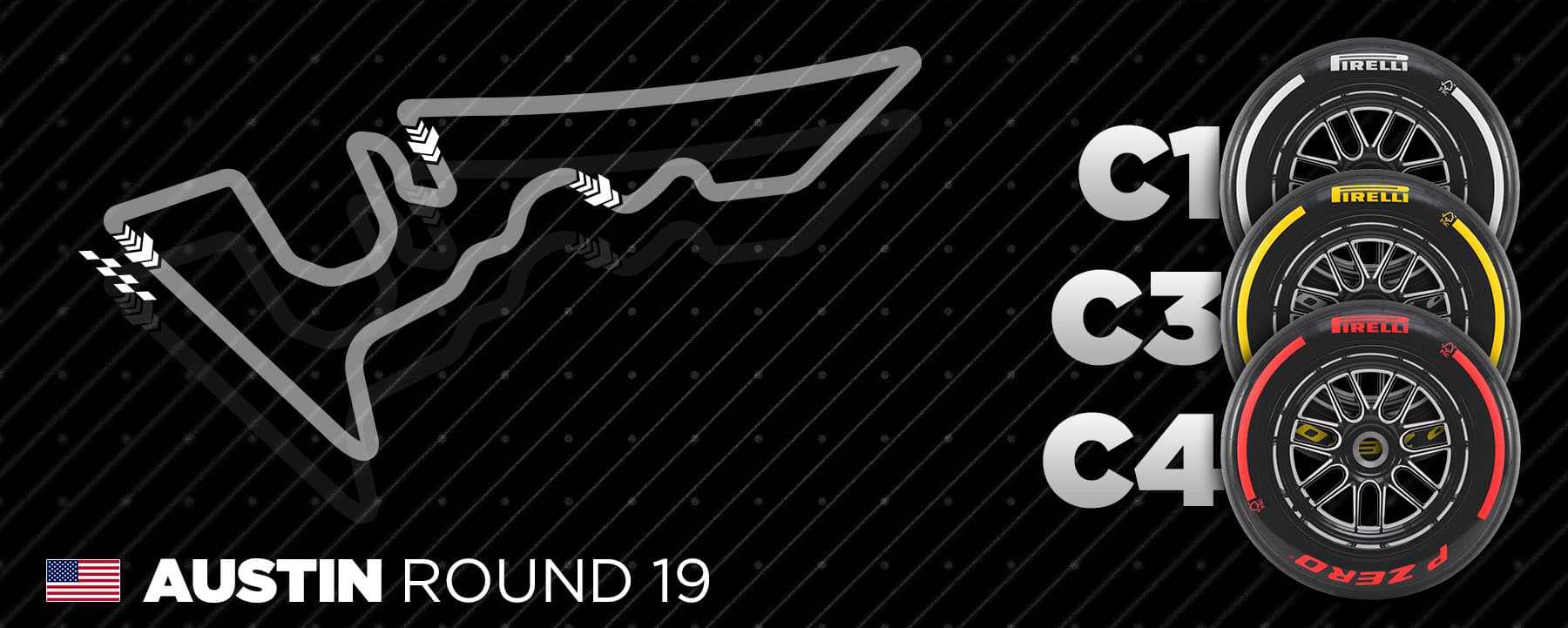
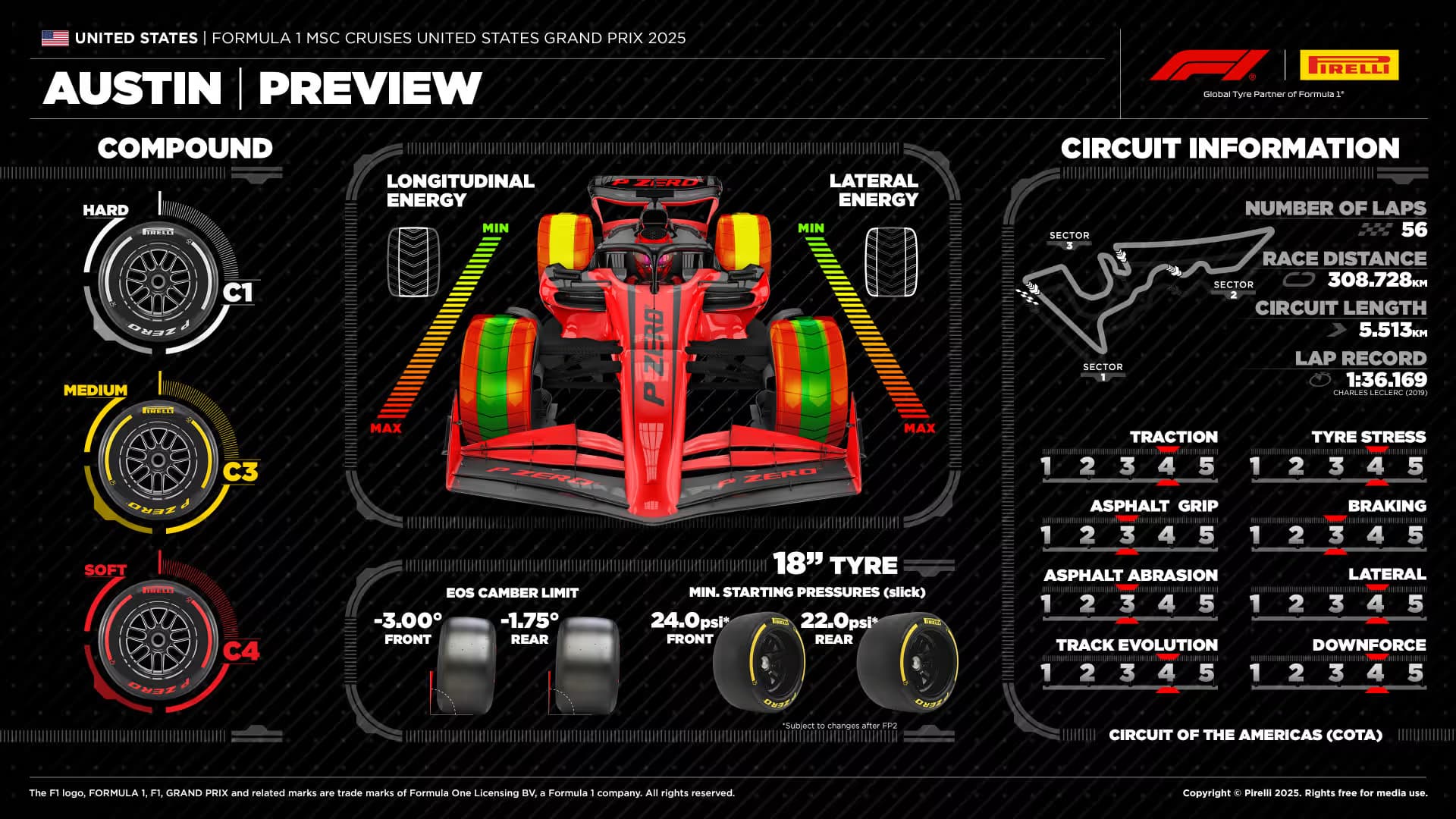
For the event at the Circuit of the Americas, on the calendar since 2012, the teams will have a trio of compounds that features an extra step between the Hard and the Medium-Soft pair. It will be an interesting experiment to see if this could lead to a greater choice of strategies on one of the most complete tracks on the calendar.
The United States Grand Prix will be the second race of the season for which Pirelli is bringing three non-consecutive compounds, the last time being Spa-Francorchamps and the available tyres will once again be the C1 as Hard, the C3 as Medium and the C4 as Soft. In Belgium, bad weather meant it was not possible to find out how this choice might have affected strategy and so the event in COTA could be the first real test of this choice, which sees the use of a harder Hard than last year at the American track, while the Medium and Soft are the same.
The increased performance difference between the hardest compound and the middle one should, theoretically, give rise to two scenarios. If drivers prefer the C1, the slowest but also the most consistent of the three, then they could run a one-stop race combining it with the C3. On the other hand, using the latter along with the C4, with its improved resistance to degradation, would produce quicker lap times but would almost certainly require two stops. Another similarity with the Belgian round is that Austin is also running to the Sprint format, which means teams only have one hour to try the various options over long and short runs, which could add to the uncertainty as to how the weekend might pan out.
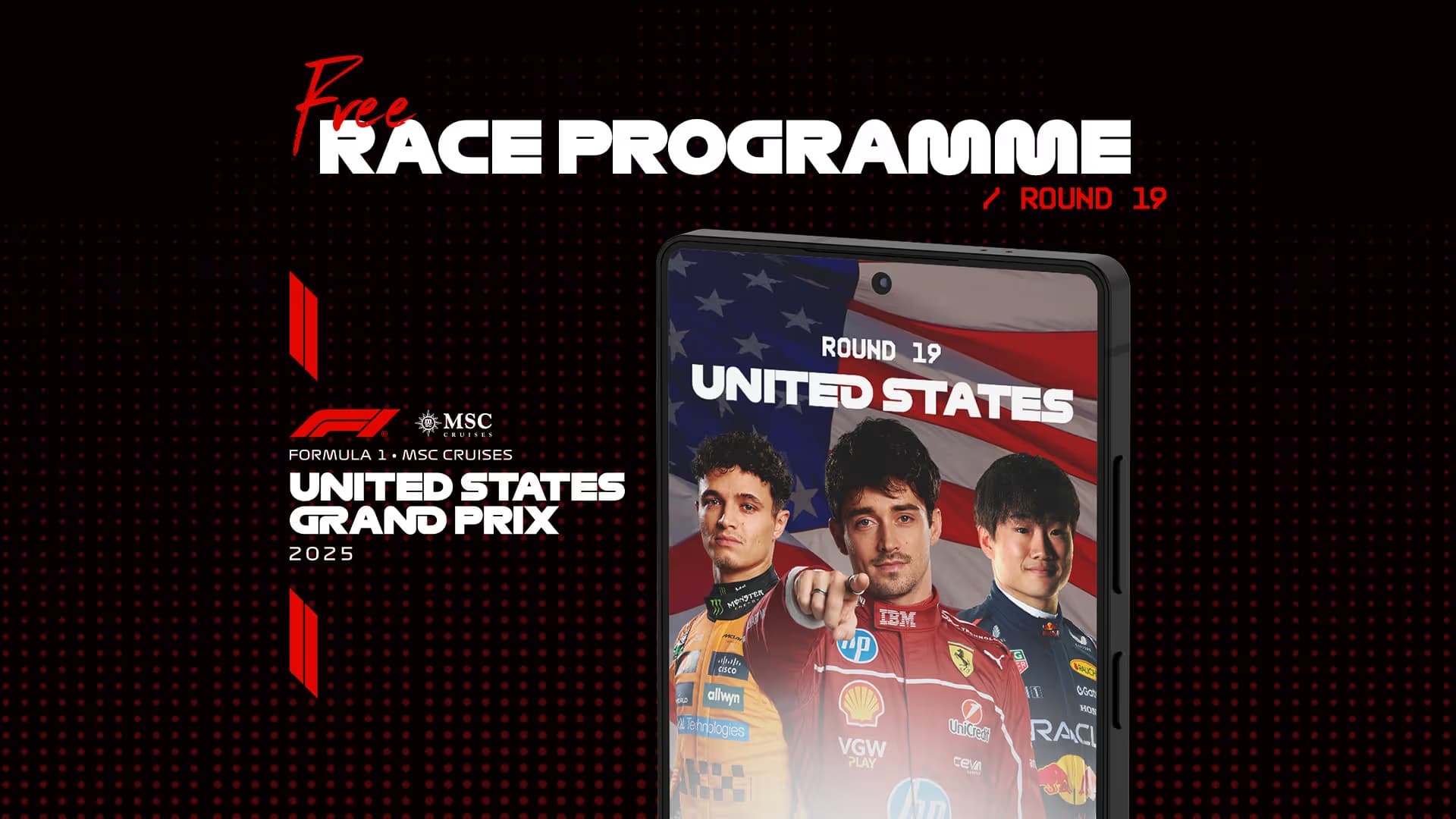
Check out the all-new digital race programme for the Formula 1 MSC Cruises United States Grand Prix 2025, with everything you need to know about the GP weekend, whether you are attending in person or tuning in from afar.
Discover the big talking points in the paddock, the vital stats for the Circuit of The Americas (COTA), what’s going on in the F1 Fanzone, plus what to see, do and eat when visiting this amazing region.
You can also get the lowdown on all 20 drivers and their teams, and in-depth features – including how McLaren earned back-to-back Teams’ titles and why drivers love coming to COTA.
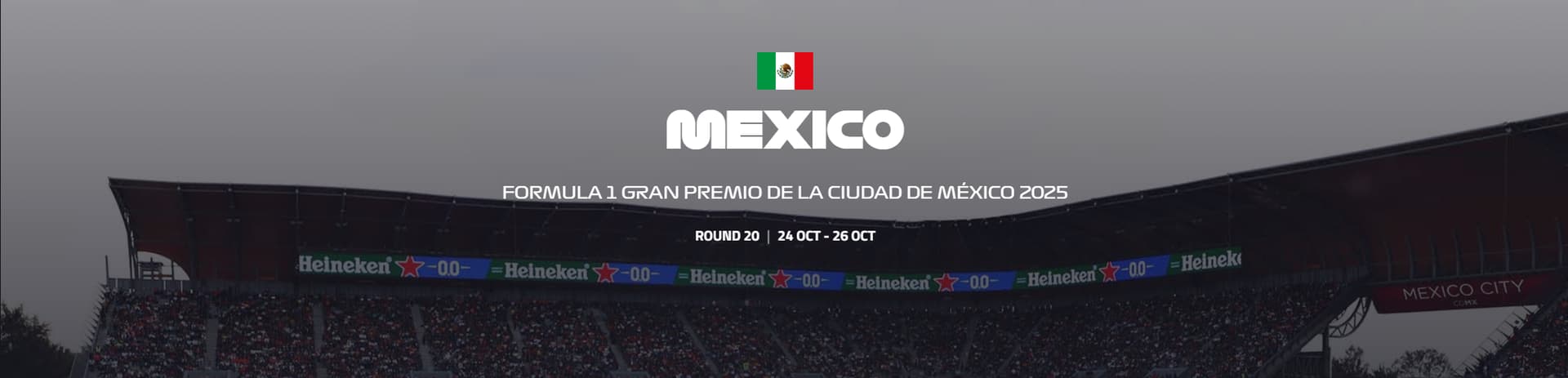
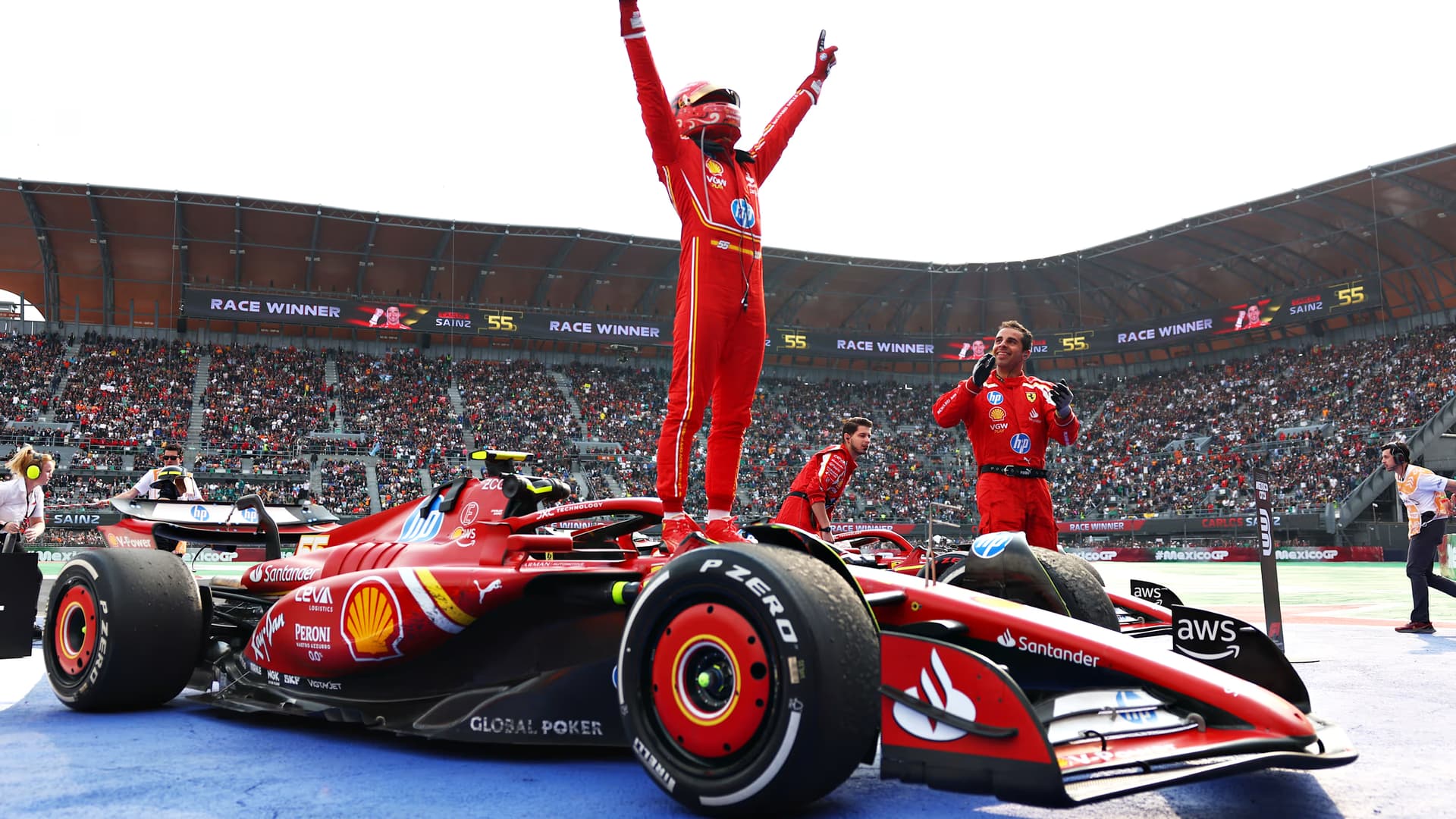
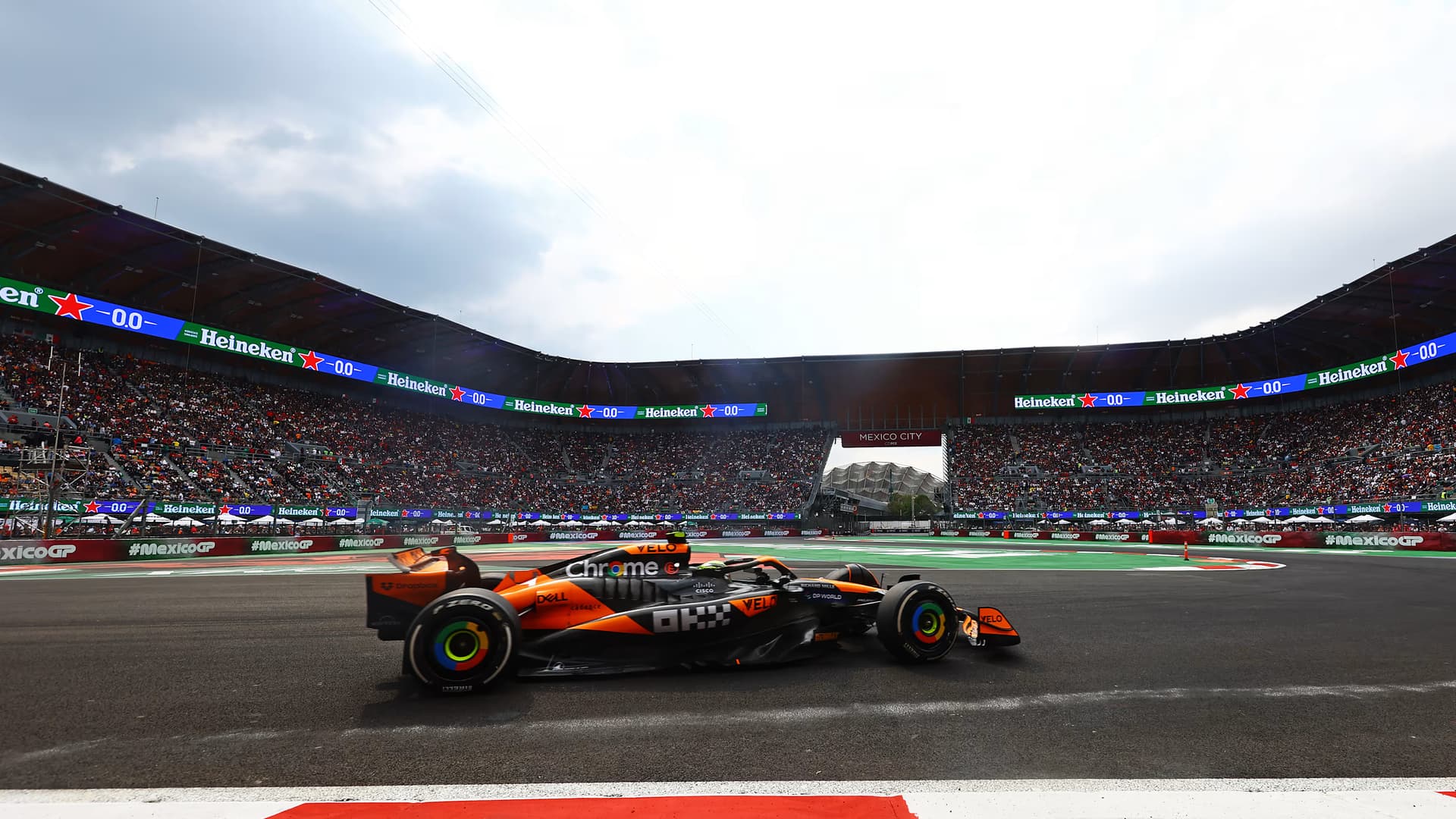
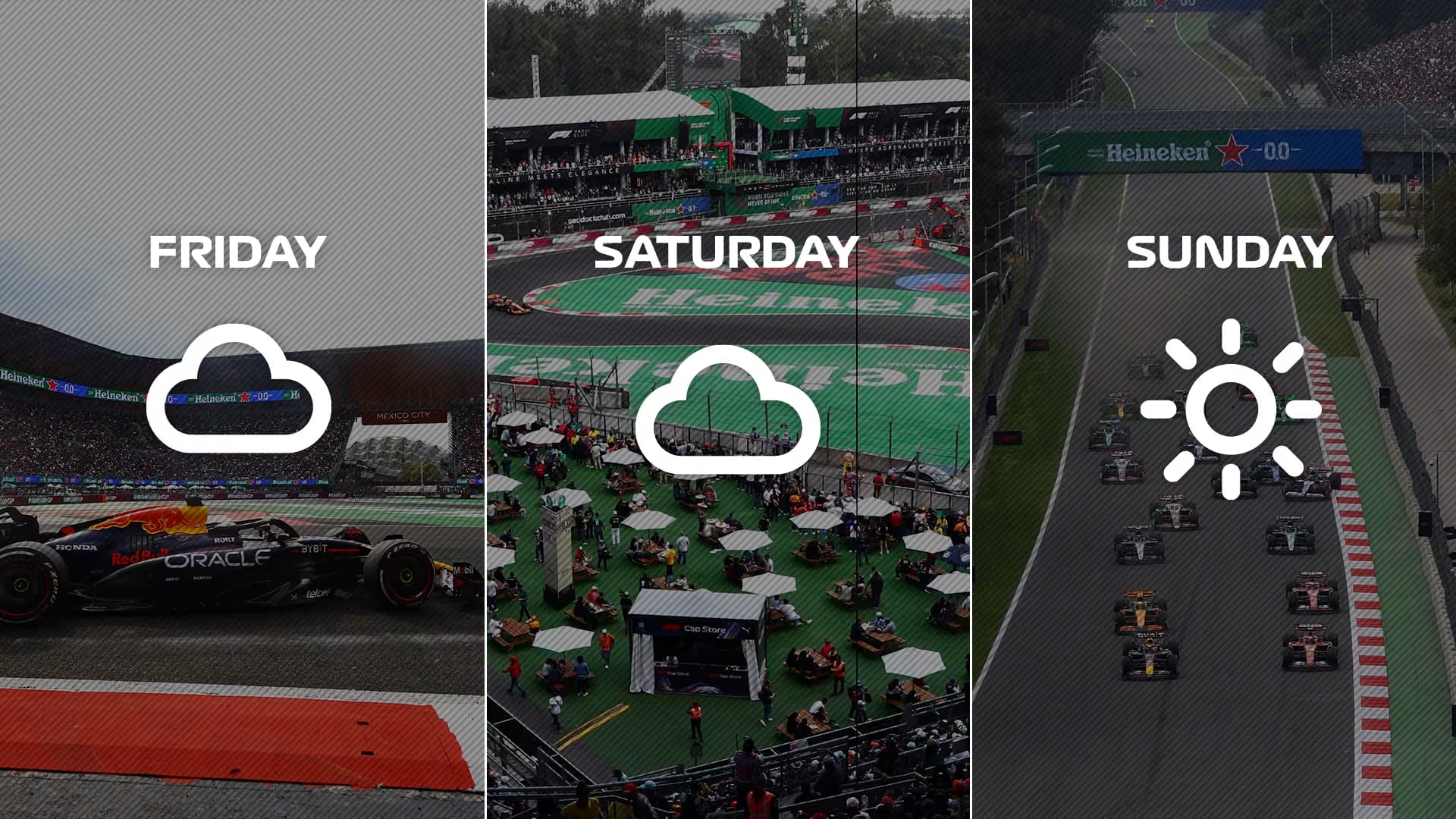
The Formula 1 paddock travels to the Autodromo Hermanos Rodriguez this weekend for Round 20 on the 2025 calendar, the Mexico City Grand Prix.
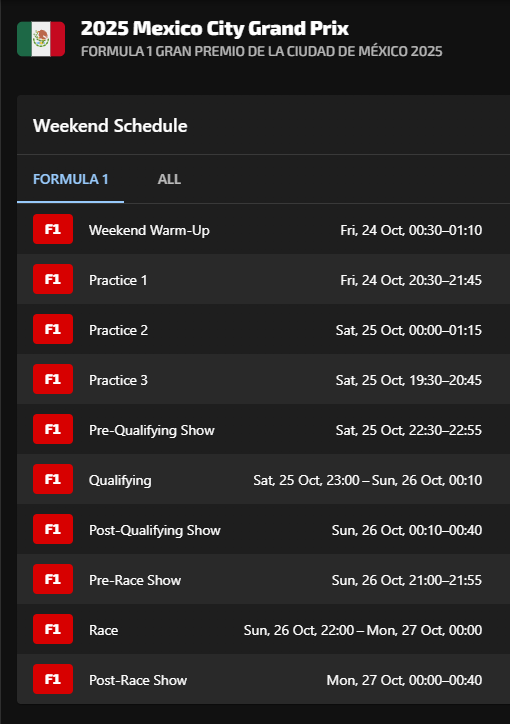
Free Practice 1 and Free Practice 2 will take place on Friday, October 24, followed by Free Practice 3 and Qualifying on Saturday, October 25, and the Grand Prix itself on Sunday, October 26.
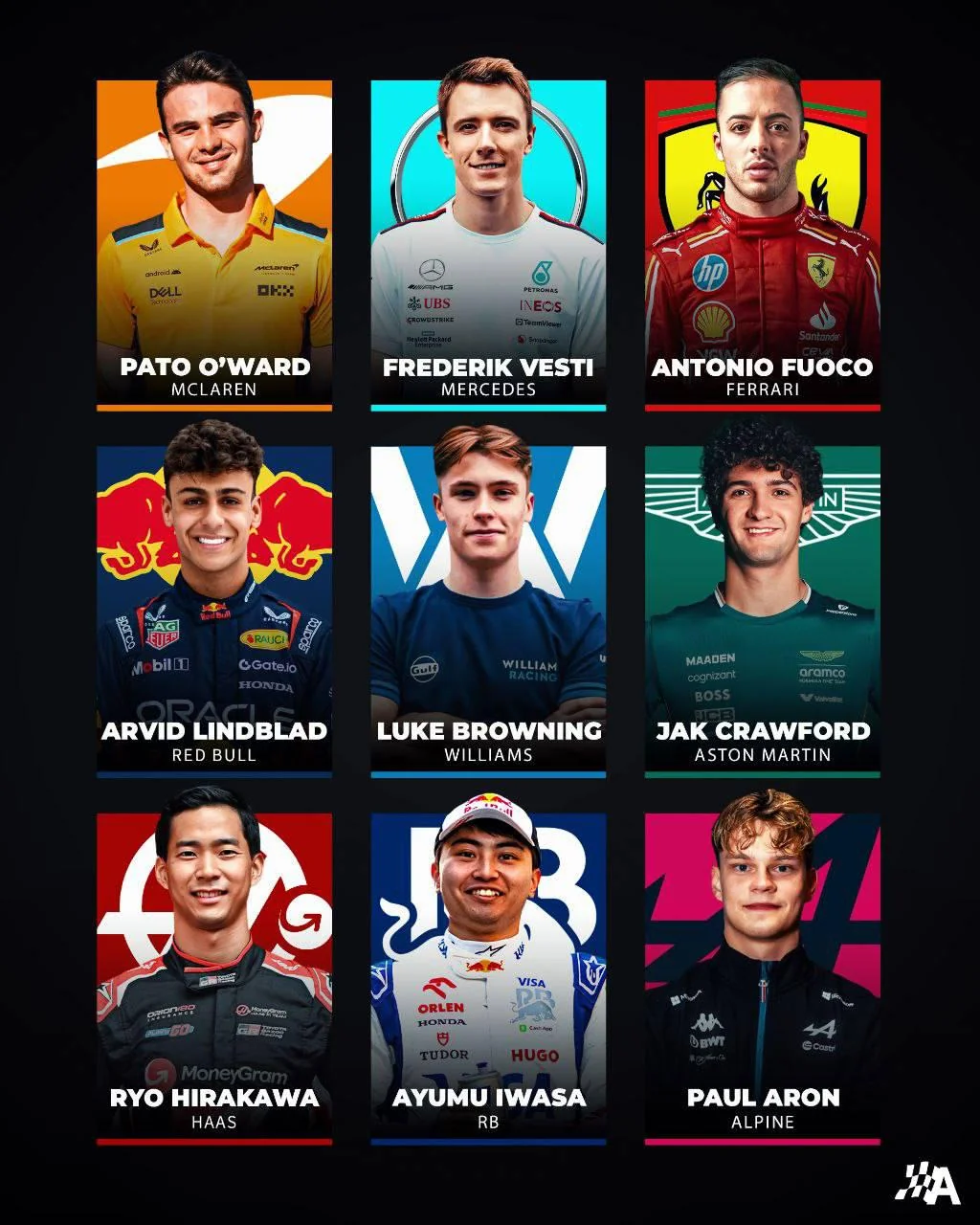
Nine of the ten teams will have rookies in their cars for FP1, which could make for some interesting insights into how the next generation of F1 drivers compare in F1 machinery.
Trivia – The 20% air pressure reduction at 7,200ft AMSL (above mean sea level) means Mexico has taken over from Italy as the race with the highest top speeds. In the 2016 race, Valtteri Bottas set the fastest ever trap speed in F1 history (231.46mph) but Williams telemetry said his maximum speed reached 231.96mph before braking for Turn 1
Last five Mexican GP polesitters
2024 – Carlos Sainz (Ferrari)
2023 – Charles Leclerc (Ferrari)
2022 – Max Verstappen (Red Bull)
2021 – Valtteri Bottas (Mercedes)
2019 – Charles Leclerc (Ferrari)*
*Max Verstappen set the fastest time in Qualifying, but received a three-place grid penalty for failing to slow for yellow flags
Jolyon Palmer, former Renault F1 driver:
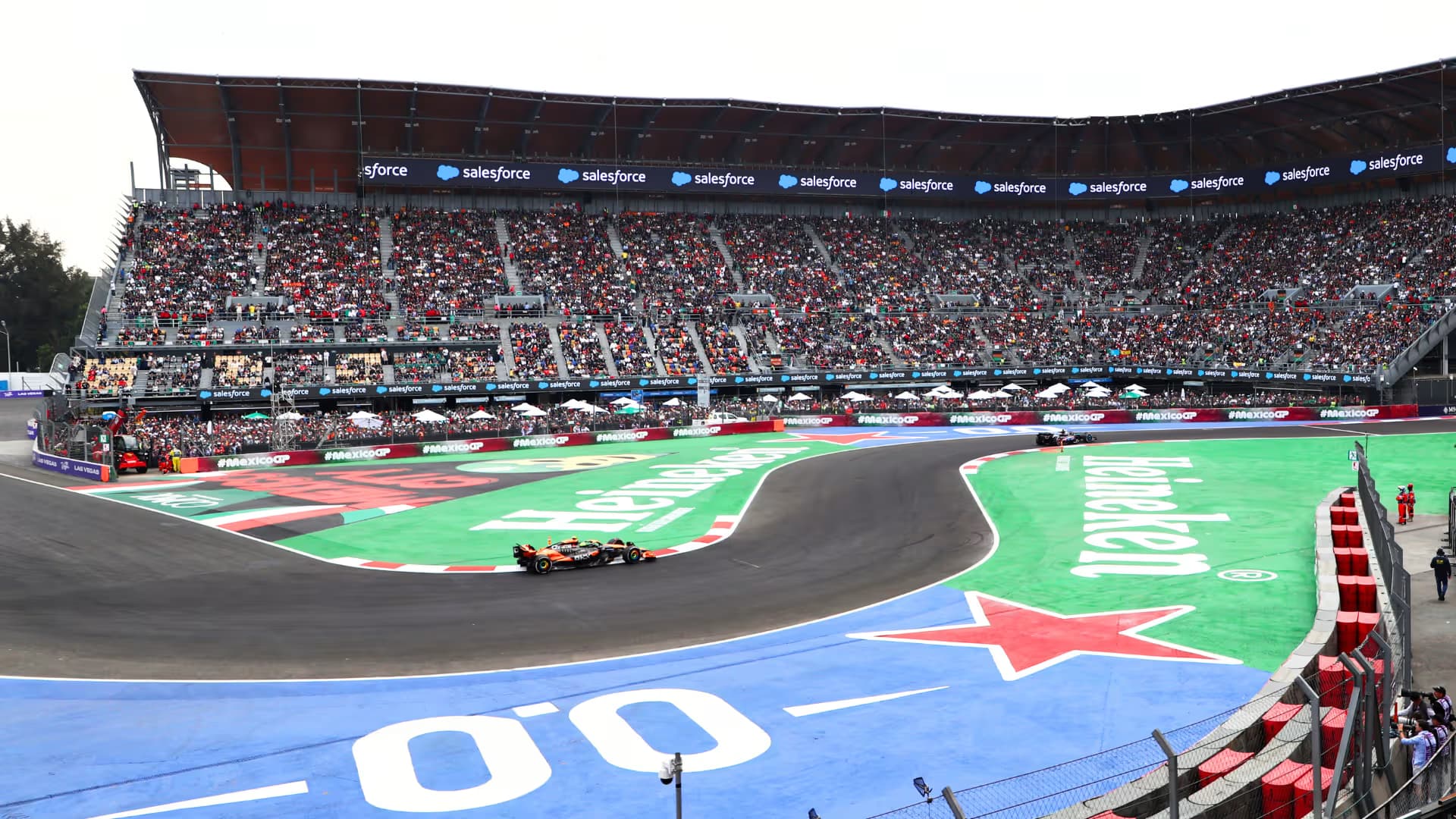
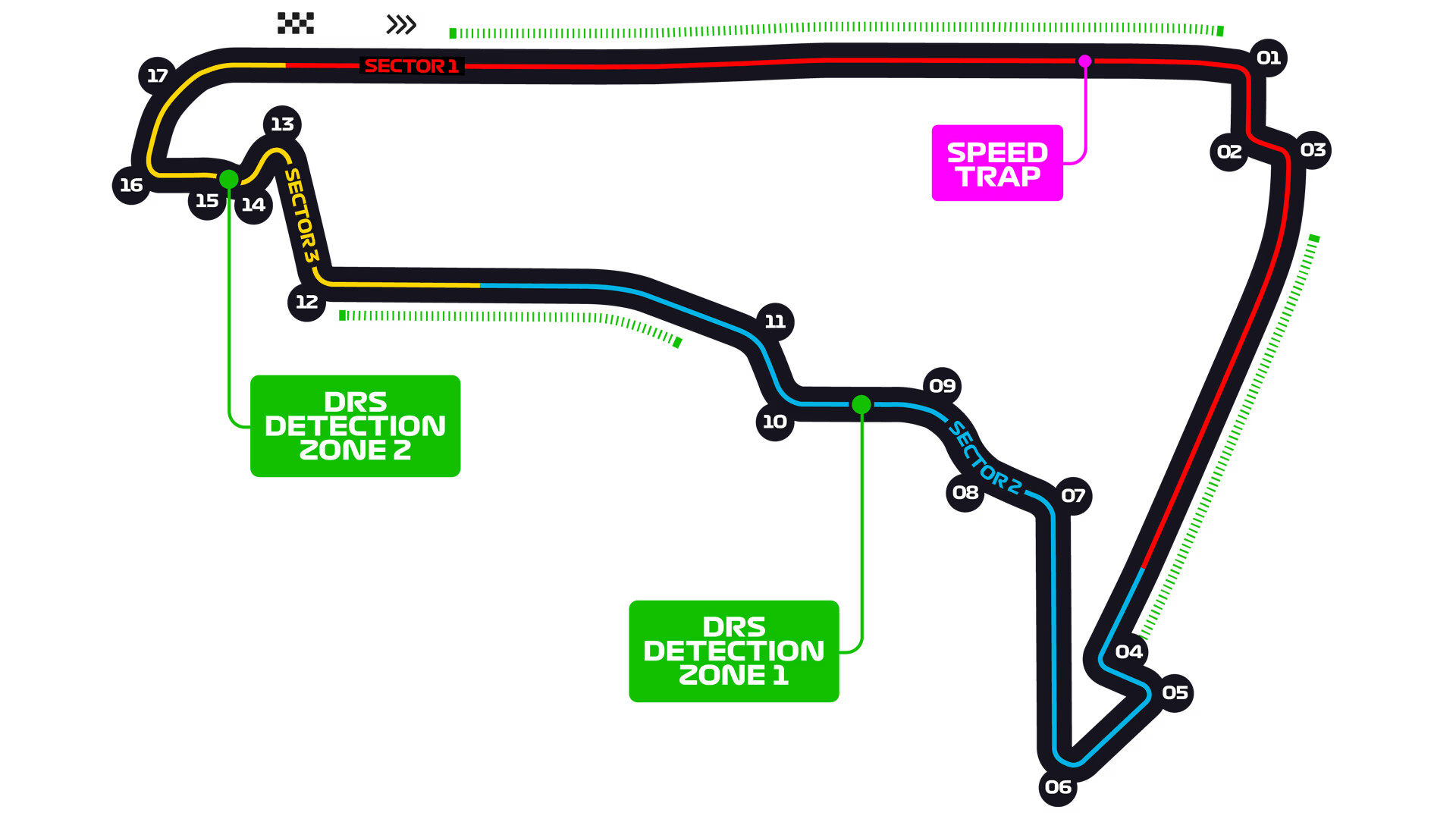
The Autodromo Hermanos Rodriguez has a low downforce effect but, here in Mexico City, you run to the maximum due to the thin air. The car always feels low on grip and on the edge around here.
The big braking zones are tricky in the first half of the lap and it is always loose through the middle sector thanks to the aforementioned low downforce. You’ve got to work out how much kerb you can take early on; take too much and it can really unsettle the car.
The last sector is fiddly and it feels ridiculously slow through the stadium. The penultimate right-hander feels like it might be nothing, but it is arguably the easiest to crash on with low grip and the wall so close.
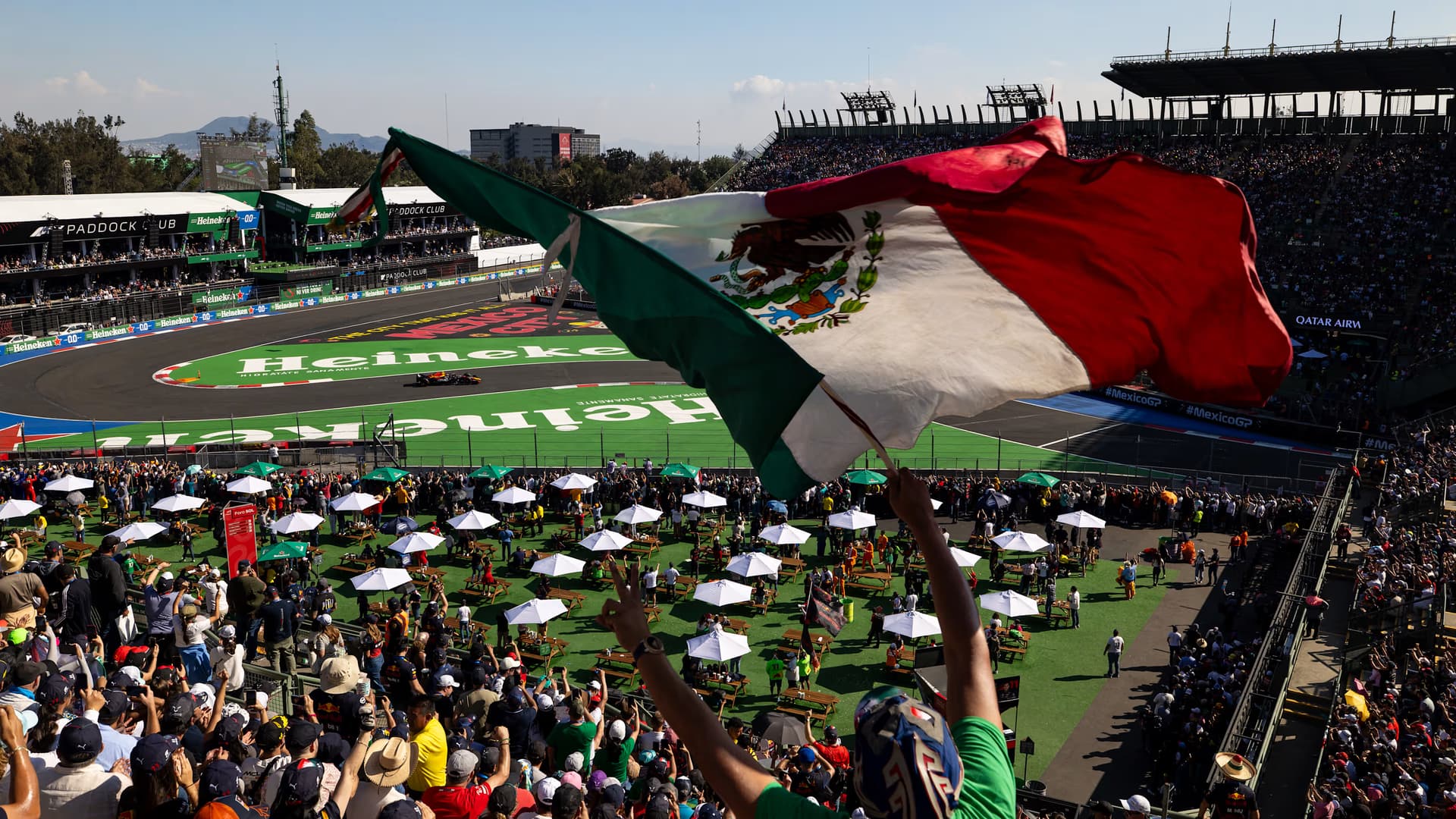
Grip level overall is very low and the car feels so clumsy at such a low speed. But the atmosphere around here in Mexico is great, which is such a buzz.
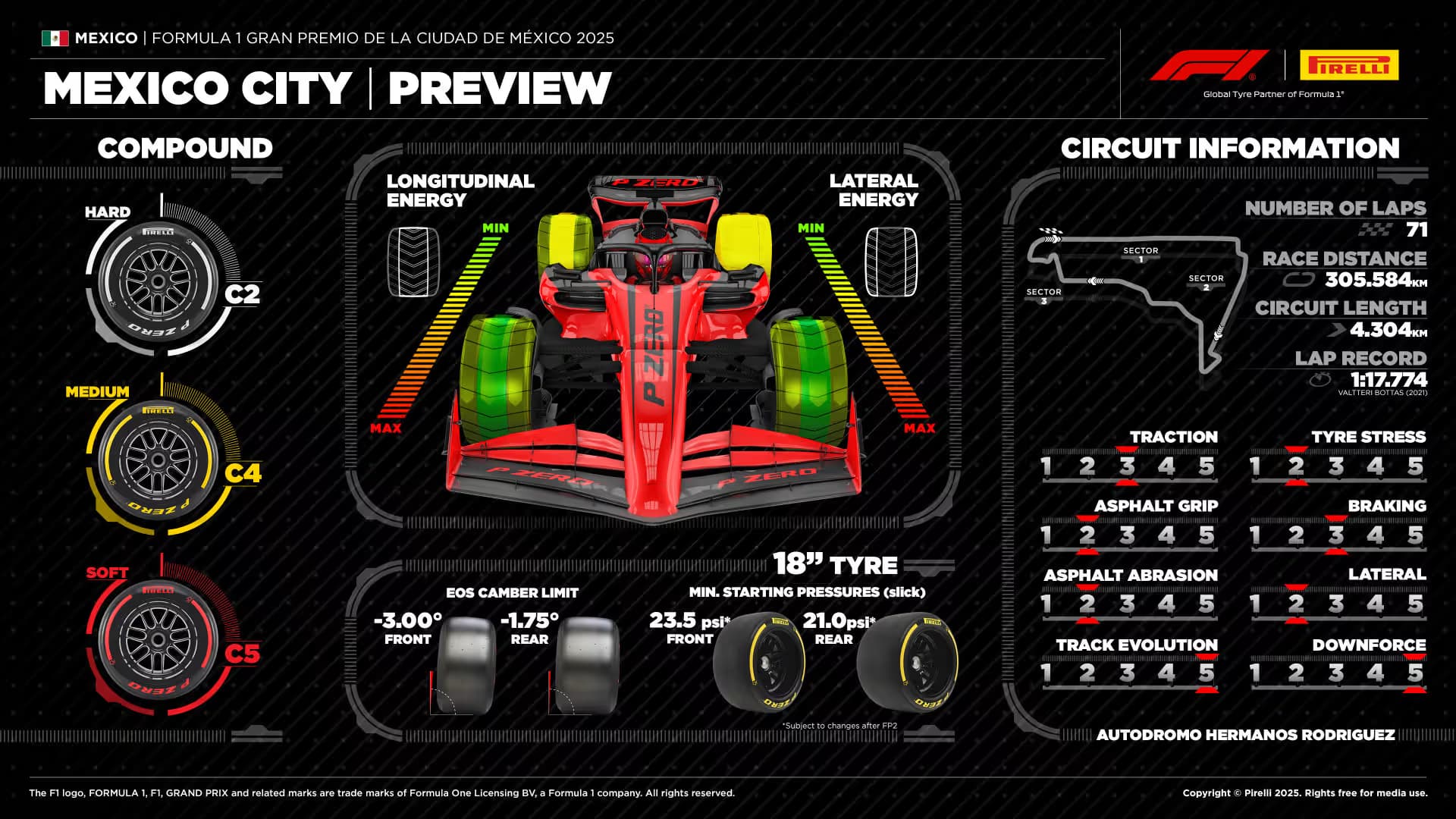
As was the case in Austin last weekend, for the Mexican round there is again a jump in the compound selection between the hardest of the three and the medium.
While the medium and soft are the C4 and C5 respectively, as in 2024, the hard will now be the C2. For the Mexico City track, this compound is an extremely conservative choice, with a considerable delta in terms of lap time compared to the other two, while also offering less grip.
Last year, the soft only came into play in Qualifying and then in the race, only in an attempt to secure the extra point for setting the fastest race lap, but now the scenario could change considerably. The advantage to be had from the C4 and C5 could in fact lead the teams to aim for a race run predominantly on these compounds.
However, that comes with the risk of possibly having to make a second pit stop because of degradation. Anyone choosing the C2 could relatively comfortably manage a longer stint, going for a one-stop on the way to the chequered flag, although it entails a reduction in performance.
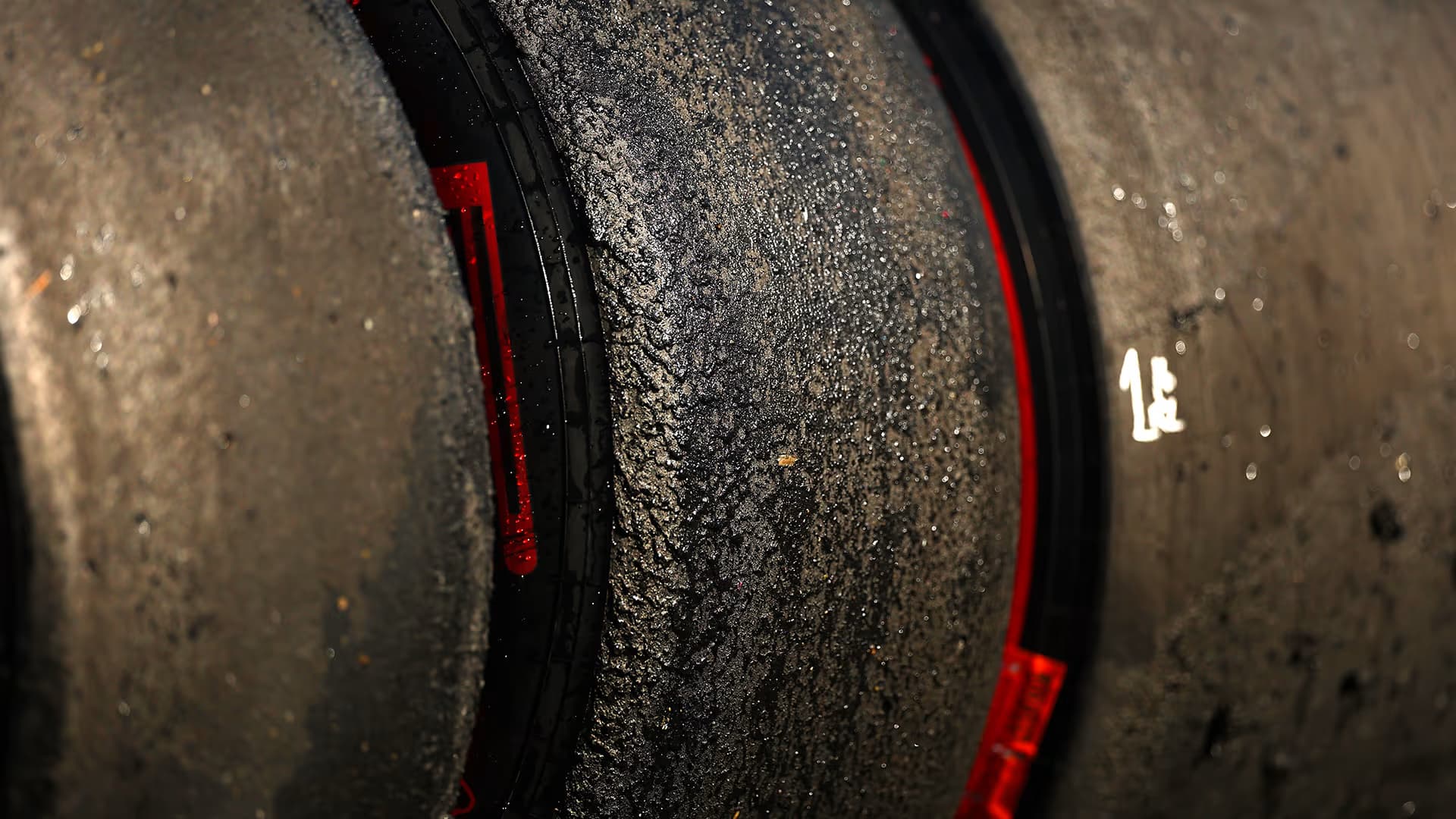
The use of the two softest compounds will certainly be carefully evaluated during the three free practice sessions, when teams will be able to run long stints with full fuel loads and check the condition of the tyres. Historically, graining levels in Mexico are quite pronounced, since the thin air at altitude reduces the amount of aerodynamic downforce that the cars can produce.
On a track that already offers little grip due to its limited use, the tyres tend to slide, which leads to graining. It will also be interesting to see whether the greater resistance to this phenomenon offered by the current compounds will help limit it and therefore benefit those who are masters of tyre management.
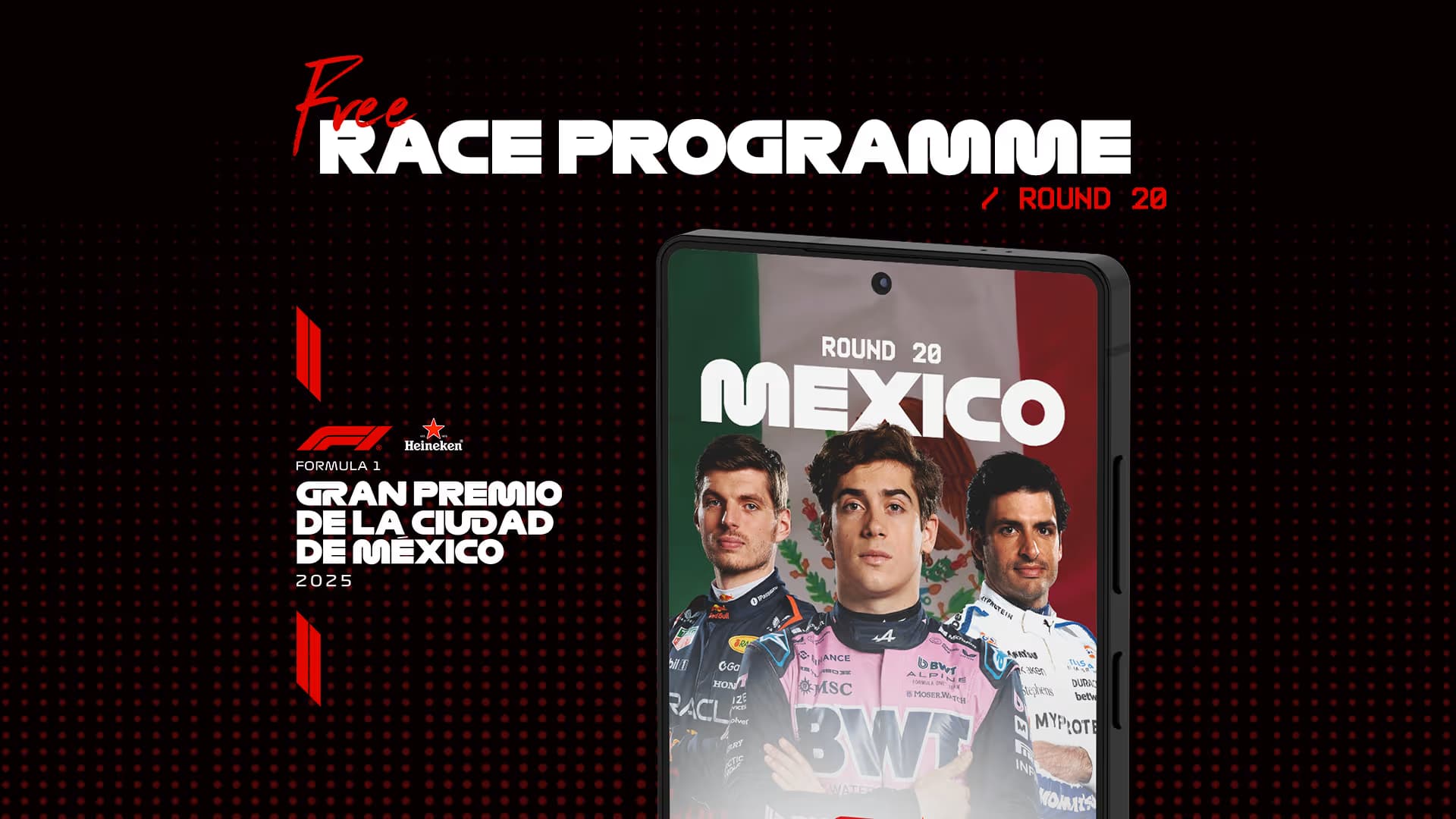
Check out the digital race programme for this weekend’s Formula 1 Gran Premio de la Ciudad de Mexico 2025.
Discover the big talking points in the paddock, the vital stats for the Autodromo Hermanos Rodriguez, what’s going on in the F1 Fanzone, plus what to see, do and eat when visiting this amazing region.
You can also get the lowdown on all 20 drivers and their teams, and in-depth features – including how Sergio Perez turned the Mexico City Grand Prix into a national celebration, and which rookies are getting FP1 outings.
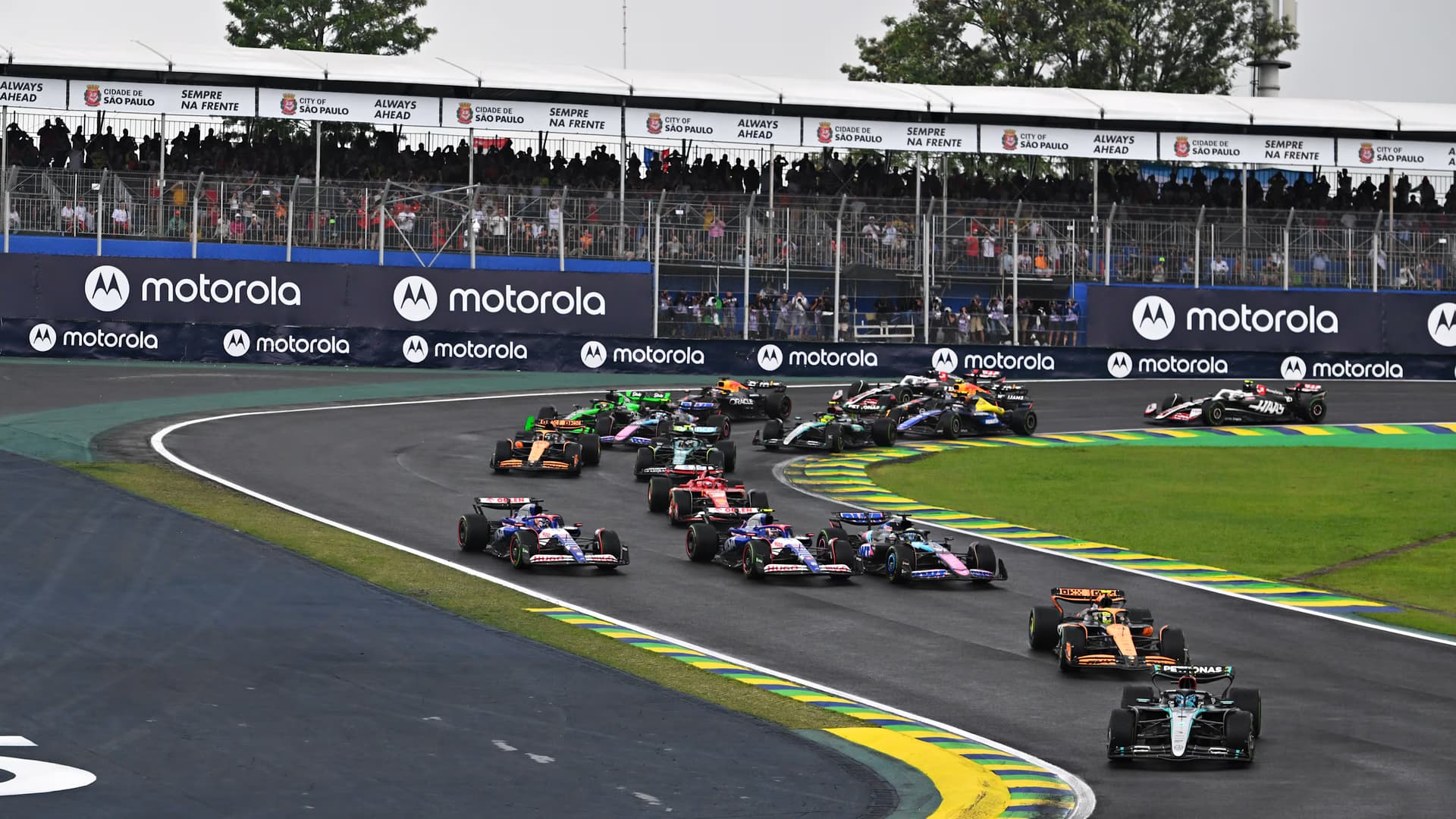
In the heart of Sao Paulo, the legendary Autodromo Jose Carlos Pace, better known as Interlagos, sets the stage for one of Formula 1’s most electrifying weekends. The circuit’s sweeping curves, unpredictable weather, and passionate Brazilian fans create an atmosphere that pulses with energy from the moment the lights go out.
From the echoes of Senna’s legacy to the samba beats drifting through the city, and a bumper-packed Sprint weekend, the Sao Paulo Grand Prix will not be one to miss.
This year, all eyes will be on Kick Sauber’s rookie driver Gabriel Bortoleto as he makes his F1 debut on home soil, bringing a fresh wave of local pride for this new generation of home-grown drivers. Add in the music, street food, and electric Interlagos backdrop, and you’ve got a weekend that feels like a Brazilian celebration.
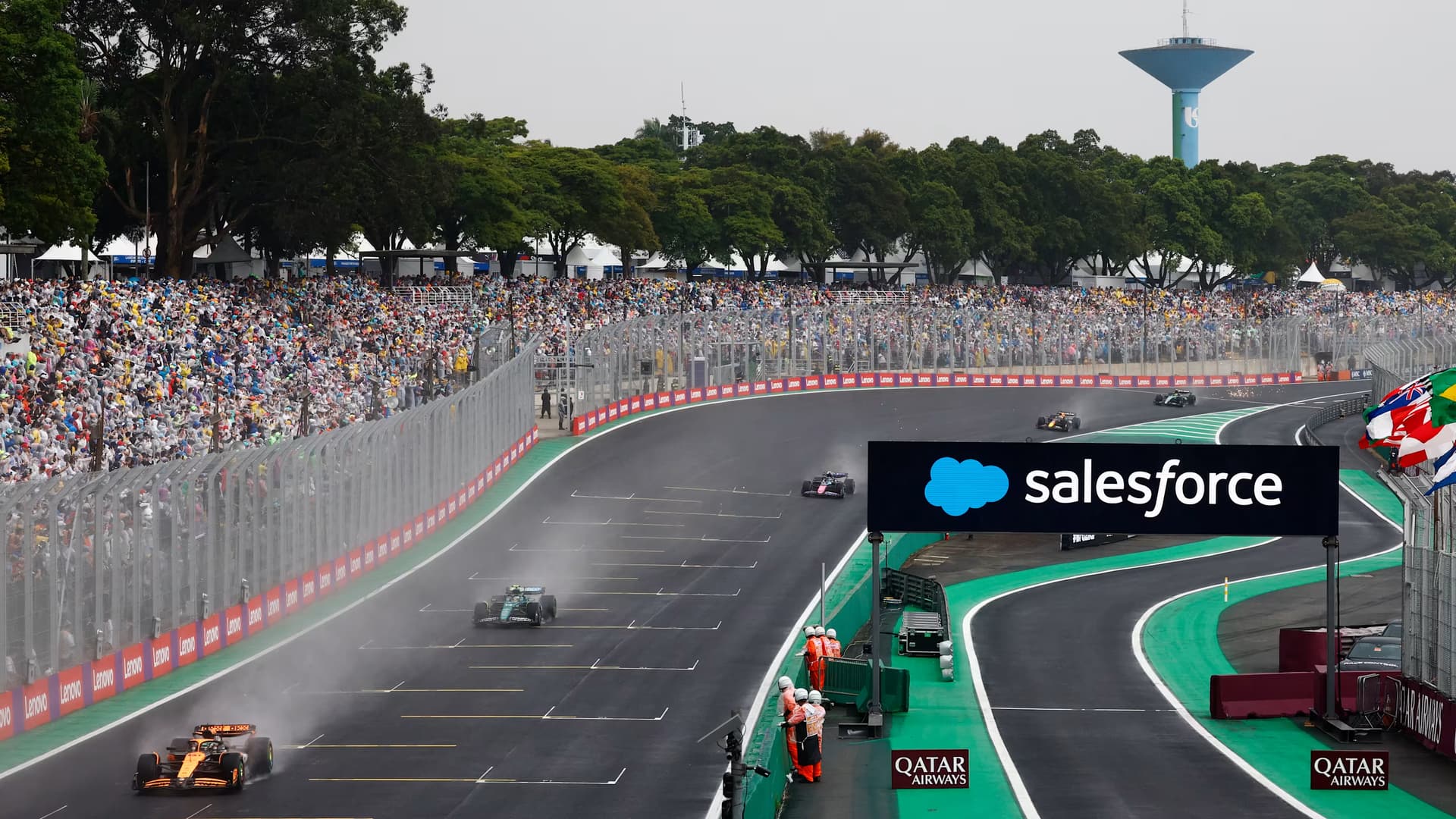
There’s going to be rain in Brazil this weekend. And Max Verstappen may be facing a grid penalty if he needs to take new components beyond the allocation. Guess what happened last year when it poured with rain in Brazil. Max Verstappen started 17th after taking a grid penalty for exceeding his allocation of power unit components. And then he drove an F1 wet weather racing masterclass like a man possessed with the spirit of all the F1 World Champions before him and went on to win the race.
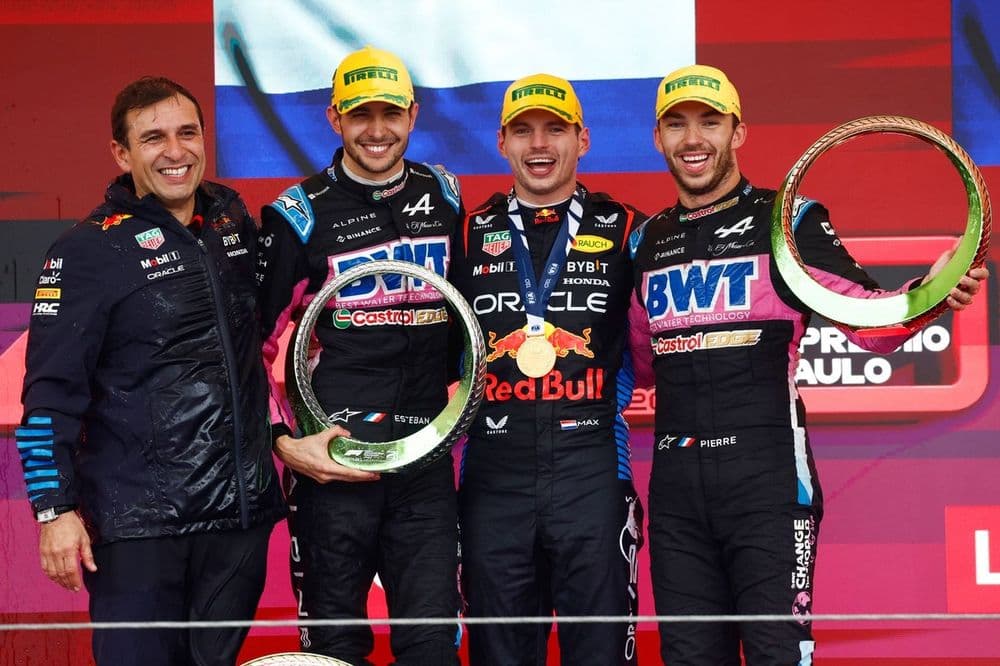
He was joined on the podium unlikely pair of Esteban Ocon and Pierre Gasly of Alpine, who achieved their team’s first double podium since the 2013 in Korean with Kimi Räikkönen and Romain Grosjean. Last year was also the first time since Räikkönen’s win at the 2005 Japanese GP that a driver had won from 17th or lower on the grid.
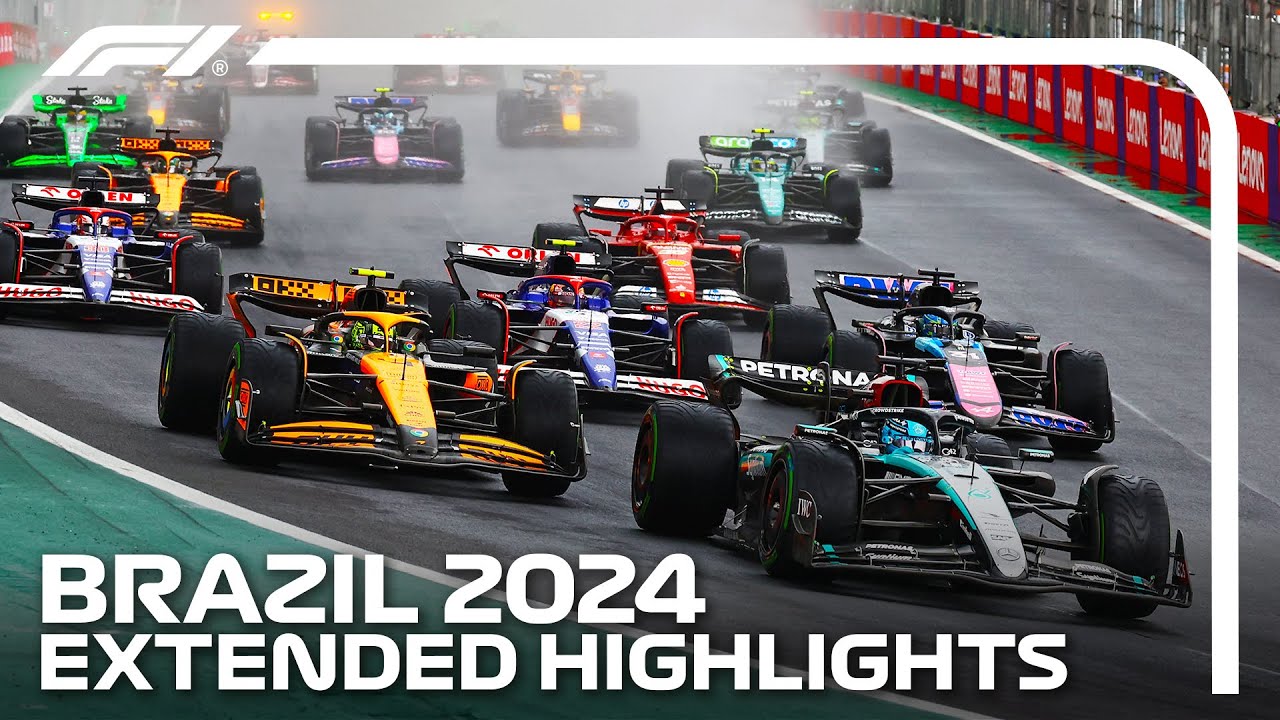
With retirements before the start, Stroll beaching it on the first Formation lap, Norris and others breaking the aborted start rules, a whole host of other on track spins and shenanigans, and the insane confidence of Max Verstappen, it’s worth watching the extended highlights from last year.
Just 1 point now separates the squabbling McLaren drivers and Max 36 points behind. There’s a maximum of 33 points up for grabs this weekend. This Championship is going to go to the wire.
The Vital Statistics
Formula 1 travels to the Autodromo Jose Carlos Pace – also known as Interlagos – this weekend for Round 21 on the 2025 calendar, the Sao Paulo Grand Prix.
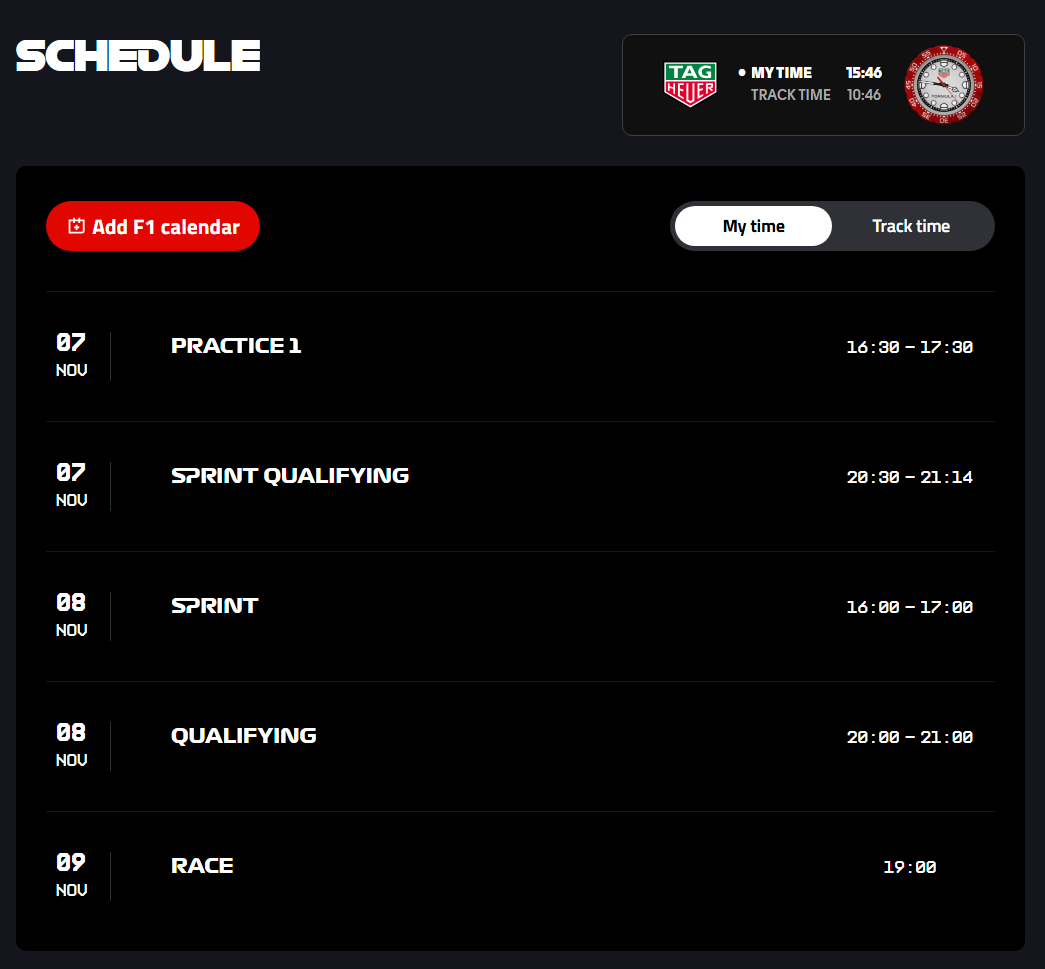
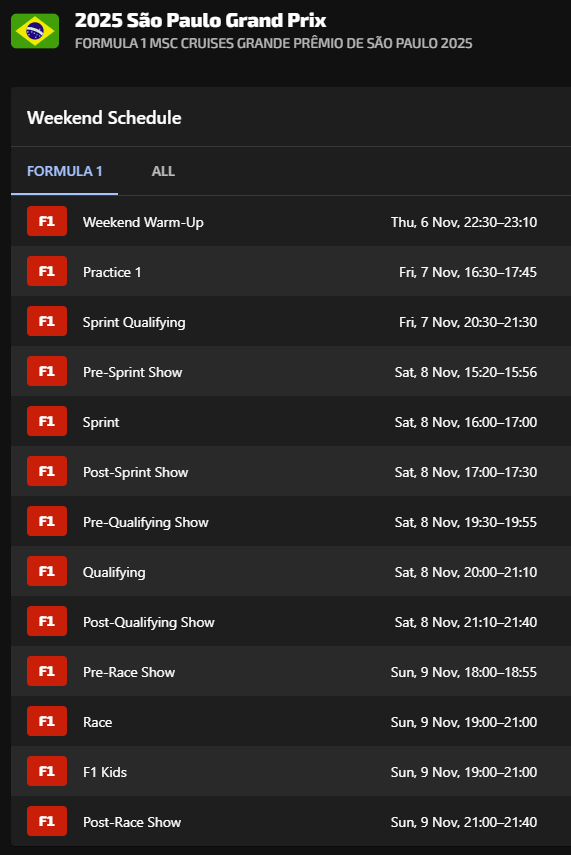
With the Sprint format in play, Free Practice 1 and Sprint Qualifying will take place on Friday, November 7, followed by the Sprint and Qualifying on Saturday, November 8, and the Grand Prix itself on Sunday, November 9.
First Grand Prix – 1973
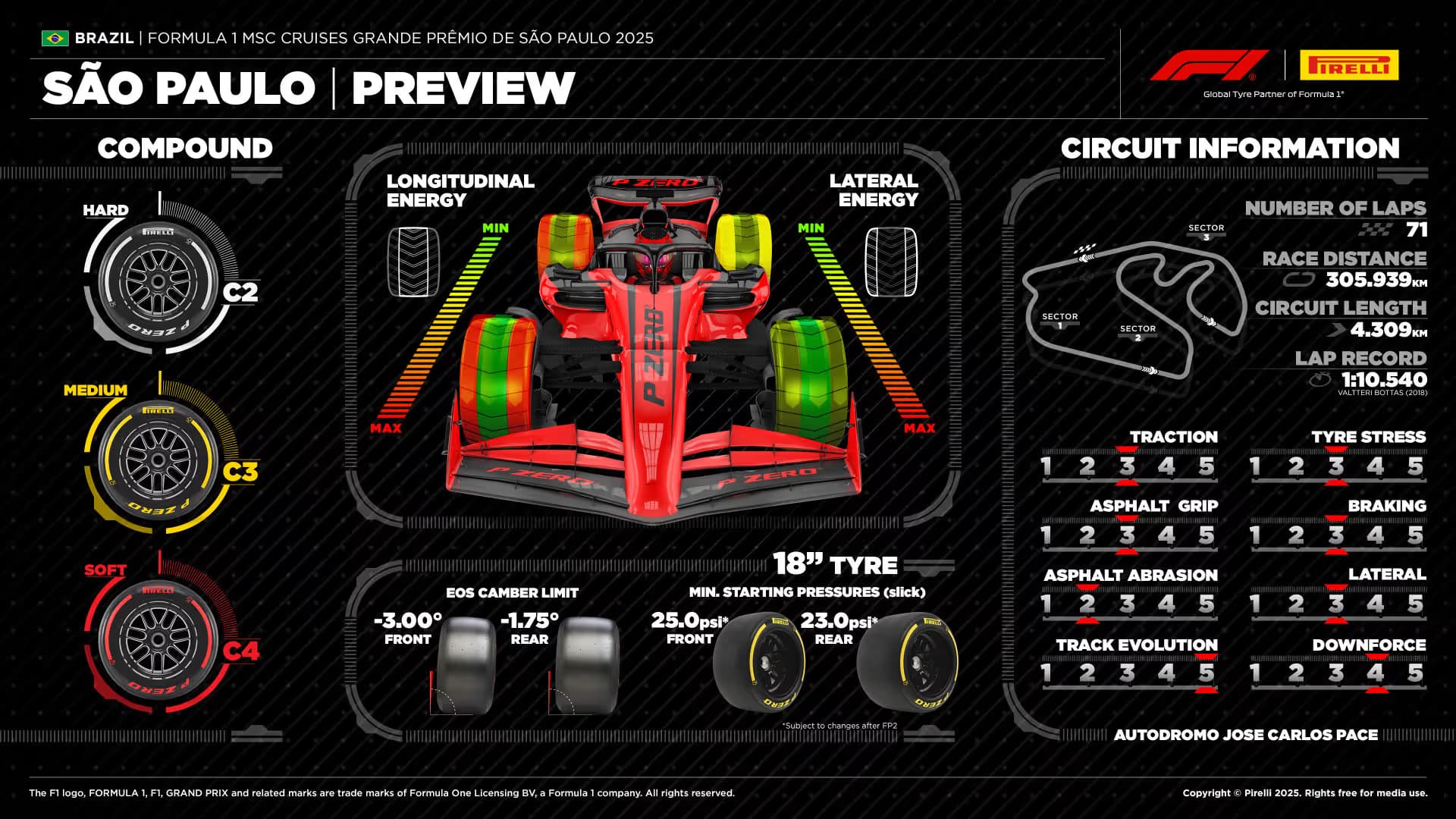
Track Length – 4.309km
Lap record – 1m 10.540s, Valtteri Bottas, Mercedes, 2018
Most pole positions – Ayrton Senna, Mika Hakkinen, Felipe Massa, Rubens Barrichello, Lewis Hamilton (3)
Most wins – Michael Schumacher (4)
Pole run to Turn 1 braking point – 200 metres
Overtakes completed in 2024 – 72
Safety Car probability – 86%*
Virtual Safety Car probability – 43%*
Pit stop time loss – 20.8 seconds
*From the previous seven races in Sao Paulo
Trivia
Interlagos was built in 1938, on a plot of land unsuitable for housing. The circuit is named after Jose Carlos Pace, who won here in 1975 for Brabham.
“Interlagos” translates to “between lakes,” a Portuguese phrase that describes the location of the famous race circuit in São Paulo, Brazil, situated between two artificial lakes.
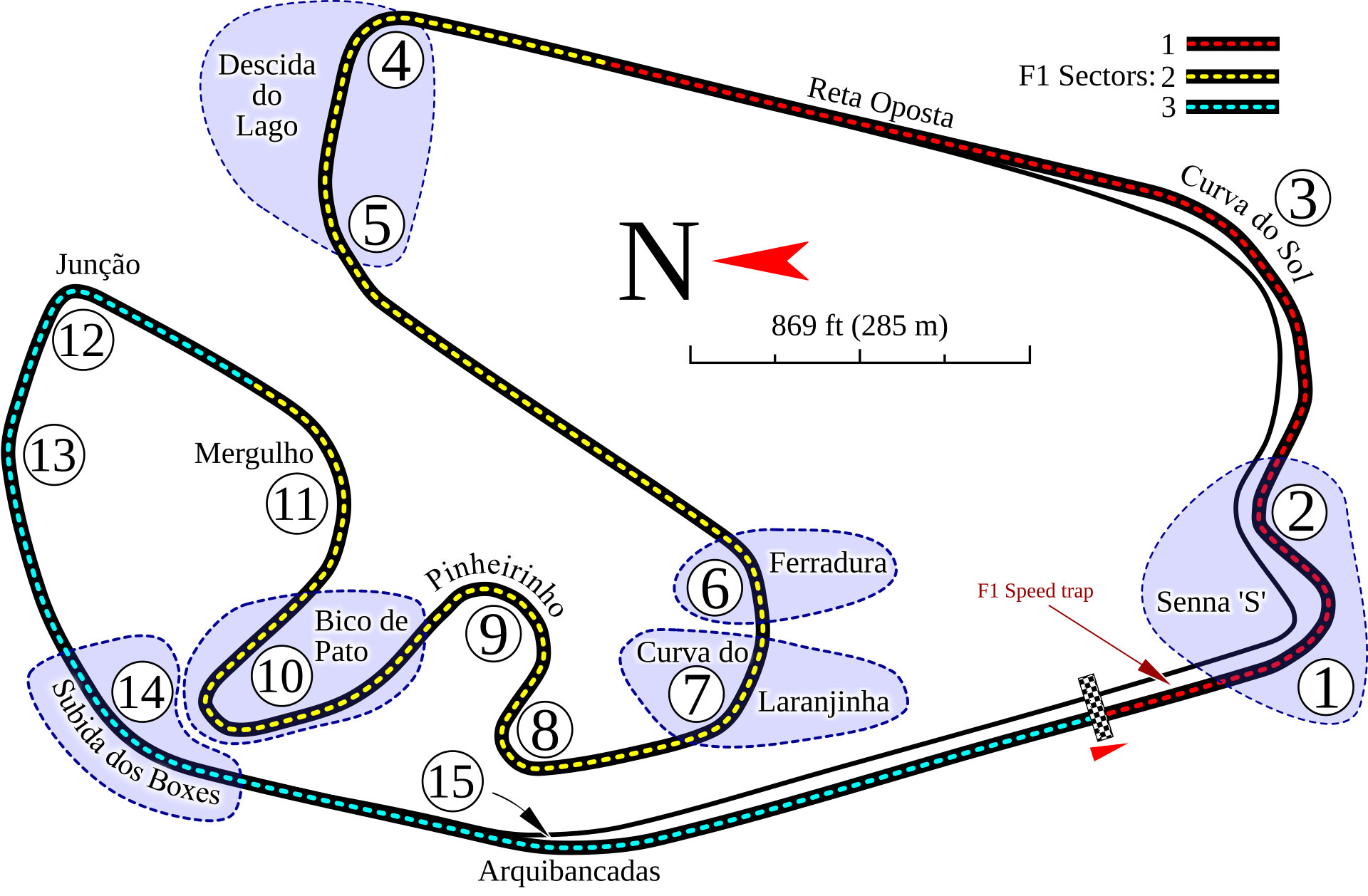
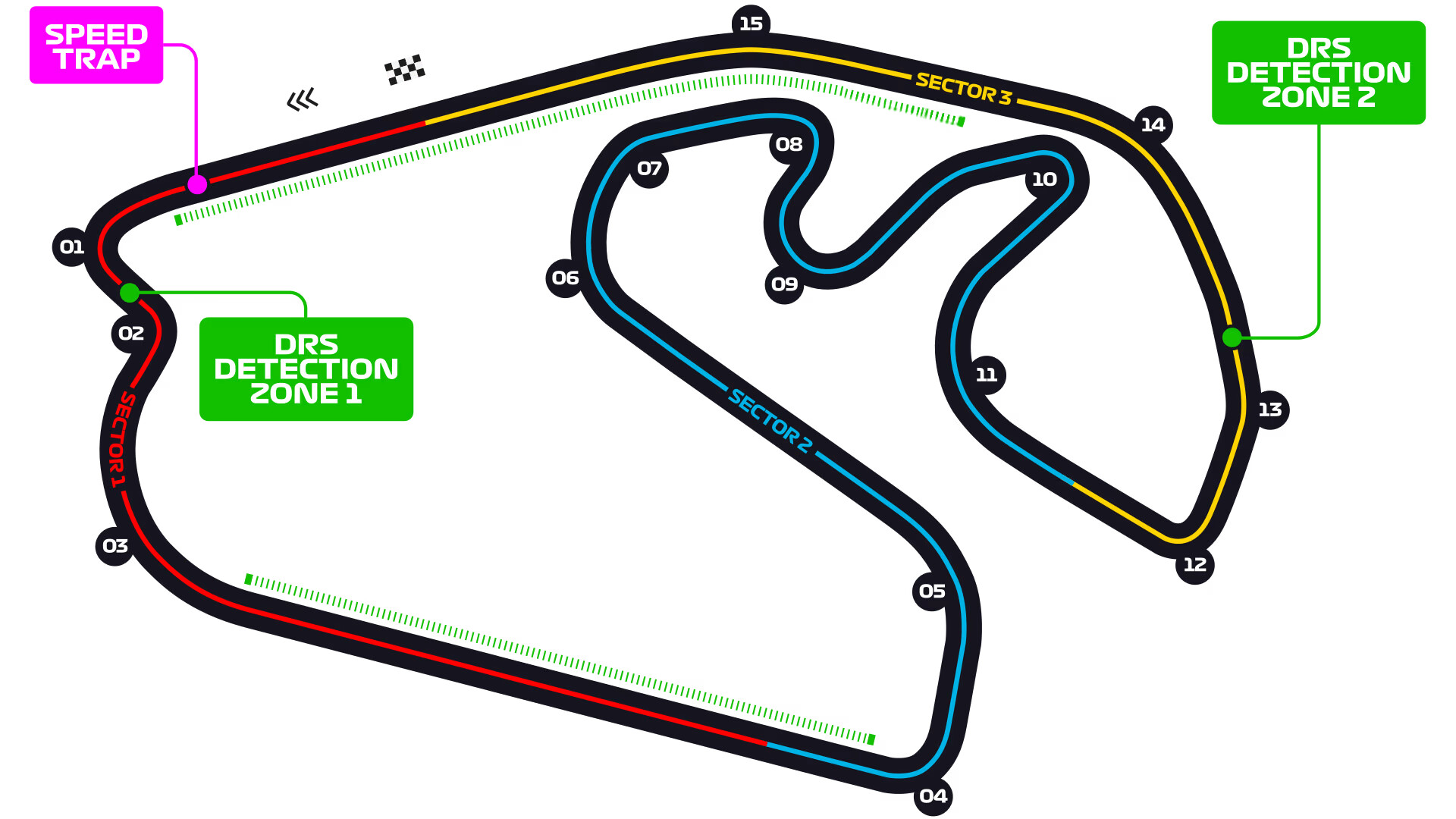
Interlagos has a tricky first corner, you can brake much later than you imagine and carry speed into the apex – but go too late and it’s easy to lock up the front left.
The middle sector here is all about the flow, the corners come thick and fast. One lock-up in either of the tight right-handers and it puts you off line and out of sync for the whole lot. It’s easy to lock up as well because you are loaded laterally on the entries there. It’s a technical sector where the rhythm is everything.
The final corner is critical, it’s all about exit speed to carry you onto the whopping straight back up the hill. You’ve got to get the right balance between opening up the corner and taking too much kerb as well, which can unsettle the car and cost you exit speed.
Overall it’s a short but fun circuit to drive. The anti-clockwise nature and long, loaded left-handers make this one a bit harder physically for the drivers as well. By the end of this race you might be feeling it on the neck, which isn’t used to being loaded up so much on that side.
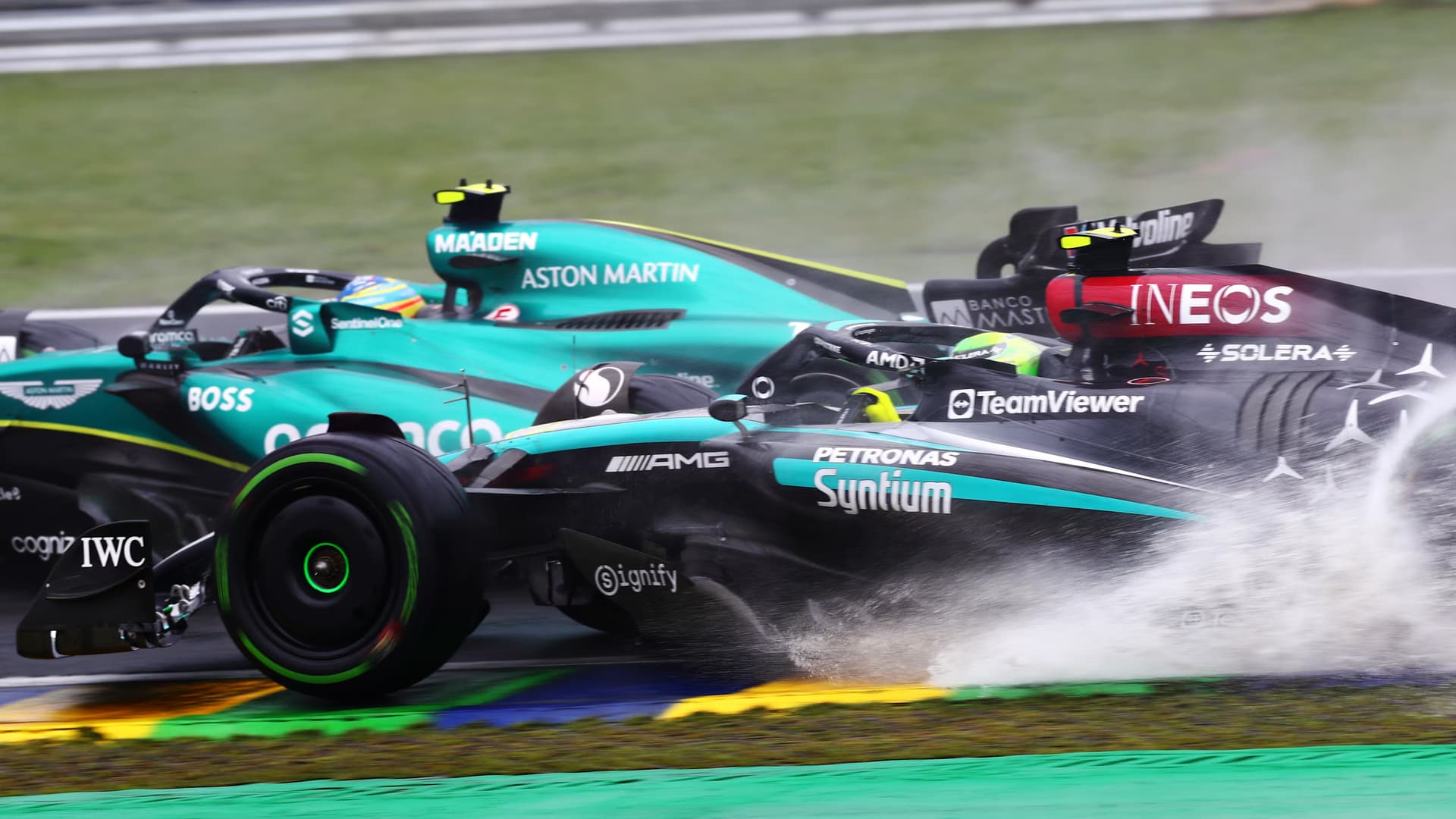
The 2024 event was memorably affected by heavy rainfall, with Max Verstappen navigating the changing conditions to make a stunning recovery from P17 on the grid to take victory, while Alpine scored a surprise double podium with Esteban Ocon and Pierre Gasly.
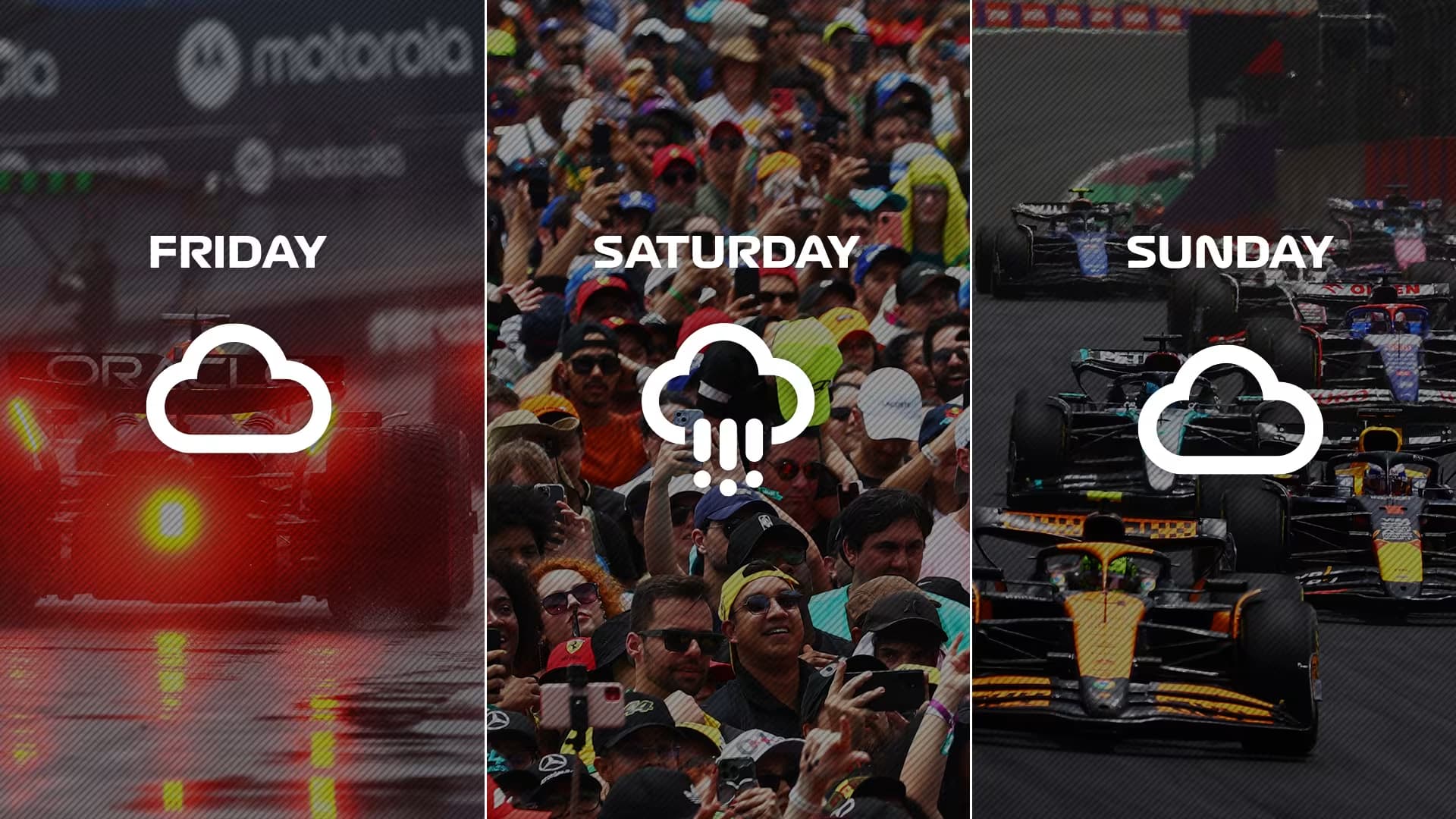
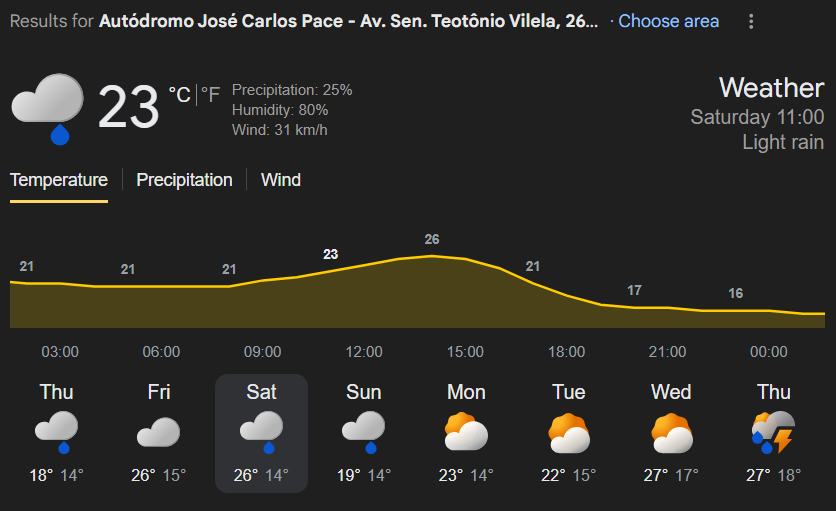
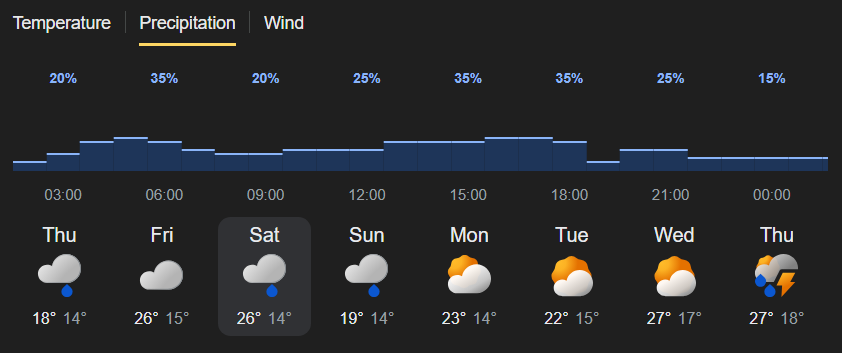
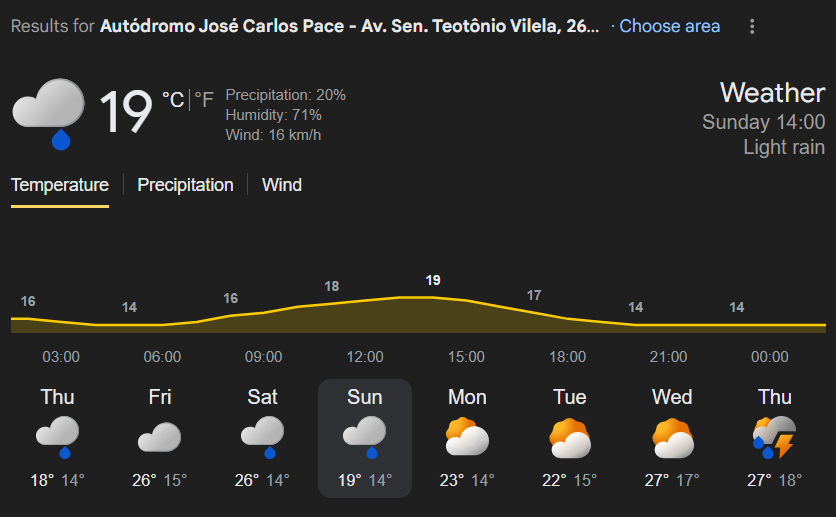
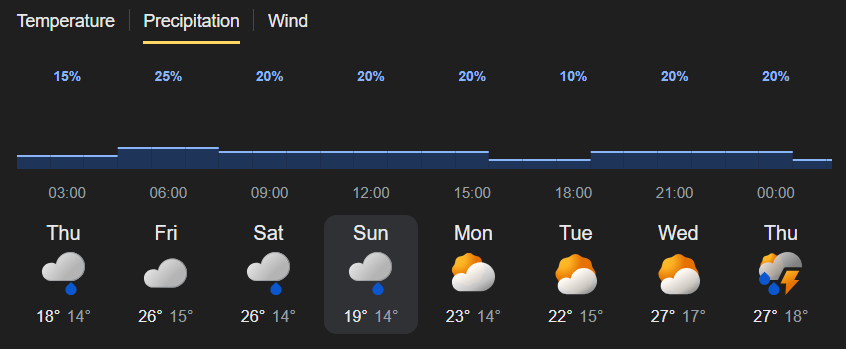
There is again a chance of showers hitting Interlagos this year. Heavy rain is expected on Saturday, lessening in probability for the Grand Prix on Sunday.
Partly to mostly cloudy but likely dry in the morning. Becoming unsettled in the afternoon with a gradually increasing chance of showers, possibly thundery in the evening. Light north-westerly wind bringing showers from the hills.
FP1: 25°C // Sprint Qualifying: 28°C
Chance of rain: 40%
Saturday: Sprint and GP Qualifying
Very unsettled air mass with high chance of showers possibly thundery in the morning, decreasing a bit in the afternoon. Strong wind expected westerly with gusts up to 75 kph possible.
Sprint: 24°C // Q: 26°C
Chance of rain: 80%
Sunday: Grand Prix
Cooler than previous days. Mostly cloudy at first with a slight to moderate chance of light rain until noon. Becoming clearer for the race with only a slight chance of one light shower. Light south-easterly wind.
This year’s compound selection for the Sao Paulo Grand Prix harks back to 2023, with the C2, C3 and C4 as hard, medium and soft, therefore one step harder than the trio used last year.
Last year, the dry weather tyres were not required for the race, but when used on Friday and Saturday morning, they showed high levels of wear, as well as graining, especially on the rear axle. The circuit had been completed resurfaced, thus leaving a very smooth surface, less abrasive than in previous years, although still with plenty of bumps around the track.
If conditions are similar, with the inevitable variations due to the ageing of the asphalt, the decision to bring harder compounds could thus extend the performance life of the tyres, which are already more resistant to degradation than the 2024 range. That might allow the soft to come into play, which last year was only used for Sprint Qualifying.
The layout at Interlagos is interesting, with hints of an anti-clockwise oval circuit, which the drivers deal with 71 times in the race. It boasts 15 corners with relatively balanced lateral and longitudinal forces that do not put any undue strain on the tyres, as they are subjected to loads distributed equally between the front and rear axles.
The combination of several straights and much twistier sections offers plenty of overtaking opportunities, although it also means there’s a higher risk of Safety Cars and incidents. At this time of year, the weather and temperature can be very variable, with a risk of frequent rain and the inevitable use of wet weather tyres.
A further peculiarity of Interlagos is the bumpy nature of the track, as a result of it being built on relatively unstable ground: just one more challenge for drivers and teams to deal with in terms of set-up and tyre management.”
One of the most fun tracks to race in Sim Racing… Unless my buddy Jeff races there… He loves it a bit too much.
Looking forward to a nailbiting end of the season! McLaren’s “fair team” play is going to cost them the WDC this year. I wont mind Max getting the number 5 as I do like him more than Seb (ever so slightly) and he deserves it on skill alone!
What a spicy sprint it was, and last the Sprint has been spicy the main race ended up a snooze. but lets see. I just want Ferrari to move up, but the damn Mercs are giving us hard times.
Was wild to see Max out in Q1, and not just the 2nd driver